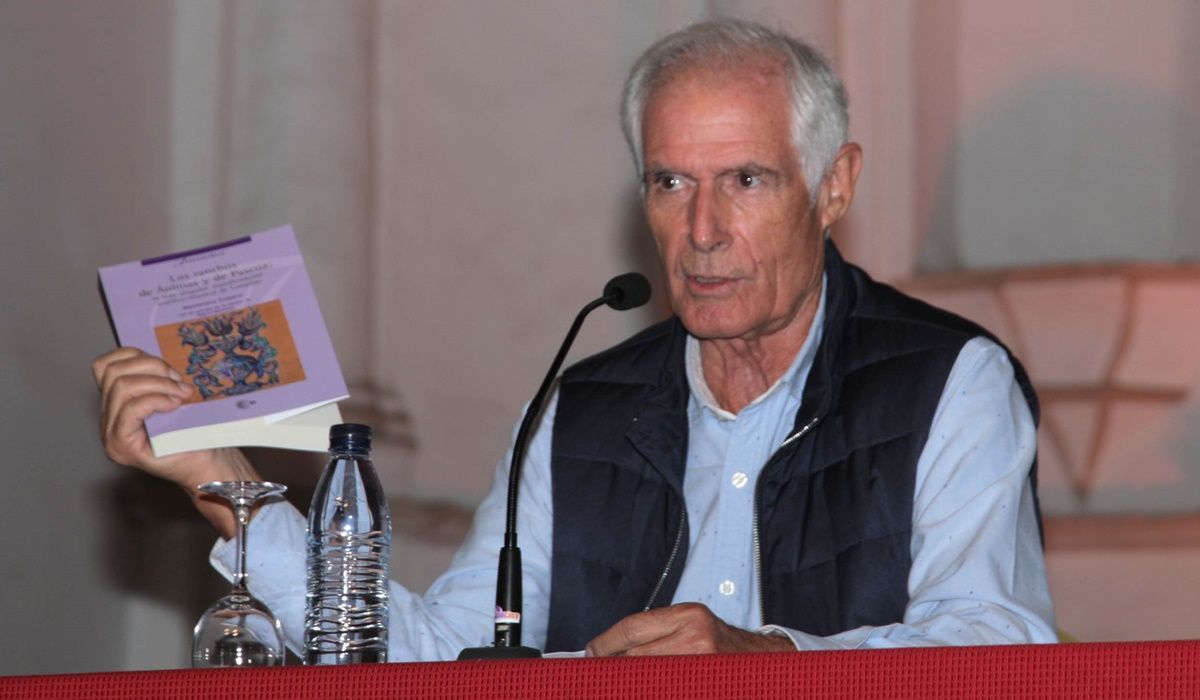
Maximiano Trapero, Professor of Spanish Philology and Emeritus Professor at the University of Las Palmas de Gran Canaria, presented his book "Los Ranchos de Ánimas y de Pascua", on Tuesday afternoon at the Santo Domingo convent in Teguise.
The Councilor for Culture, Nori Machín, was in charge of starting the event by thanking the writer for "choosing Teguise for his presentation." In addition, she was "very proud" of the Rancho de Pascua, the only one in the Canary Islands, and encouraged it to continue spreading this legacy, as well as the other cultural groups that with dedication and work make Teguise "a cultural reference recognized throughout the Canary Islands and beyond our borders."
After the Councilor's speech, the Official Chronicler of Teguise, Francisco Hernández, took the floor, introducing Maximiano Trapero and his lines of research, which have focused on lexical semantics, the study of Canarian toponymy and general toponomastics, the Guanche lexical study and traditional literature.
Throughout his research career, he has received numerous awards, including the Gold Medal of the Canary Islands in 2003, the National Distinction of Cuban Culture, also in 2003, the José Vasconcelos Gold Medal from the Hispanic Affirmation Front of Mexico in 2009, the Canary Islands Award for Historical Heritage in 2007 and the Philological Research Award from the Royal Spanish Academy in 2019, for his 'Dictionary of Guanchismos'.
Maximiano Trapero is a brilliant speaker, possessing a lot of documentation about the existence of the Ranchos de Ánimas y Pascua in the Canary Islands, and during the presentation of his book he was telling the audience how his first contacts with the ranches were. The first of them, a Rancho de Ánimas in a house in Gran Canaria, and from that moment he began a great research work that has taken him 30 years and that is now collected in this book where the reader can find it.
What are the Ranchos? The name of Rancho and its Terminology, Tradition and Modernity, Annotated Edition of the Texts, The belief in Purgatory as the foundation of its Existence, The poetics of the texts of the Ranchos... are some of the details that in the 376 pages of the book, the reader will have the opportunity to know in more depth.
In addition, Trapero also details how the Ranchos de Ánimas y de Pascua arose, two of the most characteristic manifestations of Canarian folklore. They are not the oldest, but they are the most peculiar because of the history, religion, poetry and music, all of which together, they represent. He adds in his speech that they are musical groups whose purpose is, "those of ánimas, to sing and pray for the souls of the deceased, and those of pascua, to sing and brighten Christmas."
Finally, he adds that two are the main aspects that support them: "that of popular religiosity and folklore (in the poetic-musical)"; but several other aspects are of interest to their knowledge: "the anthropological, the sociological, the historical and the geographical."
After the presentation of Maximiano Trapero, the Rancho de Pascua de Teguise made its entrance through the central corridor of the Convent, until reaching the stage where they continued with their performance playing "El Salto", also called "Basapié".
The mayor of Teguise, Oswaldo Betancort, addressed those present congratulating the writer Maximiano Trapero for choosing Teguise for the presentation of his book, extending his congratulations to the members of the rancho for their "brilliant performance", encouraging them to continue working to keep alive an ancestral tradition and which he as mayor and his corporation "will continue to support", ending with a congratulation for these holidays to all those present.
[related:galleries:1:{orientation:vertical}]

Add La Voz de Lanzarote as a preferred Google source.
Stay informed with the latest current news.