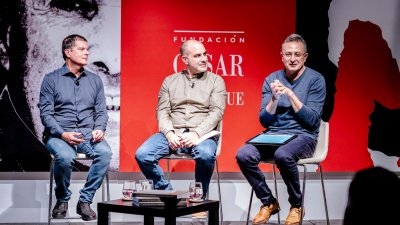
For the first time, a publication compiles entirely in universal musical language, that is, in musical scores, the main and best-known pieces of traditional and popular music from Lanzarote and La Graciosa. This cultural milestone is entitled Traditional Musical Repertoire of Lanzarote and La Graciosa, and was presented to the public this Wednesday afternoon by its two authors, Benito Cabrera and Pablo Díaz.
The book is published by Los Campesinos and the Cabildo de Lanzarote, as part of the 60th-anniversary celebrations of the long-standing Lanzarote folk group, Gold Medal of the Canary Islands in 2003. The publication also has the collaboration of the Island Corporation's Publications Service, the Department of Culture of the Arrecife City Council, CajaSiete, and the César Manrique Foundation, which hosted the publication's launch this Wednesday afternoon in its José Saramago Room. A Powerful Didactic Tool
Traditional Musical Repertoire of Lanzarote and La Graciosa stands as a powerful educational, cultural, and historical tool that, for the first time, makes tangible a valuable oral heritage, reflecting the diversity and depth of the musical folklore of Lanzarote and La Graciosa. The publication records in sheet music musical styles specific to the two islands and all of the Canary Islands, such as isas, folías, malagueñas, seguidillas, and habaneras, but also the sorondongo, the mazurka, and the zaranda. Thus, among the best-known titles are the Zaranda de Juan Brito, the Isa del Uno, the Isa del Cinco, and the Sorondongo itself.
The publication doesn't stop there and, despite its technical difficulty, transposes the compositions of the Ranchos de Pascua or the Carnival repertoire into musical notation, with songs from the Parranda Marinera de Buches or unique pieces from La Graciosa, such as Isa de Seño Redusindo or the Charleston.
Before the scores of each of the styles or musical pieces, the authors add a technical sheet with information of interest, such as the different names by which the piece is known, a general description, the instruments and voices with which it is performed, the festive cycle in which it is usually played, the bibliographic source, a historical review, or even clarifications on the transcription criteria that have been used to convert the pieces into musical language.
In addition to all this, the book has a comprehensive introduction that reviews the history, origin, and evolution of the folklore and music of both islands.
“Let the oral tradition not be lost” During the book presentation, which was moderated by musician, producer, and folklorist Víctor Batista, former director of Los Gofiones, both authors highlighted the importance of the publication as an educational tool and its value as a written legacy for future generations. "Our hope has been to create a written document that prevents a large part of the musical and oral tradition of both islands from being lost, and that at the same time, by transcribing these genres into the universal language of music, it serves as didactic material in music schools, conservatories, or in the folk groups themselves. The ultimate goal is none other than to preserve and disseminate the musical richness of our islands," declared Benito Cabrera.
The timple player from Lanzarote expressed his gratitude to Los Campesinos "for trusting us to produce this publication and for having the generosity to want to leave this legacy to the islands of Lanzarote and La Graciosa, to all of the Canary Islands and the entire world on their 60th anniversary," Cabrera concluded.
For his part, Pablo Díaz highlighted the book, "in addition to helping to preserve these compositions, many of which had not been transcribed until now, we believe it is an ideal instrument for composers, music teachers, researchers, and the general public to have an approach to the history of popular music of Lanzarote and La Graciosa. Both Benito and I want to thank Los Campesinos for the trust they have placed in us."
On behalf of the Cabildo of Lanzarote, Councilor Samuel Martín spoke, noting that "the Cabildo of Lanzarote will always be willing to embark on projects that help preserve the cultural heritage and traditions of Lanzarote and La Graciosa. This publication was absolutely necessary, and from here I want to express my gratitude to Los Campesinos and the Culture and Publications departments of the Corporation for making it a reality."
In turn, the Councilor for the Publications Service, Ascensión Toledo, present at the event, stated that "this book is the perfect complement to the Memoria Sonora de Lanzarote website, a project presented earlier this year by the Data Center of the Cabildo de Lanzarote, and which compiles all the records of folk and popular music from Lanzarote so that they can be listened to online for free."
At the end of the event, the president of Los Campesinos, Miguel A. Corujo, spoke, thanking Benito Cabrera and Pablo Díaz for the great work done, and all the public institutions and companies involved for their support in carrying out this project.
Biographies of the Authors
Benito Cabrera. Timple player, composer, and cultural promoter. He has developed an extensive artistic career both in and outside of the Canary Islands, performing on prestigious stages such as the Teatro Comunale in Treviso, the Konzerthaus in Berlin, and Carnegie Hall in New York. Author of highly popular melodies, lyrics, and songs—including the text of the Anthem of the Canary Islands—, he has published several books and studies on traditional music. Between 2007 and 2020, he was the musical director of Los Sabandeños. He has hosted television programs and documentaries, and currently directs the Casa-Museo del Timple in Teguise, in addition to working on projects such as Memoria Sonora de Lanzarote.
Pablo Díaz. Flutist and composer. He studied at the Tenerife Professional Conservatory and the Canary Islands Higher Conservatory of Music, expanding his training in Paris with Philippe Lesgourgues and at the Escuela Creativa in Madrid with Patxi Pascual. His career encompasses classical performance, jazz, world music, and ethnomusicological research. He is a flute teacher at the Tenerife Professional Conservatory of Music, a job he combines with musical creation and performance as a soloist on the Herreño flute.
Víctor Batista (debate moderator). Musician, folklorist, and producer. He has developed extensive work in the dissemination and direction of traditional Canarian music. For more than two decades he was musical and artistic director of the group Los Gofiones, an essential reference of island folklore. He has served as musical director of the Tenderete program of Televisión Española and as co-director, together with Pedro Grimón, of the ethnographic space Barrancos de Televisión Canaria.


Add La Voz de Lanzarote as a preferred Google source.
Stay informed with the latest current news.