
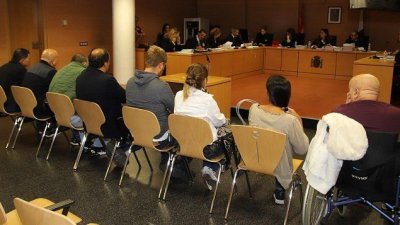
The former Urbaser delegate in Lanzarote, Jacinto Álvarez, faced his first criminal trial this Tuesday, although the accusation in this case is only exercised by his former company, which is asking for seven and a half years in prison and a fine of 450,000 euros for alleged crimes of misappropriation, unfair administration, falsification of commercial documents, fraud and contractual simulation. Along with Álvarez, Urbaser accuses seven other people and demands that they all jointly pay 392,956 euros plus interest, which is the sum it claims was defrauded. It claims that the former delegate himself and three of his direct relatives, who are also accused in the case, benefited from that amount.
Urbaser filed this lawsuit in 2010, shortly after Jacinto Álvarez was arrested in the Unión case, in which four other company executives in Madrid were also arrested, who are currently awaiting trial accused, among other things, of paying bribes and rigging the tender for which the cleaning and garbage collection of Arrecife was awarded. "My client is unrelated to any activity (much less illegal) carried out by Mr. Álvarez, outside the strict channels of the management of the delegation that was entrusted to him," says the company's lawyer in his statement of accusation in this case.
This statement only includes another employee of the company in Lanzarote, Gregorio Aparicio, who has not even been fired, and for whom he is only asking for six months in prison, after having testified against his former boss. The other six defendants are Jacinto Álvarez's current wife and two children - who were also hired by Urbaser in their day and fired after Jacinto Álvarez's arrest - the owner of one of the companies that was a supplier of Urbaser in Lanzarote, Fernando González Berriel, and two employees of this same company, dedicated to the sale of fuel.
"Arbitrary" election of the defendants
"You are right, it is arbitrary," responded the general advisor for legal affairs of Urbaser when testifying as a witness, when Jacinto Álvarez's lawyer asked him why more people were not included in this lawsuit, both in relation to suppliers and his own staff. "If the company had taken it to the ultimate consequences, it would not have been just this gentleman the object of this lawsuit," he said, adding that "to maintain a minimum of social peace, you cannot act against everyone."
In fact, the accusation itself and the account they have presented on the first day of the trial implies that at least a good part of the staff was involved in the allegedly criminal acts that the company imputes to Jacinto Álvarez, and a good part of them has begun to testify as a witness on this first day of trial and will continue to do so in the coming days. "Everyone had their piece and there were people who were comfortable with that situation," said Justino Sagredo, who was the area director in Las Palmas of Urbaser, who initiated an internal investigation after Álvarez's arrest. An investigation that has nothing to do with the events that will be judged in the Unión case, but with which they claim to have concluded that Álvarez acted behind the company's back for his own personal gain.
Until the arrest of Jacinto Álvarez, according to what the former provincial director declared, the delegation in Lanzarote did not give him an account of its activity and responded directly to Madrid, being thus the only contract they had in the islands that did not pass through his signature. "And did you bring this to the attention of your superiors?" asked the prosecutor, who has not filed charges in this case but has been present and participated in the hearing, among other things because of her connection with the Unión case. "I transmitted it two or three times and they told me that in Lanzarote I should only dedicate myself to pending collection," the witness replied. Then, he specified that one of the people who told him that was Santiago Alonso, who at that time was director of Cleaning and Gardening of Urbaser in Madrid, and who was later one of those arrested in the Unión case. Alonso is currently accused along with Jacinto Álvarez and three other directors from Madrid of bribery, embezzlement, fraud against the Administration and prevarication, in relation to the contract that the company maintained with the Arrecife City Council and whose award would have been rigged according to the summary of the Unión case.
For his part, the legal advisor of Urbaser has tried to justify the fact that the delegation of Lanzarote did not render accounts of the contract with Arrecife to the provincial manager but directly to Madrid, attributing it to a matter of "personal relationships" and to the fact that the internal procedure was not "so rigid" at that time. "As a consequence of personal proximity, the procedure may have been violated, but it is not something that the organization imposed," he said, pointing out that Jacinto Álvarez had been working for a longer time with other directors from Madrid than with the provincial director.
Recharges of private telephones with gasoline vouchers
As for the events for which Urbaser accuses Jacinto Álvarez and seven other people, they have several fronts. On the one hand, with respect to the owner of Coscofe SL and two of his employees at the Pcan gas station in Arrecife, he maintains that they allowed different recharges of mobile phones that did not even belong to the company to be paid with Urbaser gasoline vouchers, but to Jacinto Álvarez himself and to family members and people in his environment. In addition, he points out that some of these vouchers were signed by Jacinto Álvarez's wife, Zenaida Alcaide, who also worked in the company but "in no way had authorization to execute such a task." For her, the company is asking for three years in prison.
In total, Urbaser puts the amount allegedly defrauded with this method at 1,016 euros, and for this it is based on the testimony of one of the workers, who already in the investigation phase declared that Jacinto Álvarez ordered him to go to the gas station with gasoline vouchers from the company to exchange them for recharges for those mobile phones.
As for the other operation related to this company, it focuses on the purchase of two drums of oil for a total value of 2,490 euros, shortly before the arrest of Jacinto Álvarez. According to Urbaser, these drums were neither necessary nor did they ever reach the company's warehouses. For their part, those accused of these events have stated that since the new managers contacted the company, they indicated that they had them in the warehouse and that they could go and pick them up, but they never did.
For these two events, the private prosecution exercised by Urbaser is asking for three years in prison for Fernando González Berriel as the owner of the company, and another three years for the two employees he also accuses, Pedro César Pérez and Felipe Santiago Hernández, since he maintains that they were "fully aware of this machination" and that they were "aware of the fraudulent maneuver." They, for their part, have denied it and have defended their innocence during the trial, in which they have only responded to their respective defenses.
Materials and workers supposedly diverted to works in his house
To these two events, Urbaser's accusation adds others of a much higher economic amount related to other suppliers, although it has not asked for criminal responsibility for anyone else. According to the company, Jacinto Álvarez managed to charge "at least 178,319 euros" in different false invoices to the company for materials that in some cases he then "fraudulently incorporated into his assets," mainly to carry out works in two of his homes.
In this case, it was also the workers under his charge who signed the delivery notes, according to what they themselves told the company when Urbaser opened its internal investigation after the arrest of Jacinto Álvarez. And those employees have not been fired or disciplined either, except for one who in 2010 refused to answer the company's questions, alleging that he had already testified before the UCO of the Civil Guard and that they had told him that he could not reveal anything about the investigation. "The reason for the dismissal was not refusing to testify," said the head of Labor Relations of the company in the Canary Islands, who defended that the dismissal letter was extensive and detailed, among other things, that there were invoices for delivery notes whose merchandise "had not entered the company." However, neither he has been taken through the criminal route nor have other workers who did answer the company's questions and who will testify during the trial even been fired, despite the fact that they claim that they participated in fraudulent operations by order of Jacinto Álvarez.
Among the purchases of material that did not reach the company, Urbaser includes almost 97,000 euros in invoices from a plant nursery and about 7,400 euros for 4,000 pots, of which they only have a record of 700. The rest includes everything from aluminum conductor cable and doors and windows to concrete blocks, which are "unsuitable for a gardening service" and which Urbaser links to the works that Jacinto Álvarez was carrying out in his two houses.
In addition, the company also maintains that the former manager allocated Urbaser personnel to these works. "Under no circumstances. If I ordered them to go there, they would laugh in my face," replied Jacinto Álvarez's son, when his lawyer asked him if as head of service he ordered Urbaser workers to go and do work in his father's houses.
In this regard, it should be remembered that the investigation of the Unión case has already revealed that company workers allegedly provided services in the homes of politicians and public officials accused in that case, such as María Isabel Déniz. In addition, Jacinto Álvarez has confessed to the payment of bribes both in cash and in kind, pointing out that it was not only known, but also ordered by the directors of Madrid who are accused in the Unión case.
Advances and false overtime
The other front on which Urbaser bases its accusation involves several workers, who for years would have requested advances or loans from the company on the instructions of Jacinto Álvarez. Then, always according to his statement, they gave that money to Álvarez. "With the purpose that this operation did not involve any economic cost for the worker, who was theoretically obliged to return the advance, he was compensated by remunerating him with overtime never actually performed, but which were opportunely authorized by the accused Mr. Alvarez de la Fuente so that the company would pay them," the company points out in its statement of accusation.
For this operation, Urbaser maintains that Jacinto Álvarez used the other accused worker, Gregorio Aparicio, on some occasions. This is how he himself has recognized it during his statement, in which he has assured that he was "threatened" and "coerced" by who was his boss, and that is why he asked other workers to request those advances and then give him the money to give it to Jacinto Álvarez. For this worker whom he still keeps on staff, Urbaser is asking for six months in prison. "Do you find any explanation for the fact that this worker who is still in the company is accused of fraud?" asked the magistrate who presides over the Chamber of the Provincial Court to the legal advisor of Urbaser. "If I answer you honestly, no. I would have recommended his dismissal. In fact, I think I recommended it," he replied.
Regarding this employee who has testified against Jacinto Álvarez, the company is asking for six months in prison considering that his confession should be applied as a very qualified mitigating factor. In the case of the alleged payment of fictitious overtime and other salary supplements that did not correspond, Urbaser maintains that the defrauded sum amounts to 223,480 euros.
Fictitious contracts to his children
Finally, Urbaser also accuses Jacinto Álvarez of having simulated employment contracts with his two children, since he assures that for a time they were paid without actually working for the company. In the case of Iciar Álvarez, when she signed her first contracts in 2003 she was studying outside the island, so she did not even reside in Lanzarote. In this regard, in the trial she has stated that she did not start working in the company until 2005 and has denied that she received payments of 800 euros per month in the two previous years. "I cannot explain it," she said when asked why she received that money from Urbaser. For his part, his brother Joaquín Álvarez has defended that he did actually start working for the company (then under the name of Tecmed) in 2001, and that although he resided in Tenerife he "spent seasons here." However, in his case he has recognized that he was "surprised" to receive payments from the company while he was away. "I asked my father and he told me that there was no problem, that he could do it," he declared.
Afterwards, both he and his sister did effectively join the company's staff, although according to Urbaser's accusation, by then they had already received about 100,000 euros each unduly. For Iciar Álvarez the company is asking for six years in prison and 270,000 euros of fine and for her brother seven years in prison and a fine of 315,000 euros, also adding other crimes.
The hearing that began this Tuesday in Arrecife will extend until next Friday, although the Chamber has dispensed Jacinto Álvarez from being present due to his health problems. In addition, his wife and daughter will also be able to be absent until the last day of the trial, so that they can attend to him. In total, Urbaser has asked that 29 witnesses, the majority Urbaser workers, and five experts testify in the hearing.


Add La Voz de Lanzarote as a preferred Google source.
Stay informed with the latest current news.