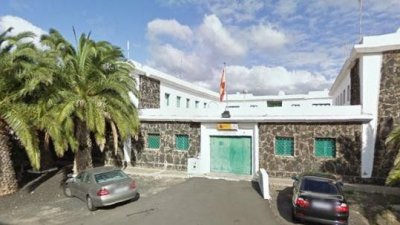
The Central Military Court has endorsed a sanction imposed by the Chief Colonel of the Canary Islands Zone on an agent of the Civil Guard of Yaiza of suspension of duties for five days after arriving an hour late to work "for oversleeping", by dismissing a contentious appeal filed by the affected party.
Specifically, as considered proven in the judgment, which was issued on April 24, the agent was to provide door service at the main post of Yaiza between 10:00 p.m. on July 29, 2017, and 6:00 a.m. the following day but "did not appear" at the barracks "for oversleeping." This, it is indicated, caused the citizen security and population surveillance patrol that was providing "night patrol service" to "have to remain" in the barracks "until the arrival of said agent, which occurred at 11:00 p.m."
After that, the General Chief of the Canary Islands Zone issued an agreement on November 23, 2017, ordering the initiation of disciplinary proceedings against the agent "as the alleged perpetrator of a serious offense consisting of not appearing to provide a service, absenting himself from it, or neglecting it" provided for in the Organic Law of the Disciplinary Regime of the Civil Guard, which ended with a sanction of "loss of five days' pay with suspension of duties."
Violation of his right to defense and legal assistance
Said agreement was appealed by the affected party who, after exhausting the administrative channel that ended with a resolution from the general director of the Civil Guard, filed a contentious military disciplinary appeal, considering that "his rights to defense and legal assistance" had been violated, among others. And it is that, after having been summoned by the instructor of the file to testify on March 26, 2018, he presented a writing in which he stated "his desire to have a lawyer for his advice," while requesting the change of date of his statement and those of the witnesses" because "his lawyer was not" on the island that day, "providing as justification a copy of a plane ticket in his name."
However, despite "knowing" that three of the four witnesses cited "could not appear" that day "because they were on vacation, the instructor denied his request, concluding that it could be "a delaying tactic." Thus, although the defendant appeared before him, he did so "refusing to testify because he did not have the assistance of the lawyer designated for his defense."
"It is inadmissible to deny a claim fully protected by the rights to defense and legal assistance with the argument that it is a delaying maneuver, especially when the inactivity that the processing of the file evidently presents between December 5, 2017, and March 15, 2018, is exclusively attributable to the instructor, who did not carry out any action," the Central Military Court points out.
"And equally intolerable is the suspicion that is slipped in the statement that it was not proven that the plane ticket had been acquired before the date of the summons was known, an assertion made recklessly without having proceeded to a minimum verification that would have been extremely simple," adds the chamber, which points out that from the examination of the documents attached to the writing of allegations presented by the agent, it appears that the ticket was acquired "a month before the defendant received the summons."
The court concludes that there was "inexcusable negligence" and "seriousness"
However, although the Central Military Court considers that "there was a violation of the fundamental right of the plaintiff to defense and legal assistance" and even concludes that "the statement of a witness that occurred without the presence of the lawyer cannot be valued as evidence of charge," it rejects the appeal filed by the defendant agent and confirms the sanction against him, considering that there are "probative elements that must be considered as incriminating or of an incriminating nature" that allow concluding that there was "inexcusable negligence in the conduct of the plaintiff, who despite knowing that he had to provide door service from 10:00 p.m. on the day in question, did not take the necessary precautions not to oversleep and thus be able to go on time to the place where he had to perform that service."
Likewise, the agent considered that, if the facts had any disciplinary relevance, it should be "as a minor offense." However, his claim has also been rejected by the Central Military Court, which considers that "the required seriousness exists," which "emanates in the first place from the time that the appellant remained completely oblivious to the provision of the service." Furthermore, it adds, "the conduct of the appellant not only caused damage to the door service to which he did not join, but also determined that a citizen security service began to be provided with an hour of delay."


Add La Voz de Lanzarote as a preferred Google source.
Stay informed with the latest current news.