
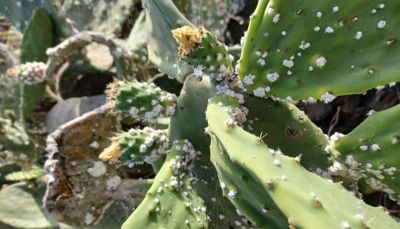
The carmine cochineal, or Mexican cochineal (Dactylopius opuntiae), which mainly affects the prickly pear, has been declared a plague by the Ministry of Agriculture of the Government of the Canary Islands. It was discovered in the archipelago in 2010, in the municipality of Fuencaliente in La Palma.
This harmful insect, when attached to the plant, produces yellowing and, subsequently, the death of plant tissues in the pads and fruits, weakening it and causing its premature fall to the point of causing the death of the plant, so for its control the regional government recommends the 'in situ' destruction of the infected material.
13 years ago, a resident of Fuencaliente, Juan José Santos, noticed that on a prickly pear on the side of the road there was a colony of cochineals "different from the dye, from the one of a lifetime", so he contacted the agricultural inspection service of the Cabildo de La Palma to confirm his suspicions.
The Government of the Canary Islands has issued recommendations to differentiate between the carmine cochineal (Dactylopius opuntiae), recently declared as a plague, and the carmine cochineal (Dactylopius coccus), which has the European distinctive mark of Protected Designation of Origin (PDO) for the extraction of the natural carminic acid dye.
"It arrives late because now it is already widespread"
The Ministry of Agriculture explains that "while the Mexican cochineal has a flattened shape and smaller size and can cause the destruction of the prickly pear, the traditional one is globose, larger and coexists with the plant".
For Juan José Santos, the declaration of plague "arrives late because now it is already widespread", and he has related how "the fight against this insect is continuous and constant, because it always reappears".
Since it was discovered in La Palma, the presence of this plague has been confirmed in the municipality of El Rosario, in Tenerife, as well as on the islands of Lanzarote and Gran Canaria in later years.
Santos has tried to deal with the plague of his prickly pears using different methods for its control, such as the use of turkeys and roosters that eat the insect "and that worked quite well until some dogs killed the animals".
Although he recognizes that "there are those who use chemical products from the banana plantation for pest control", Juan José Santos recommends "pressurized water and sweeping the plant every fifteen days", especially in the lower areas of the prickly pear, which is where the cochineal forms the largest colonies.
The declaration of plague of the Mexican cochineal implies control and phytosanitary measures such as the prohibition of the movement of any plant material of the genus Opuntia between the island territories, or the removal of plant material from an infected plot, except in the case of fruits harvested and free of the insect.


