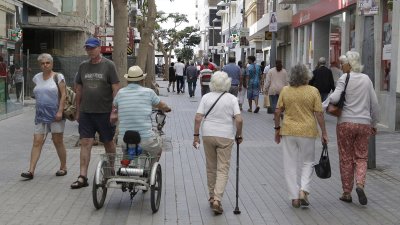
The State's spending on pensions distributes about 13.5 billion euros each month throughout Spain, the equivalent, for example, of five times the Gordo of the Christmas Lottery, of which almost 2.5 billion fall in Catalonia, about 2 billion in Andalusia, slightly less in the Community of Madrid and 441.33 go to 370,170 recipients in the Canary Islands.
Pensions are not a territorialized expense of the State, since they are an individual economic benefit that is received for different reasons, such as retirement, disability, widowhood or orphanhood, and their amount is determined by personal circumstances, such as the contributions made by each worker throughout their working life.
However, as stable income, they represent an enormous amount of funds that, month after month, have an impact on the economy, not only personal and family of the beneficiaries, but also of the localities and territories in which they reside, consume and pay taxes.
Data by autonomous communities
The latest data published by the Ministry of Inclusion, Social Security and Migration, corresponding to the month of April, indicate that Social Security paid that month 10,324,244 pensions to 9.3 million pensioners -4.7 million men and 4.6 million women- for an amount of 13,515.2 million euros.
By territories, in Catalonia 2,452.02 million were paid, 18.1% of the total; in Andalusia 1,989.62, 14.7%; in Madrid 1,930.20, 14.3%; and in the Valencian Community 1,283.27 million, 9.5%.
In the Basque Country it was 941.63 million; in Galicia, 880.79; in Castilla y León, 827.73; in Castilla-La Mancha, 488.93; in Asturias, 458.64; in Canary Islands, 441.33; in Aragon, 437.59; in Murcia, 310.53; in Extremadura, 268.88; in the Balearic Islands, 258.82; in Navarra, 220.17; in Cantabria, 204.15; in La Rioja, 96.88; in Ceuta, 12.42; and in Melilla, 11.50 million euros.
Of the total pensions, 1,802,429 were paid in Catalonia, 17.4% of the total; 1,692,247 in Andalusia, 16.39%; 1,272,319 in Madrid, 12.32%; and 1,060,710 in the Valencian Community, 10.27%.
In the rest of the communities there were 783,699 pensions in Galicia; 632,117, in Castilla y León; 583,678, in the Basque Country; 399,771, in Castilla-La Mancha; 370,170, in the Canary Islands; 316,247, in Aragon; 301,750, in Asturias; 266,298, in Murcia; 243,024, in Extremadura; 211,966, in the Balearic Islands; 147,963, in Cantabria; 146,925, in Navarra; 74,638, in La Rioja; 9,311, in Ceuta; and 8,982, in Melilla.
Redistributing effect
The territorial distribution of pension money and the number of pensions has to do with factors such as the average amount of salaries and the aging of the population.
For example, Andalusia, with a younger population and salaries below the average, receives 14.7% of the pension money and gathers 16.39% of these having 17.7% of the population, which means 3 and 1.3 percentage points less, respectively.
On the contrary, Basque Country, with an older population and the highest salaries in Spain, receives 7% of the money and has 5.6% of the pensions having 4.6% of the population, which represents 2.4 and 1 point more, respectively.
Depending on the greater or lesser aging or youth of each community, there is also a redistributing effect towards the areas affected by the phenomenon of depopulation.
Thus, while in the first communities of both lists, which are the most populated, reside six out of 10 Spaniards (59.7%), they gather 56.6% of the money and 56.44% of the pensions paid, that is, more than 3 points less in each case.
The opposite occurs in communities affected by the phenomenon of depopulation such as Castilla y León, which with 4.9% of the inhabitants of the country receives 6.1% of the money and pensions, that is, 1.2 points more in each case; or Galicia, which with 5.5% of the population receives 6.6% of the funds and 7.6% of the pensions, 1.1 and 2.1 points more.


Add La Voz de Lanzarote as a preferred Google source.
Stay informed with the latest current news.