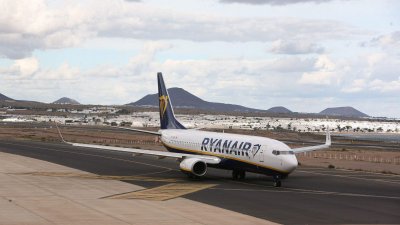
The Minister of Transport and Sustainable Mobility, Óscar Puente, has explained that the proposal of the Irish low-cost airline Ryanair to increase its offer in 2025 and 2026 in fourteen of the 32 regional airports in the country was conditional on a discount policy on airport fees and support from the territories.
The minister has detailed in the Commission of Transport and Sustainable Mobility of the Congress of Deputies that the airline's proposal, which he described as absurd, consisted of reversing the tariff adjustment of 2024 and massive discounts at regional airports for maintaining (50%) or increasing (100%) their traffic in 2025 and 2026, with effects extended for seven years.
In addition, it requested a contribution of public funds from local entities or autonomous communities of the affected territories, valid for 5 years, for an amount of 150,000 euros per year to maintain each existing air route and 250,000 euros per year for each new route.
Puente has appeared in the lower house to explain Aena's tariff policy after Ryanair announced in mid-January that it was reducing its activity by 18% at some regional airports (Vigo, Santiago, Zaragoza, Asturias and Santander, in addition to abandoning those of Jerez and Valladolid from April) for the summer season of 2025 (800,000 seats, one plane and twelve fewer routes), justifying this decision on the airport manager's "excessive rates".
According to the minister, this aggressive commercial policy of the Irish airline is not exclusive to Spain and has been repeated in other European countries when they have not complied with its interests.
Puente explained that, despite these cuts, the airline's activity forecasts are for growth in Spain as a whole in the next summer season (2% more seats in the entire Aena network, concentrating the growth of its activity in the largest tourist airports and in the large hubs".
The paradox is that it is precisely in these large airports where the airport fees paid per passenger are substantially higher than in the regional ones.
For Puente, these data clearly demonstrate that it is not true that the decision to eliminate routes in regional airports is due to the amount of the fees, where the cost of rotation per additional passenger is only 2 euros per passenger, he stressed.
Puente has clarified that Ryanair has also made public that its decision occurs after its aforementioned proposal to increase the offer in Spanish regional airports by 800,000 annual seats, which it conveyed to both the minister himself and Aena, which he has described as "absurd" and impossible to attend to, was not attended to.
And that is so, he added, because doing so "would not only be disproportionate and dangerous for the sustainability of the solid Spanish airport system, but would also be illegal given the existing airport regulatory framework in Spain, and could even be considered state aid by the European Union".
In his opinion, Ryanair's modus operandi, constantly requesting aid and withdrawing aircraft when there is hardly any room for reaction from competing airlines, "could fit into a type of blackmail that the State and the Government of Spain cannot accept".
Alternatives to Ryanair
In response to the situation created, Aena has already intensified the usual contacts with both airlines and local and regional institutions to develop new routes and cover the void created by Ryanair.
In fact, in some airports where this company has expressed its decision to eliminate routes, the summer schedule points to an overall increase in seats.
There are also airlines that have publicly announced that they are open to covering these routes in medium and small airports to connect smaller cities, he commented.
Ryanair also "openly advocates breaking the current airport model, which has had such a good result for Spanish society and the economy," the minister said.
In this sense, according to Puente, it would be madness to break the Spanish airport system, even more so with the idea of obtaining practically free airport fees, which would undoubtedly entail the need to make public contributions, financed by Spanish taxpayers, to subsidize the activity, which would very likely be considered as State aid.
This intention to demolish the airport network model seeks only to have weaker interlocutors, who comply with their requests, with the institutions and tourist entrepreneurs of the territories in which the airports are located paying all the airline's operating costs, with the ticket being free for tourists.
According to this model to which the airline aspires, the passenger who decides to fly would not pay, but rather the rest of the actors in the aviation sector or, where appropriate, all citizens with subsidies to the airline, even if they do not use this means of transport, he summarized.
The intended demolition of the airport system and the breach of the regulatory framework would only introduce legal uncertainty, benefiting the shareholders of the airline to the detriment of public budgets, Spanish taxpayers, Aena shareholders, among whom the majority are the Spanish citizens as a whole, he concluded.


Add La Voz de Lanzarote as a preferred Google source.
Stay informed with the latest current news.