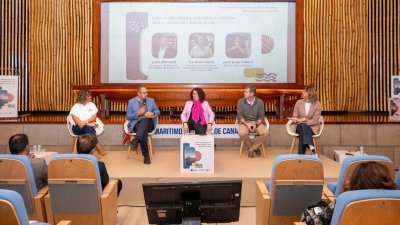
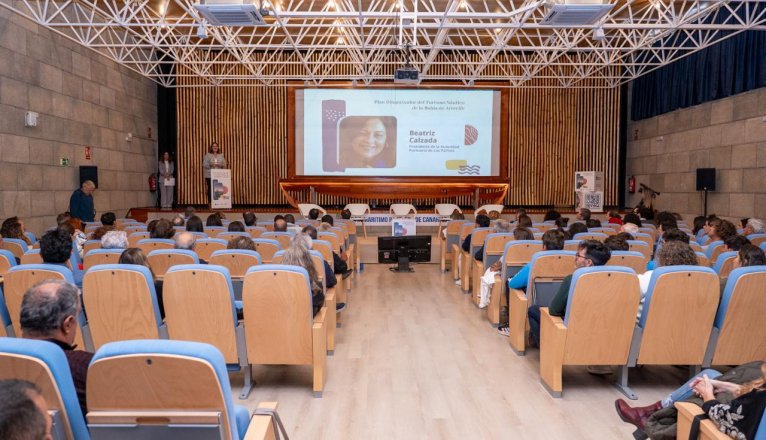
The Instituto Politécnico de Formación Profesional Marítimo-Pesquero de Canarias hosted on the morning of this Friday the presentation day of the Plan Dinamizador de Turismo Náutico de la Bahía de Arrecife, a project promoted by the Cabildo de Lanzarote, through SPEL-Turismo Lanzarote, and developed in collaboration with the specialized consultancies Deloitte and Verne.
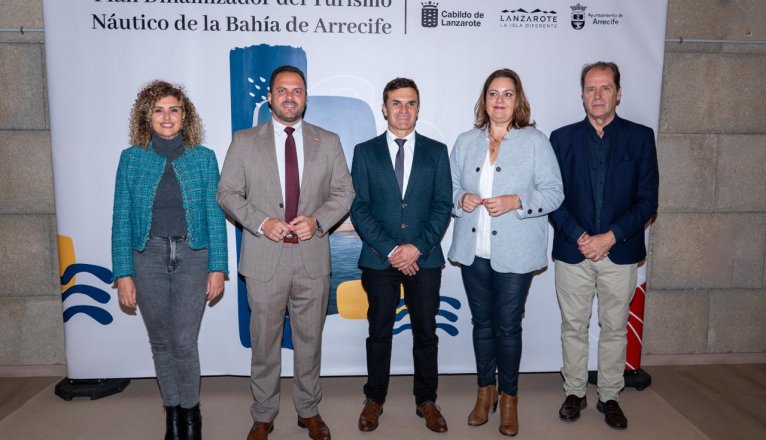
The event was attended by the CEO of SPEL-Turismo Lanzarote, Héctor Fernández; the president of the Port Authority of Las Palmas, Beatriz Calzada; the Deputy Minister of Tourism of the Government of the Canary Islands, Jose Manuel Sanabria Díaz, and the mayor of Arrecife, Yonathan de León, as well as the participation of institutional and sector representatives linked to the project's development, who were able to learn firsthand about the results, learnings, and proposals resulting from this revitalizing and transforming initiative for Arrecife Bay.
The environmental and cultural value of Arrecife Bay, coupled with a privileged location and a climate that allows nautical practice throughout the year, make it one of the most outstanding settings for the nautical tourist and social future of Lanzarote.
Aware of this potential, SPEL-Turismo Lanzarote has promoted this plan as an initiative based on the principles of the blue economy, which marks a new course for nautical activity on the Island, with a clear objective: establish a sustainable nautical tourism model, revitalize the spaces and services of the bay, and recover the historical and emotional bond that unites citizens with the sea.
For the president of the Cabildo de Lanzarote, Oswaldo Betancort, this plan “is a strategic tool to advance towards a vibrant Arrecife, open to the sea and capable of transforming its bay into a space for coexistence, sport, innovation and sustainable economic activity. We are laying the foundations of a model that respects our environment and that, at the same time, generates new opportunities for citizens and for the business fabric of the Island. The bay must once again be a place that unites us, that identifies us and that projects the best version of Lanzarote to the outside world”.
“We are talking about a strategic roadmap, driven by SPEL–Turismo Lanzarote, which is born with a clear objective: to convert the Bay into a true engine of blue economy, sustainable development and social progress for our island. And our responsibility as an institution is to order, give coherence and generate a stable framework that allows progress with legal certainty, territorial balance and environmental sustainability”, he added in his message.
The president thanked the active participation of the public and private sector that has contributed to this process, as well as the technical work of the consulting firms Deloitte and Verne, whose contribution has been fundamental to provide the document with rigor and viability.
“Arrecife Bay, of our island's capital, is part of our identity and our future, and I am convinced that this Plan will allow us to advance with a shared vision, from cooperation and towards a new nautical model. It is not an end point. It is the starting point to transform Arrecife and reinforce responsible, innovative, and inclusive tourism”, concluded.
For his part, the Deputy Minister of Tourism of the Government of the Canary Islands, José Manuel Sanabria, highlighted that "nautical tourism, integrated into the blue economy, is a growing sector worldwide and will generate not only employment and wealth opportunities, but also the recovery of traditional activities and the revitalization of a municipality like Arrecife".
Furthermore, he stressed that "from the Government of the Canary Islands we consider that everything is virtues in this project, that is why, the Consejería de Turismo y Empleo decisively supports these initiatives that do nothing more than try to combine sustainability, economy, employment and tourism in the same scope of action, in this case nautical tourism, in this project so novel and for us exemplary".
The president Beatriz Calzada conveyed “the absolute support of the Port Authority of Las Palmas for this urbanization plan, as well as absolute respect and loyalty to the decisions made by all administrations to make it possible for the plan to be carried out and be what, without a doubt, will be a great success that will improve, not only the island of Lanzarote for what it entails, but also the city of Arrecife and its people, which in the end is what should move us all: seeking the improvement of the quality and well-being of our people”.
In his speech, the mayor of Arrecife, Yonathan de León, highlighted “the city's potential as a port enclave and engine of the blue economy, valuing its connectivity, infrastructure, and capacity to generate employment and attract investment linked to sustainable nautical tourism.”
The mayor emphasized that “Arrecife has all the attributes to become in the North Atlantic the neuralgic base of nautical tourism, like La Rochelle (in the Bay of Biscay), precisely a port linked to the history of Lanzarote and Canarias since the 15th century”.
Likewise, the CEO of SPEL-Turismo de Lanzarote, Héctor Fernández, highlighted that “this plan is born from consensus and active listening. We have worked for months with public and private agents to build a shared vision that allows Arrecife Bay to be a more dynamic, competitive, and sustainable space. It is not just about attracting nautical activity, but about doing so under a modern, responsible model aligned with the blue economy, and for Arrecife to become a differentiated nautical benchmark in the Canary Islands and the Atlantic.”
Ultimately, the Nautical Tourism Revitalization Plan for Arrecife Bay represents a firm commitment to a more sustainable, integrated, and participatory future. A project built on dialogue and cooperation, that looks to the future with ambition: to promote a nautical model that generates value for citizens, tourists, and businesses on the Island.
SPEL-Turismo de Lanzarote thanks for attending the meeting and the involvement of all people and entities that have participated throughout the process. The nautical future of Bahía de Arrecife can only be built with collaboration, commitment and a shared vision.
10 star projects with real capacity for transformation
Started in February 2025, this project has involved the participation of more than 100 agents linked to the main institutions and social and business organizations of the nautical sector, who contributed their vision, knowledge, and experience through different collaboration spaces to define a viable, realistic, and adapted strategy to the real needs of the maritime ecosystem.
The result of this process is a roadmap that includes 50 concrete actions, organized into six strategic axes: maritime culture and identity; territory and infrastructure; activities and services; promotion and brand; innovation and digital transformation; and blue economy.
Specifically, the plan, with a 10-year time horizon, will initially be activated through these 10 flagship projects with real transformation capacity, aimed at positioning Arrecife as a nautical and maritime benchmark: to recover scenically and structurally the historic Salinas of Arrecife as a space with high social, environmental, and maritime value, to promote the construction, enablement, and opening of safe public ramps and accesses to the sea in different coastal areas and a greater recreational and cultural use of the Islote de Fermina through the development of activities linked to nautical and the environment; to enhance the cultural heritage of the area around the Puente de las Bolas and Muelle comercial and its link to the maritime tradition and history of the bay; to structurally rehabilitate and activate the space of the Islote del Francés as a cultural and social enclave linked to nautical; to promote the hydraulic optimization and natural cleaning of the Charco de San Ginés to favor its recovery, regularization of uses and activities for its revitalization; to transform the surroundings of Puerto de Naos into an eco-sustainable space through the improvement of infrastructures and creation of spaces linked to marine dissemination and fishing tradition; to deploy a destination brand strategy that boosts the national and international projection of nautical tourism, and to consolidate a stable and effective governance structure that guarantees coordination among the different agents involved and strengthens shared leadership.
Likewise, it contemplates the establishment of a stable and continuous governance model that guarantees the fulfillment of its objectives, an aspect in which collaboration between administrations is essential.



Add La Voz de Lanzarote as a preferred Google source.
Stay informed with the latest current news.