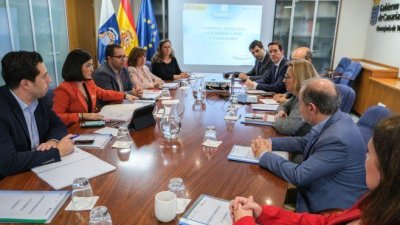
The Ministry of Economy, Knowledge and Employment of the Government of the Canary Islands and the Labor and Social Security Inspectorate of the Government of Spain will launch a total of 26,886 inspections during 2020 aimed at improving the quality of employment, as a result of the joint action program that was approved this Thursday within the framework of the meeting of the Autonomous Operational Commission of the Labor and Social Security Inspection of the Canary Islands. According to the agreement, these actions are aimed at promoting the monitoring of working conditions to guarantee access to decent and quality employment in the Archipelago.
They will be carried out by 119 officials on all the islands, 13,435 inspections in the province of Las Palmas and 13,451 in that of Santa Cruz de Tenerife, from which more than 60,000 actions will result at the end of the next year.
The actions are oriented to the scope of prevention of occupational hazards; employment and labor relations; social security; irregular economy and work of foreigners. As explained by the Minister of Economy, Knowledge and Employment, Carolina Darias, "an integrated and coordinated action plan has been launched whose objective is to ensure respect for the basic rights of workers in the Canary Islands, not only in terms of hiring, salaries and schedules, but also in terms of the conditions in which that work is carried out".
"We share the concern to create a framework that allows all people to have decent work", said Darias, who stressed the importance of having "the complicity of economic and social agents". "Each and every one of our actions are aimed at improving people's living conditions", she added.
Apart from approving the planning for 2020, the coordination commission between the state and regional administrations analyzed the "stupendous results" of the Master Plan for Decent Work in the Canary Islands since its inception in August 2018, valued the general director of the Labor and Social Security Inspectorate, María Soledad Serrano. "Until October 2019, more than 12,000 employment contracts have been converted into permanent contracts, the working day of 900 contracts has been increased, employment has been created in almost 12,000 jobs and 234 false self-employed workers have been detected who have moved to the general regime", she detailed.
In addition, "the Labor Inspectorate has been counting since January of this year the actions in recovering wages for workers, an issue that had never been done and that obliges companies through requirements to pay all their wage debts". As explained by the director of the ITSS, in the Canary Islands "more than 356,000 euros have been recovered for workers". "The implementation of the Master Plan for Decent Work has given wonderful results in the Canary Islands", said the director of the ITSS.
Scheduled inspections
By areas of action, in prevention of occupational hazards there are 5,766 inspections scheduled for 2020, preferentially oriented to the control of temporality in hiring; monitoring of working time, especially excess working hours and part-time contracts, registration of working hours and the correct application of aid to hiring and vocational training; as well as monitoring the principle of effective equality of women and men in the labor market.
In addition, inspections will be carried out to ensure that companies recognize the days actually worked and pay the corresponding amounts for all hours worked. In addition to direct monitoring, the control of the registration of the working day that came into force in May of this year will be carried out in a coordinated manner at the state level. To this end, the sectors and companies that are going to be prioritized will be decided based on the indicators on overtime worked and in those where there is a greater risk of exceeding working hours without recognition.
On the other hand, 1,747 inspections have been planned to diversify actions to control abuse and fraud in temporary and part-time hiring, promoting their conversion to permanent contracts and the declaration of the days actually worked. These controls include companies with a higher rate of temporality; temporary contracts that have exceeded their maximum validity or have been chained until exceeding the legal limits; part-time contracts with abnormally reduced working hours and training contracts, among others. It will also be verified that temporary employment companies hire exclusively for temporary positions and not for permanent needs of companies.
Promotion of equality
In the coming year, the Labor Inspectorate plans to reinforce the control and monitoring of equality plans, especially to verify their updating and real execution in those companies that have current plans. In addition, the inclusion of salary aspects in the plans of those companies that must have them compulsorily, that is, those that have more than 150 workers, will be promoted. Likewise, a specific control of cases of discrimination based on sex will be carried out, especially in salary matters. The inspections will also ensure in the Canary Islands to guarantee equal treatment of workers with disabilities. To this end, direct controls will be carried out to verify compliance with the 2% reserve quota in companies and it will be promoted that this obligation or alternative measures continue to be met.
Occupational safety and health
In terms of prevention of occupational hazards, it is planned to launch 5,766 inspections to verify compliance with preventive measures, distributed in 29 operational campaigns that will pay special attention to sectors with higher rates of accidents and greater severity; to the prevention of occupational hazards with a gender focus; to ergonomic factors and to new and emerging risks resulting from the advancement of technology, economic and social changes. Likewise, the greatest possible number of accidents will be investigated in coordination with the Canarian Institute of Occupational Safety (Icasel).
In 2020, controls on preventive action and the protection of temporary workers, especially those with shorter-term contracts, will also be included. In addition, the investigation of more than 500 work accidents and occupational diseases is planned, selecting, in addition to the fatal and serious ones, those classified as mild but that may hide a higher severity depending on their type.
Social Security, irregular economy and work of foreigners
The fight against fraud against social security and undeclared employment is another of the priorities of both administrations, for which 14,110 inspections have been approved, distributed in 34 campaigns based on the agreements reached with the General Treasury of Social Security, the State Public Employment Service, the National Institute of Social Security, the Social Institute of the Navy and the Tax Agency, fundamentally; and through the realization of controls of irregular economy distributed among the different sectors of economic activity. These actions are aimed at detecting deficiencies in the contribution of companies, improper classifications, fictitious companies, improper benefits and the emergence of workers who are not recognized their registration with Social Security or are only partially registered.


Add La Voz de Lanzarote as a preferred Google source.
Stay informed with the latest current news.