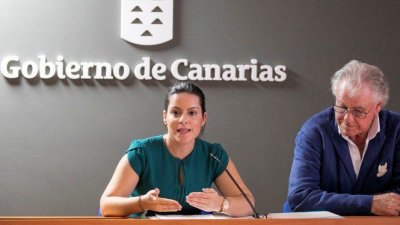
The Canary Islands tourism sector continues to play a relevant and strategic role in the economic system of the Archipelago, as highlighted by the Study of Economic Impact of Tourism Impactur Canarias 2018, prepared by the Government of the Canary Islands and the Alliance for Tourism Excellence Exceltur, whose main conclusions were presented today by the Minister of Tourism, Industry and Commerce of the Government of the Canary Islands, Yaiza Castilla, together with the executive vice president of Exceltur, José Luis Zoreda.
According to the report, direct and indirect tourism activity in the Canary Islands in 2018 amounted to 16,099 million euros, raising tourism's contribution to the total economy of the Canary Islands to 35% and generated 343,899 jobs, 40.4% of total regional employment.
This study, as explained, shows the behavior of the sector referring to 2018 and is not comparable with the results of previous editions of the report, due to the change in methodology in the Survey of Tourist Spending of the Canary Islands Institute of Statistics (ISTAC), source on which Impactur is based in a good part, especially in regard to tourist demand.
In any case, the report once again highlights the important pulling capacity of tourism on the rest of the Canary Islands' productive fabric. Thus, for every 100 euros of added value generated in the branches in direct contact with the tourist, 50.7 euros were contributed in other sectors, and in the same way, for every 100 jobs created in branches in direct contact with the tourist, 38.7 were generated in other branches of activity.
Yaiza Castilla highlighted in her speech the positive fact that "although since 2018 a slowdown in tourist demand began to be observed, as could be seen at the end of the year with around half a million fewer visitors, business investment in tourism in 2018 registered an increase of 9%" to reach 1,100 million euros.
Just over half of that investment, according to the Minister of Tourism, focused on the modernization of equipment and facilities of the accommodation plant and the rest of that capital of 1,100 million euros was mobilized by catering companies, transport and vehicle rental, among others.
"It is precisely facts like this", she clarified, "for which the Canary Islands must continue to bet, even more so at a time when we are facing a scenario with important challenges that affect our tourist demand and in which the Canary Islands' bet must continue to be for the excellence of the destination, even more so at a time of strong price competition from other destinations, with which we can neither should compare ourselves".
For his part, the executive vice president of Exceltur, José Luis Zoreda commented that "the results of Impactur Canarias 2018 reaffirm the strategic nature of tourism for the generation of prosperity in the islands".
Zoreda mentioned the new competitive challenges facing the sector, among which he highlighted "the scenario of economic slowdown in the issuing markets, the normalization of tourism activity in the competitors of the Eastern Mediterranean, the uncertainty and the final result of the process of disconnection of the European Union from the British market, the reaccommodation of market shares of the large wholesalers after the bankruptcy of Thomas Cook and the renovation and modernization of the product and the most mature Canary Islands destinations that requires enriching the tourist experience, together with the management of the load capacity and the environmental and digital transition in the destinations of the Archipelago".
In this framework, he encouraged the authorities to prioritize the action of the Government, the island councils and local corporations in favor of the tourism sector, "to face with rigor a new horizon, which will require intensifying collaboration between public and private actors in the islands and favoring the conditions that ensure and accelerate administrative procedures to address the necessary business investments, which allow to continue advancing in the renovation and consolidation of the attractiveness of the Canary Islands tourist offer. All this with the necessary political leadership in favor of a new governance that facilitates the greater alignment of public and private agents in the islands, with strategic vision and capacity for action, to ensure a gradual sustainable transformation of the Canary Islands tourism model and the greater extension of its pulling effects and socioeconomic benefits for the whole of Canary Islands society"
Impactur Canarias highlights the importance of foreign tourist consumption to guarantee stable growth in the medium and long term of tourism activity in the Canary Islands. Specifically, as reflected in the report, tourist revenues associated with trips by foreigners to Canary Islands destinations amounted to 11,682 million euros in 2018. These figures were determined by the influx of 13.8 million foreign tourists, who with an average stay of 9.6 days enjoyed 132 million overnight stays in tourist accommodation in the Canary Islands in 2018, with an average daily expenditure that reverts to destination of 85.9 euros in 2018.
Likewise, the detail of the results by issuing markets contemplated in the Impactur Study reveals the high economic impact generated by British tourists in Canary Islands destinations despite the uncertainty linked to Brexit and the accumulated depreciation of the pound in 2018. Specifically, the 5 million British tourists who visited the Canary Islands that year and who stayed an average of 8.5 days (42.6 million overnight stays) generated an impact of 3,663 million euros.
The report also reflects the high level of income associated with German tourists in 2018. The influx of 3 million German tourists in 2018, who made a total of 32.5 million overnight stays in tourist accommodation in the archipelago, contributed to generating 2,716 million euros of economic impact from the German issuing market.
In this framework, Zoreda wanted to emphasize the need to "continue prioritizing the strategy of guaranteeing connectivity to the islands with the main issuing markets, which has played a fundamental role in recent years, and advance the design of new more experiential proposals that strengthen the differential attractions of the islands and their ability to satisfy the most desired European tourists"
The positive behavior of tourism in the Canary Islands in recent years evidenced in previous editions of the study and the tourist specialization of the Canary Islands economy is reflected in the important contribution of tourism activity in the archipelago to the whole of the Spanish tourism sector. As detailed, the weight of the added value generated by tourism activities in the islands explains 11.4% of the total economic impact of tourism in Spain, a very revealing fact when compared with the 3.8% that represents the whole of the Canary Islands economy, on the total of the Spanish GDP.

Add La Voz de Lanzarote as a preferred Google source.
Stay informed with the latest current news.