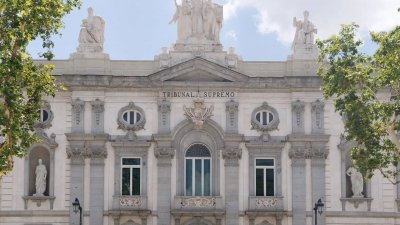
The Supreme Court has confirmed the sentence of a judge from Las Palmas de Gran Canaria who ordered a rapper to close his social media accounts for four years who used those spaces to intimidate a journalist, in conduct that was classified as a crime of threats and insults.
The ruling had already been upheld on appeal by the Audiencia de Las Palmas, which considered that prohibiting the rapper 'Frankie Gee' from having accounts on Facebook, Instagram, and Youtube or interacting on those networks is the direct consequence of one of the punishments provided for in the Penal Code long before the internet revolution.
That sentence referred, in particular, to article 48.1 of the Penal Code, which empowers judges to prohibit the accused from "going to the place where the crime was committed".
For four judges from the islands (the judge of Criminal Court number 4 of the capital Gran Canaria and the first section of the Audiencia), that place could be none other than the social networks that Frankie Gee (Francisco Manuel González, his real name) used to lash out for almost a year and a half against the journalist from Canarias 7 Francisco Fajardo with homophobic insults and unequivocal threats.
And all this, in retaliation for having published a true news story: that the Prosecutor's Office had reported him for a hate crime and was requesting prison time for him for allegedly disseminating xenophobic messages against immigrants, an accusation for which Frankie Gee was later tried and acquitted.
On appeal, the accused managed to have the prison sentence imposed on him for these acts reduced from a year and a half to only six months, which included going to the door of the Canarias 7 newsroom to try to confront the journalist.
The Audiencia considered that it was appropriate to leave the prison sentence at the minimum provided for threats, but confirmed the other two parts of the ruling: his expulsion from social networks for four years and the payment of 30,000 euros in compensation to the journalist.
"While journalists are not exempt from criticism, the unquestionable importance of free journalism in shaping and guaranteeing a democratic system must be emphasized (...). It is not tolerable that any citizen who considers journalistic information biased should react with a defamation campaign with very serious insults and even allusions to the affected person's supposed sexual orientation," reasoned the appeals court, which also noted an aggravating factor of discrimination in the insults.
The case has reached the Supreme Court, whose Criminal Chamber has dismissed it by not admitting Frankie Gee's appeal.
However, the High Court expressly rules on whether it is proportional or not to prohibit someone from using social networks, even for a limited period of time.
For the Supreme Court, this sentence is in accordance with its jurisprudence, specifically, with what was established in a 2022 ruling that found that "limiting access to a specific social network does not constitute a disproportionate affectation of the individual's faculties, as might result from the general imposition of a penalty consisting of a ban on internet access."



Add La Voz de Lanzarote as a preferred Google source.
Stay informed with the latest current news.