
On October 9, 1959, at eight in the morning, the church of San Ginés hosted the mass that officially began the 1959-1960 academic year of the National Institute of Secondary Education of Arrecife. As that new academic year began, Lanzarote was facing a reality that would soon be impossible to ignore: more and more young people wanted to continue studying, and the island's only secondary education center was starting to become too small. That seemingly routine start of the academic year allows us to glimpse an era when continuing high school could become the first step towards a different life.
The story had begun much earlier. In 1928, the Local Institute of Secondary Education of Arrecife had been created, which began its trajectory near the Charco de San Ginés. Its first director was Agustín Espinosa García, whose name would end up being linked decades later to the second institute in the capital. The center would change its name and location throughout its history, but it would maintain an essential characteristic for half a century: it was the only secondary education institute in Lanzarote.
In 1947-1948, it moved to the building on Coronel Bens street, built by the Cabildo. There it was in 1959, when it welcomed a new generation of students. For many young people from other municipalities, reaching those classrooms meant traveling to Arrecife to be able to study high school, at a time when continuing studies after primary education was still conditioned by distance, family finances, and the needs of each household.
Those displacements were part of a reality that is difficult to imagine today. For some families, keeping a child studying meant incurring expenses and organizing travel, while for certain young people it meant delaying their entry into the workforce. On an island where agriculture, fishing, and small trade continued to occupy a large part of economic activity, high school represented an opportunity that was not yet within everyone's reach.
The institute thus began to become something more than an educational center. In its classrooms, a young person could discover that after high school there were other studies, a profession, and the possibility of not necessarily repeating the same career path as their family. Education began to modify expectations and, at the same time, generated a demand that existing facilities would have increasing difficulty absorbing.
The evidence appeared very soon. In July 1960, the weekly newspaper Antena denounced the serious situation faced by the Instituto Nacional de Enseñanza Media de Arrecife due to the lack of space and shortage of teachers, to the point of warning that these deficiencies could lead to its closure. The paradox was evident: while the number of young people who wanted to study increased, the center that should have received them did not have sufficient means to attend to them.
One of the most significant responses was evening classes. In 1960, they began to operate to meet the requests of workers who wanted to continue their training without abandoning their work obligations. The first course brought together 34 male students and 33 female students, 67 people who attended the institute after finishing their workday. Secondary education was beginning to open a second door for those who had had to work or had not been able to study when they should have.
Among the teachers at that institute was María Luisa Perdomo Sosa, born in Nazaret. She had been a student at the center herself before moving to La Laguna to study Philosophy and Letters, and since 1947, she had worked as a substitute Latin teacher. During the 1959-1960 academic year, she obtained a position as a Latin associate professor through competitive examination at the same institute where she had occupied a desk years earlier.
Her career path summarizes, as few others can, the possibilities that education could open up. After training off the island, she returned as a teacher to the same center where she had begun her studies. Between one stage and the other were the university and a profession that showed how far training initiated in Lanzarote could lead.
The photographs from those years preserve other faces from that history. In one of them, students and teachers appear on the institute's stairs, including teachers Ana María Suárez Lubary and Natalia Cabrera Medina, along with the janitor Jaime Salces. These are names that may be unknown to many today, but they are part of the memory of an institution through which a large part of the youth who were beginning to look beyond school passed.
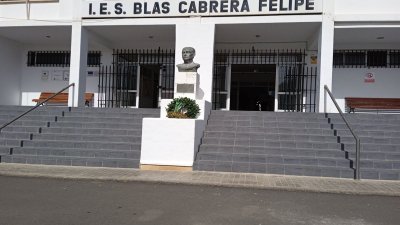
The center was also looking for a proper name at that time. In 1960, its faculty proposed that it be named after Blas Cabrera Felipe, the scientist born in Arrecife who had achieved international recognition. The proposal would reappear in the following years until Lanzarote's first institute would definitively adopt that name.
The pressure on the facilities eventually made a new building necessary. In 1969, the first institute left Coronel Bens street and moved to Titerroy, where it would continue its trajectory as the center that would later be named Blas Cabrera Felipe. The old building, however, did not cease to have an educational use: it remained as a delegated section of the institute.
By then, a new generation was beginning to arrive in the classrooms. The 1970 educational reform profoundly reorganized the Spanish system and created the Unified and Polyvalent Baccalaureate and the University Orientation Course. The acronyms BUP and COU would eventually become part of the school memory of thousands of young people, also in Lanzarote, but when they began to enter the classrooms, the history of secondary education on the island already spanned more than four decades.
Demand continued to increase, making the creation of a second institute inevitable. In 1978, fifty years after the creation of the first, the Ministry decided to establish another secondary education center in Arrecife to meet the growing need for baccalaureate places. Thus, the Mixed Institute number 2 of Arrecife was born, which began to function during the 1978-1979 academic year precisely in the building on Coronel Bens street that had been the seat of the first institute until 1969.
The scene has something of a historical paradox: the building that had been small for one generation reopened its doors to receive the next. The place that had concentrated the island's youth who wanted to continue studying for decades was now becoming the headquarters of a second institute because a single center was no longer enough to serve a school population that demanded more space.
That new institute would later receive the name of Agustín Espinosa, in memory of who had been the first director of the institute created in 1928. This fact allows us to distinguish two stories that over time may have become confused: the first institute in Lanzarote was the one created in 1928, whose historical continuity is linked to the current IES Blas Cabrera Felipe, while the current IES Agustín Espinosa was born as the second institute in Arrecife in 1978.
Both centers were also united by the same building. The current IES Agustín Espinosa continues to occupy Coronel Bens street, number 7, while the IES Blas Cabrera Felipe preserves the historical continuity of the first institute in Lanzarote.
Later, new centers would arrive in other municipalities and, at the beginning of the nineties, Lanzarote would enter a new stage of expansion of its secondary education network. What in 1959 forced numerous young people from the island to travel to Arrecife would eventually give way to a much closer educational offering in the different municipalities.
Seen from today, the sequence is revealing. In 1928 there was a single institute; in 1959 it was still the reference center for all of Lanzarote; in 1960 it opened its doors at night to serve workers; in 1969 it had to move to Titerroy; in 1970 BUP and COU arrived and, in 1978, the island needed a second institute. Behind these dates were specific people: students who traveled kilometers to study, families who made efforts to keep them in the classrooms, workers who returned to school after their workday, and teachers who accompanied a generation that was beginning to imagine different possibilities. Among them was María Luisa Perdomo Sosa, who had been a student at the institute and ended up returning to those same classrooms as a teacher after attending university.
That is why that morning of October 9, 1959, takes on another dimension when viewed from the present. The Mass at San Ginés officially opened a new academic year, but within the building on Coronel Bens street, something much deeper was happening: there were more and more young people who wanted to continue studying, and it was becoming increasingly difficult to accommodate them all. Two decades later, that same building would receive students again, but this time as the seat of a new institute.
Therein lies, perhaps, the true measure of what happened. Not in the plaques on the facades, nor in the name changes, nor even in the educational reforms that modified the curricula. It lies in those students who arrived in Arrecife from other municipalities, in those who studied at night after working, in the families who made it possible for their children to remain seated in a classroom, and in those who left the island to study and later returned with a profession.
The BUP and COU arrived later and occupied a central place in Lanzarote's school memory for decades. But when they appeared, others had already paved the way.
The first students of the institute in 1928 had paved the way, the young people who in the fifties crossed the island to reach Arrecife, the workers who in 1960 entered at night, and those who, like María Luisa Perdomo, demonstrated with their own careers that an education started in Lanzarote could lead much further than seemed possible at the time.
And perhaps that is why the history of that institute does not end on a date, nor in a building, nor in a name. It continues every time someone remembers that there was a time when studying was a conquest, every time a former student recognizes those classrooms as the place where they began to imagine their future, and every time a generation discovers, as those first ones did, that where one is born does not have to determine how far one can go.
Because that institute did not only teach subjects. It taught an island to imagine that its children could go further. And when a society manages to bring that idea into its classrooms, no building, distance, or circumstance is capable of closing its doors again.
SOURCES
-
Antena, no. 328, October 13, 1959, p. 5.
-
Antena, no. 368, July 26, 1960, p. 2.
-
Memoria de Lanzarote, historical chronology of education in Lanzarote.
-
Enrique Díaz Herrera, The Arrecife Institute: the beginnings of secondary education in Lanzarote.
-
Academia de Lanzarote, historical documentation on the first institute and the creation of the second center in Arrecife.
-
Boletín Oficial del Estado, Law 14/1970, of August 4, General Education Law.
-
Boletín Oficial del Estado, Royal Decree 2053/1978, of July 15, on the creation of the second institute in Arrecife.
-
Historical documentation on María Luisa Perdomo Sosa.
-
Historical documentation of IES Blas Cabrera Felipe.
-
Official documentation from the Ministry of Education of the Government of the Canary Islands on IES Agustín Espinosa.

Add La Voz de Lanzarote as a preferred Google source.
Stay informed with the latest current news.