
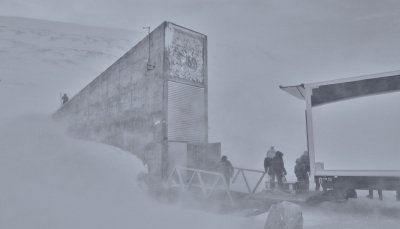
Olive seeds stand out among the latest samples incorporated into the Svalbard Global Seed Vault (Norway), recognized this Wednesday with the 2026 Princess of Asturias Award for International Cooperation, whose collection also includes wild olives from the Canary Islands.
The jury has distinguished the world's largest seed bank for its model of "effective multilateralism" with the common goal of guaranteeing the genetic base of food systems and "the knowledge accumulated over millennia" by the different agricultural cultures of the entire planet.
Last February, a delegation led by the International Olive Council (IOC) traveled to Svalbard to deliver the sample of such a symbolic crop as the olive tree.
In total, 500 seeds from the collection of the World Olive Germplasm Bank of Córdoba were sent, which houses more than 700 varieties originating from IOC member countries, such as Albania, Algeria, Cyprus, Croatia, Spain, France, Greece, Italy, Morocco, Portugal, Syria, Tunisia, and Turkey.
Material from wild specimens (wild olives) from different natural populations of the Iberian Peninsula and the Canary Islands collected by the University of Granada was also included.
The initiative was promoted by the IOC, the UN Food and Agriculture Organization (FAO), and the Ministry of Agriculture, Fisheries and Food of Spain.
In addition to the universities of Córdoba and Granada, the Spanish National Research Council (CSIC) participated.
These local olive varieties are threatened by the aging of trees, the low profitability of traditional olive groves, and the proliferation of improved varieties that are easier to mechanize.
In addition to olive seeds, more than 8,800 seed samples from different crops from twelve countries were deposited in the Vault in February, including the first from Guatemala and Niger.
Spain's participation
Spain has had a growing participation in Svalbard since, for the first time, it sent genetic material to the facility on June 9, 2022, when 1,080 varieties of Spanish seeds were deposited.
Subsequently, in May 2024, a delegation from the CSIC deposited 42 different species, mainly horticultural, including 33 new varieties of tomatoes or 23 of beans, as well as onions, collard greens, borage, and cardoon, among others.
This continuity of deposits is part of a broader project through which Spain aims that, within a decade, approximately 40% of the active resource collections in the 15 national seed banks will have a copy both in the Spanish collection and in Svalbard.
The Svalbard Global Seed Vault is an underground facility located in the Svalbard archipelago (Norway), near the North Pole, which stores about 1.3 million samples of about 6,500 plant species from around the planet.
Known as the 'Noah's Ark' of seeds or the Doomsday Vault, its function is to ensure that humanity can continue to produce food in the event of natural disasters, wars, failures in national gene banks, or due to the impacts of climate change.
Add La Voz de Lanzarote as a preferred Google source.
Stay informed with the latest current news.


