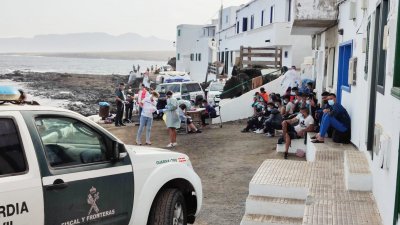
The Spanish Commission for Refugee Aid (CEAR) has detected in recent months the presence of a new profile of migrant arriving in the Canary Islands: that of the worker in the tourism sector of countries that have seen their economy "sunk" by the Covid-19 pandemic.
As explained to Europa Press by the Commission's spokesperson in the Canary Islands, Txema Santana, these are migrants, mainly Senegalese and Moroccans, who in their country were "guides, taxi drivers or street vendors" and who have been ruined by the loss of tourism due to Covid-19.
The presence of these people could be one of the reasons for the large increase in the arrival of boats to the Canary Islands in September and October. As Santana has pointed out, in these last two months the figures usually increase every year, because the sea is at an optimal time for travel. However, in 2020 these numbers have skyrocketed and, from the 800 who arrived in August, there has been an increase to 2,200 in September and 3,500 in October, with 11 days to go until the end of the month.
Sleeping on the dock
"It is a much higher arrival," denounced the CEAR spokesperson, before denouncing the "unsustainable" situation in the archipelago, where, "without a humanitarian reception network," migrants are received in an "improvised" manner and without "dignified" spaces in which to stay.
In figures, Santana points out that in September 2019, an average of 18 people arrived in the Canary Islands per day, compared to the average of 74 people per day who arrived in September this year. A figure that is increasing considerably again so far in October. Until now, an average of 174 people have arrived daily, he explained.
This situation has meant that more than 800 people have slept on a dock in the Canary Islands, that is, "10% of the people who have arrived in the archipelago so far this year", Santana denounced, who insists on the need for "a humanitarian reception network."
These people will remain in this situation until they have a PCR test and it is confirmed that they are not infected with Covid-19. From there they will be transferred to the different options that the Government now has, from centers to hotels.
Lack of investment
CEAR has explained that, in addition, industrial warehouses have been set up, although, it denounces, they are "more unhealthy spaces" and "with insufficient ventilation" than is now required with the pandemic.
From Doctors of the World they have also denounced the situation of these enclosures to which those migrants who have to quarantine are transferred. The spokesperson for the organization in the Canary Islands, Iriome Rodríguez, explained to Europa Press that people are left there "on the ground" without sanitation measures and in facilities that are not equipped to accommodate people there.
"Not enough has been invested to carry out humanitarian management and comply with human rights," Rodríguez declared.
This situation, he indicated, is in line with the way things are working in the Canary Islands today, where "a reception system has not been articulated." Doctors of the World and CEAR agree in denouncing the lack of an action methodology, despite the fact that the archipelago was already overwhelmed 14 years ago, in the so-called 'cayucos crisis'.
More women
At that time, Rodríguez explains, the arrival levels were higher, but even so, today "the lack of foresight continues to be noticeable." The spokesperson for Doctors of the World in the Canary Islands has indicated that warnings have been arriving for some time from the countries of origin, that the Canary route is being activated again.
Rodríguez explains that, in this situation, there is a part of strategy, since when the Libya and Greece routes are closed, the third to reach Europe is the Canary Islands.
In his case, he indicates that the socioeconomic profiles are the usual ones, with exceptions, but he has detected an "increase in the arrival of women" compared to five years ago. "There were not so many families then," he concluded.
Add La Voz de Lanzarote as a preferred Google source.
Stay informed with the latest current news.