
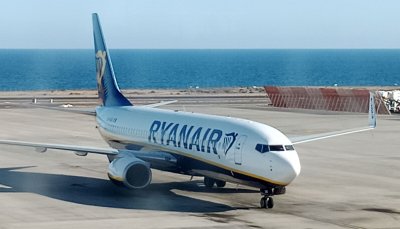
Low-cost airlines have launched an offensive to absorb the million seats that Ryanair will no longer operate in the coming months, after it threatened again this Friday to withdraw another million seats for next summer if Aena does not reverse its increase in airport taxes.
For now, Vueling, Iberia Express and Binter have already added some 434,000 additional seats compared to last autumn-winter, while others such as Volotea and Wizz Air have also applied to absorb another part of that gap left by Ryanair.
Just ten days ago, the Irish company announced that it would reduce its seats by 16% this winter and announced that it would close its base in Santiago, in addition to suspending flights to Vigo and Tenerife North from January 1.
The company had already eliminated 800,000 seats in the summer, which brings the capacity cut in recent times by Ryanair to almost two million seats.
However, that offer could be reduced even further, to 2.8 million seats, next summer if the threats of the Irish airline are fulfilled, which criticizes the 6.5% increase in fees by Aena.
Faced with this situation, Vueling or Iberia Express, both from IAG, have already announced 190,000 additional seats for this winter, especially in the Canary Islands, where Binter has scheduled some 240,000 extra seats, 100,000 of them in Tenerife North.
Others, such as Volotea and Wizz Air, have reaffirmed their presence in Spain throughout these days, and have shown interest in increasing it, such as Wizz Air, which will open 40 new routes until March 2026 departing from Spain.
Vueling already announced this Tuesday that it will schedule 1.5 million seats this winter season in Santiago de Compostela and Tenerife North, two of the airports most affected by the absence of Ryanair.
Tenerife North, with 89,000 additional seats for a total of 900,000 (11% more than in 2024), will have an extra daily frequency with Barcelona and Seville; three more weekly frequencies to connections with Santiago, Málaga and Alicante, and another two weekly to Valencia.
The seats offered by Vueling in Santiago will also increase by 15%, adding 28 weekly frequencies, with improvements to Barcelona, Palma, the Canary Islands, Seville or Málaga, in addition to recovering the route to Alicante and offering flights to Zurich, London-Heathrow and Paris.
Canary Islands, the focus of the new seats
Following Ryanair's decision, which will reduce 600,000 seats at regional airports and 400,000 seats in the Canary Islands, airlines have focused on the islands.
The Canary Islands-based Binter stands out, which this winter will operate a total of 984,349 seats between the Canary Islands and the Peninsula, the Balearic Islands or international destinations, an offer that represents 33% more capacity compared to last year.
However, airline sources assure EFE that this operation had been planned for some time.
Likewise, Binter schedules 413,000 seats in Tenerife North, 33% more (100,000 more seats), with new routes to Seville and Badajoz, in addition to reinforcing direct flights with Vigo, Valencia or Asturias.
From Binter they emphasize that Ryanair's announcement has not made them rethink the strategy "completely", although they are vigilant about the evolution of the market to analyze if "opportunities that may be interesting" arise.
Iberia Express has also already launched its winter offer: 30,000 new seats for the Canary Islands between October and next January, 5% more than last year.
The increase represents 116 more flights and 150 gauge changes of the planes with which it operates on these routes, although half of these new seats will be for Tenerife North.
"When a king is dead, a king is crowned"
The Minister of Transport, Óscar Puente, stated this Tuesday that no matter how much Ryanair "has left" some airports, "others (airlines) are entering that will replace it".
"When a king is dead, a king is crowned", Puente assured, who reiterated this Friday that the Government will not respond to "blackmail", after learning of the announcement by the CEO of Ryanair, Michael O'Leary, of a new cut.
For his part, the president of Aena, Maurici Lucena, accused the Irish airline of distorting the figures and wanting to earn more money, "even if it is paid for by the pockets of taxpayers".
This situation occurs after the Spanish airports of Aena broke a historical record in August, with 33.32 million passengers, a period in which 262,001 aircraft movements were managed, 3.1% more.


