
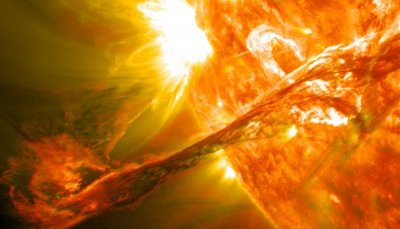
A powerful X5-class solar flare, one of the most intense of the current solar cycle, has caused a severe geomagnetic storm, visible in the form of auroras at unusual latitudes, according to the Canary Islands Institute of Astrophysics (IAC) this Wednesday.
The phenomenon was recorded on November 11 at 10:04 Canary Islands time, when the Sun emitted a flare from active region 4274, accompanied by two coronal mass ejections (CMEs) directed straight towards Earth.
Its impact, faster than anticipated, triggered a storm classified as G4 level, one of the highest intensity categories.
"The impact of the ejections is generating auroras visible in relatively low latitudes and causing strong disturbances in the Earth's magnetic field," explained Héctor Socas Navarro, researcher at the IAC and director of the European Solar Telescope (EST) Foundation.The most exceptional aspect, he highlighted, is that the event has generated a GLE (Ground Level Enhancement), a very rare phenomenon that occurs when extremely energetic solar particles reach the Earth's surface and are detected by neutron stations worldwide."Only a few GLEs are produced in each eleven-year solar cycle," he added
The combination of the X5-class flare and coronal mass ejections has resulted in an event comparable to that of December 13, 2006, one of the most powerful in recent decades.
"Everything indicates that this episode is among the most significant of the last 20 years," stated Socas NavarroAlthough no serious effects on daily life are expected, the researcher warned of possible disruptions in navigation systems, high-frequency communications, satellites, and circumpolar flightsFrom a scientific point of view, this phenomenon offers a unique opportunity to study particle acceleration processes on the Sun and their impact on the Earth's environment
Furthermore, during the coming days, auroras could be observed in unusual areas. “There’s no need to go to Norway these days to see auroras,” concluded Socas Navarro.
Add La Voz de Lanzarote as a preferred Google source.
Stay informed with the latest current news.


