
The presidents of the Canary Islands and Euskadi have sent a joint letter to the president of the Government of Spain, Pedro Sánchez, in which they request the urgent convening of a Conference of Presidents or another similar body to analyze the consequences of the war in Iran and jointly activate measures that mitigate its effects on the economy, the productive fabric of the country, and the citizens.
In their letter, Fernando Calvijo and Imanol Pradales convey their “growing concern” over the economic and social consequences derived from the current international context, marked by the escalation of the armed conflict between the United States and Israel in Iranian territory and its direct impact on energy markets.
Both presidents warn that the “unilateral” military action has generated strong uncertainty in the international community, by violating international law and human rights, and alert of the risk of an escalation that compromises global political and economic stability.
In fact, Clavijo and Pradales underline in the letter to Sánchez that the sustained increase in the price of oil and gas is already having significant effects on the European and Spanish economy.
They highlight that these effects are felt with special intensity in insular and outermost territories like the Canary Islands, highly dependent on maritime and air transport and on the use of fossil fuels for a good part of their economic activity. In parallel, they warn that industrial regions like Euskadi are suffering a direct impact on the competitiveness of their industries, especially electro-intensive ones, due to rising energy costs.
The letter also points out that, if the conflict prolongs, a scenario of lack of components and fall in demand could occur in the coming weeks that would affect the entire industrial fabric of the State. All this, they recall, is happening in less than two weeks, while citizens already perceive a deterioration of their purchasing power.
Given this situation, and given that the Government of Spain has announced that it is studying shock measures, the Canary Islands and Euskadi consider it “opportune and necessary” to activate in a coordinated manner all available instruments among the different institutional levels.
Therefore, they request the urgent convening of a meeting, forum or monographic encounter “like the Conference of Presidents” to jointly evaluate the impact of the international crisis and coordinate measures that mitigate its effects on the economy, the productive fabric and the citizenry.
The presidents of the Canary Islands and Euskadi conclude their joint letter to Pedro Sánchez emphasizing that dialogue and cooperation between administrations are “essential” to articulate effective responses in an international scenario “as complex and changing” as the one that has opened after the attack by the US and Israel on Iran.
In addition, the head of the Canarian Executive has called two meetings next week in the archipelago to discuss actions to be adopted at the autonomous level to mitigate as much as possible the effects on citizens of the war and the sharp increase in fuel prices. First, the Government will hold a meeting with parliamentary spokespersons. In addition, Fernando Clavijo has convened the President's Advisory Council, a body in which representatives of the main business and trade union organizations of the islands participate.
The rising cost of fuel has become one of the most visible effects of the war in Iran, which has strained the global energy market and driven up the price of oil. Since the start of the conflict, the partial closure of the Strait of Hormuz, a strategic passage through which nearly 20% of the world's crude oil circulates, has raised the risk premium and pushed international prices upwards.
In fact, the Brent barrel has exceeded 100 dollars in several sessions, while diesel and gasoline register sustained increases in Europe and the United States, with rises that in some cases double the usual variations. This rebound, fueled by geopolitical uncertainty and the reduction of maritime transit, is already reflected at the pumps and threatens to spread to sectors such as transport, aviation, and industrial production.
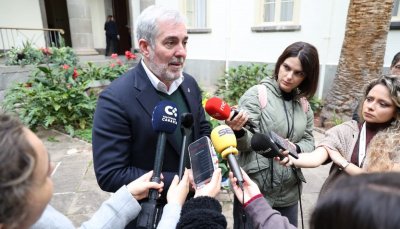
As warned by President Fernando Clavijo during statements made this Thursday, its effect can be especially intense in the Canary Islands due to its dependence on air and sea transport as it is a territory far from the continent and fragmented. “We understand that the impact will undoubtedly arrive, that there will be inflation, that this will harm families because it will reduce their income,” with which he advocated for coordinated measures among all administrations “aimed at the most vulnerable and most affected groups, so that this public money has the maximum result.”
As for the measures to be adopted at the autonomous level, the president announced that this very morning he held a working meeting with the vice president and minister of Economy, Manuel Domínguez, to analyze the fiscal measures that the Government of the Canary Islands can adopt along this line.


