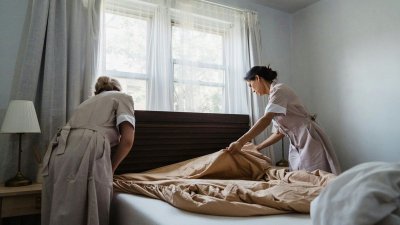
The plenary session of the Parliament of the Canary Islands has approved this Wednesday, with the sole abstention of Vox, a modification of the Tourism Planning Law that obliges accommodation establishments to install before 2033 mechanical adjustable beds, as well as motorized carts for the transfer of textiles and cleaning tools, to reduce the physical injuries of the chambermaids.
The new norm, fruit of a bill promoted by the PSOE and which has reached a majority consensus, has been driven by the historic struggle of the chambermaids, also known as the kellys (acronym for “those who clean”), to improve the arduousness of the work in the hotels of the islands for this collective, affected by the high incidence of musculoskeletal injuries.
In this law, a strict regime for the evaluation of workloads and the obligation to implement elevable beds and motorized carts in the tourist establishments of the islands is established, with a flexible calendar until 2033, although with some exceptions for small or family accommodations in islands like El Hierro or La Gomera, according to an in voce amendment incorporated in the plenary session.
For four and five-star hotel establishments, the percentage of implementation of adjustable beds and motorized carts will be 25% until the end of 2027, 45% until the end of 2029, 75% until the end of 2031 and 100% before December 31, 2033.
In the rest of hotel establishments, extra-hotel establishments and tourist use dwellings, the calendar requires the following objectives: 10% until the end of 2027, 20% until the end of 2029, 35% until the end of 2031 and 100% at the end of 2033.
The norm contemplates specific exceptions, such as extra beds and establishments of up to 30 rooms located in Cultural Interest Assets (BIC) or in protected spaces.
The requirement includes the owners or operators of tourist use dwellings who market five or more properties or group twenty or more accommodation places on the same plot.
The law obliges companies to integrate ergonomic and psychosocial factors in their occupational risk assessments and to evaluate the increase in physical load involved in the use of large volume elements, such as Nordic duvets.
Another of the business obligations is to carry out objective measurements of the real times that room maids use in cleaning the different types of rooms, in order to avoid overexertion.
The non-compliance with the installation deadlines or the repeated violation of the preventive conditions will be classified as very serious infringements, in accordance with the sanctioning regime of the new law.
To facilitate the transition towards the full implementation of adjustable beds and motorized carts, subsidies are planned from the Government of the Canary Islands and the island councils.
They denounce "numerous obstacles"
Gustavo Santana, of the PSOE, promoter of the bill, acknowledged that it is not common for a legislative initiative of the opposition to be finally approved and thanked the rest of the groups for their willingness.
The drive of the chambermaids especially stood out, which demonstrates that "the labor struggle" is essential to improve working and salary conditions.
The process, he said, has been marked by "numerous obstacles and the opposition of economic sectors with great capacity for influence," who intended to propose the health of the chambermaids as a "bargaining chip" in collective bargaining.
"They were wrong: health is not negotiated, it is a right," stressed Santana, who recalled that only 12% of the hotels in Canarias have adjustable beds and barely 6% with motorized carts.
The CC deputy Mario Cabrera affirmed that this legal change contributes to advancing in the quality of employment and occupational health in a key sector such as tourism.
David Morales Déniz (PP) thanked the joint work of the parliamentary groups to protect the health of the workers of the sector.
The deputy Natalia Santana, of Nueva Canarias, pointed out that her party has constantly defended the rights of the chambermaids and stressed that tourism cannot sustain its success on the deterioration of the health of those who make it possible.
Paula Jover, of Vox, justified her group's abstention due to the absence of a report on the economic impact for companies, the lack of guarantees on subsidies, and a calendar with numerous exceptions which, in her opinion, leaves the text as "political propaganda," although she showed herself in favor of guaranteeing the occupational health of chambermaids.
The ASG deputy Jesús Ramos Chinea highlighted that it is a milestone that for the first time the working conditions of this group are regulated by law, while Raúl Acosta (AHI) valued that the circumstances of the accommodations of the smallest islands have been taken into account.


Add La Voz de Lanzarote as a preferred Google source.
Stay informed with the latest current news.