
The Arrecife Casino, like many others in other Spanish cities, was created in the mid-19th century. The word casino, originally from Italy, means country house, which is why it is associated with recreational activities. The capital status of Arrecife, obtained in 1852 thanks to the growing economic development derived from its port, coincides with the birth of a bourgeois class composed of those who dedicate themselves to the flourishing commerce and maritime activity, as well as the landowners who came from the interior of the island.
The need to relate and enjoy a place where "to provide members with permitted distractions and recreations, as well as the reading of works and newspapers" was the reason why this society arose, as well as another institution of relevant importance for the island such as La Sociedad Democracia. The date of its constitution is known for the latter (1850), but not in the case of the Casino, although according to the historian Antonio Montelongo Fránquiz "we are facing the first Society of Lanzarote and the only one that has preserved its original name".
A characteristic of those societies of that time was the following of a strict regulation by which the "social purity" of its members was preserved. Thus, to be admitted, the applicant had to pass a secret ballot in which white and black balls were used, depending on whether he was accepted or rejected respectively. Sometimes the non-admitted was marked by the phrase "that one was thrown the black balls in the Casino". Fortunately, today's Casino has walked hand in hand with the new times, its membership currently being made up of representatives from the different strata of Lanzarote society.
On the shield of the Casino from the beginning of the 20th century, two hands are seen shaking, which can be interpreted as a Masonic sign. This fact, together with the development of Masonic lodges at that time, may make us think of a Masonic origin of the entity. Another detail that invites us to think about such a possibility is the marked philanthropic and humanitarian character of the society, as shown by the agreement of the Board of Directors held on February 9, 1898, which, on the occasion of the Cuban War, approved "contributing 25 pesetas per month for a daily telegram", or the one adopted on May 2, 1919, by which "15 pesetas per month will be delivered for the economic support of the kitchens established in the city".
The first news in which reference is made to the Casino appears in the weekly Crónica de Lanzarote on February 23, 1861. The second printed newspaper on the island includes in its pages: "The piñata Sunday took place in the halls of the Arrecife Casino the regulation dance". Basilio Cabrera presided over the Society. It would not be until August 18, 1869, under the presidency of José C. Quintana, when the Casino approved its regulations. Curiously, on the shield that the Casino brandished at that time (1888) appears a nautical symbol such as an admiralty-type anchor. More than a premonitory nod to the future and main activity of the Club, we must consider it evidence of the importance that maritime activity had in the nascent capital of the island.
In 1906, H.M. Alfonso XIII visits the city of Arrecife, who did the same with the rest of the Canary capitals. The authorities of the moment offered the monarch a reception at the Casino, where he rested briefly. It is curious to highlight that as a result of this visit to the Canary Islands, the monarch granted the title of Royal to the Tinerfeño Club of Tenerife and the Nuevo Club de la Palma (founded in 1902 and 1904 respectively), societies that he visited and that made the corresponding royal request. The board of directors of the Arrecife Casino did not make any request in this regard at that time. Later, the Gran Canaria Yacht Club, founded in 1908, would also hold the title of "Real".
The Arrecife Casino continues to develop its activities as it enters the 20th century, with a curious gathering called the "Notable Moors" emerging in the hallway of the old building (today the Agustín de La Hoz House of Culture). Among its members was the cream of the cultural society of Arrecife at that time: Leopoldo Díaz Suárez, Andrés Fajardo Ferrer, Eugenio Rijo Rocha, Miguel Armas Martinón, Carlos Sáenz Infante, among others, who, sitting in wooden armchairs as small thrones, discussed and disserted, when they did not scrutinize every new visitor, often before a young and enthusiastic audience.
This gathering was not to the liking of some who, through the newspaper "Tiempos Nuevos", attacked it in 1933: "How many temples are there in the city? / Two: the Catholic and the mosque overlooking the sea / It is clear that the Jews and the notable Moors have always understood each other".
Despite the apolitical nature of the Society, throughout the first half of the 20th century the different boards of directors corresponded to the political option of the moment. Even coinciding in several people the condition of President of the Casino and Mayor of the city or President of the Cabildo.
Under the umbrella of the Society, the Arrecife Casino Theater Group arises, which collaborated in the task of dynamizing the culture of the city. Similarly, and to this day, the Casino hosts all kinds of pictorial exhibitions, talks and conferences. In the 1940s, two illustrious figures from our island became part of the Board of Directors of the Casino, César Manrique Cabrera and Guillermo Topham Díaz.
After the Second World War, there was a turning point in the history of the Society: in 1947 a group of enthusiastic sailors from the Real Club Náutico de Gran Canaria created what is undoubtedly considered today as the regatta with the most tradition in the country, the San Ginés. From the first moment, the Casino, presided over by Federico Coll Díaz, was involved in welcoming the sailors, gaining in each edition greater organizational prominence as its newly created nautical section gained confidence and experience. It would be impossible to address the history of this regatta in such a small space, but we must point out that the nautical feeling of the Casino has run alongside the evolution of this important nautical event.
As a consequence of the events that the club organized in honor of the sailors, a group of members among whom were Francisco Sáenz, Pedro Schwart, Cristín Bethencourt and Félix Quintana, organized, in response to the dance of foreign yachtsmen, the dance of local chalanistas, constituting the party par excellence of the Club that also served as a reunion for students who came from outside the island at the beginning of their summer vacations.
Later, a new group of enthusiastic young people appeared who marked an era in the Club, they were the "7 Machos": Alfredo Morales, Andrés Martinón, Segundo Manchado, Ricardo Sáenz, Pepe Medina, José Antonio Morales and Rafael Ramírez, in whose car the group traveled. These youth movements were continued, as Miguel A. Ferrer Bermúdez collects in an article published in the third issue of the El Islote bulletin (2001), by a host of young people who respond to curious nicknames: La Chana, Picaporte, Miñoca, Porra, Baburcia, Forocho, Patera, Poeta, Coreano, Fruta, Pata?
In 1955 another activity arises that will be a reference of the entity, the Canasta Tournament. According to the weekly Antena: "Forty couples have participated in the interesting Canasta tournament held recently in our first social center". That year the San Ginés regatta adopts an International character with the participation of a representation of the Agadir Yacht Club, who did not finish the race. Four years later, the Mistic and the Sea-Sprite from the Chicago and Vancouver Yacht Clubs participate, respectively.
At the end of the fifties the first snipes appear, a light sailing boat with two crew members that in the future will give great champions to the Casino and the island. The promoters of this class that began to take off at the beginning of the 60s were, among others, Antonio Hernández, Segundo and Antonio Manchado, Alfredo and Esteban Morales, Tito Rosa, Luis Morales, Domingo and Rafael Lasso, Gerardo and Antonio Armas, Manuel Jordán, César Cabrera... In 1962, the conejera flotilla (No. 67) that had 11 boats that year, participates for the first time in the Regional Championships held in Tenerife, obtaining the Tifón, by Alfredo Morales and Octavio Betancort the first place in group B.
Little could be done with wooden boats against the "plastic" ones used by the sailors from Gran Canaria and Tenerife. In response to the rise of this class, where there are two sides called roncotes and pirates, the Yacht Club will face in 1965 the organization of a Regional Championship of the Class, where boats from Gran Canaria and Tenerife participate. It will be the first of the numerous competitions that the society has been carrying out until now. At the end of this decade, Jesús Quevedo (Panta), an experienced and enthusiastic sailor from Gran Canaria who marked a glorious era in the Club, joined the snipe fleet. Today those pirates and roncotes continue to meet to celebrate the Sancocho Regatta and remember old feats.
A fundamental date in the history of the Casino was 1960 that year, after numerous vicissitudes, the old headquarters, which today occupies the Agustín de La Hoz House of Culture, is abandoned and the current one, more spacious and with access to the sea, is inaugurated. In 1962 César Manrique made an experimental mural in the new facilities for which he used material from the scrapping of ships. A year later the new name of the Arrecife Yacht Club Casino is established. Celebrated will be the phrase of the president D. Marcelino de Páiz García: "The Arrecife Casino has died, long live the Arrecife Casino Club". D. Marcelino was one of the key presidents in the history of the Club.
In 1963 the first members of the Yacht Club Casino, Marcial Espino and Tito Rosa, participate in the San Ginés, who do so in boats attached to the Real Club Náutico de Gran Canaria. In the following edition begins the participation of conejeras boats with the Timanfaya skippered by Alfredo Morales and whose crew was composed of Domingo Lasso, Tito Rosa and the sailors of the Club Manuel Reyes and Felipe Álvarez. This participation almost ended in disaster when a leak occurred in the sailboat of just 7.50 meters.
Two years later Alfredo Morales, who is undoubtedly a reference in the nautical world on the island (the Club's Sailing School bears his name) at the command of his own boat, the Rubicón, would achieve for the Yacht Club Casino the first of its numerous victories. In the recreational-cultural section, the first rock band of the Island, Los Rebeldes, debuts at the Club, who animated the dances and parties of the Society.
At the beginning of the 70s the Optimist fleet is created and sailing courses aimed at children begin to be taught at the Club, it is important to emphasize that any child can access the courses without being a member of the Club. The boats of the Cruiser class attached to the Casino compete with those of Gran Canaria and Tenerife in the San Ginés regattas, establishing themselves as one of the best fleets in the islands. In 1975 the Rubicón wins the San Ginés again and the Lustral Regatta of La Palma in 1980.
The 80s will be the boom of the nautical activity of the Club, the Trophy of the San Ginés Regatta stays in the showcases of the Club thanks to the victories of Alfredo Morales, Pedro de Armas (3) and Rafael Lasso. The Snipe Class takes off organizing in 1988 a Championship of Spain that Pedro Ferrer and Iñaki Galán win. This championship marks the beginning of the power of the snipe fleet of the Arrecife Yacht Club Casino at national and international level. In 1998 the Club will repeat the experience of organizing a regatta of such relevance, successfully overcoming the test, Aureliano Negrín and David Martín win in conejeras waters the first of their 5 Championships of Spain, which culminated with a European Championship in 2000.
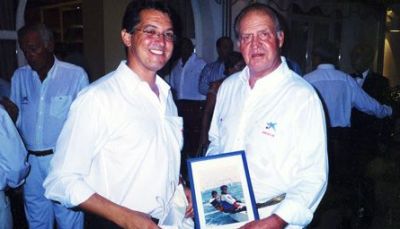
In 1997 the Club celebrates the fiftieth anniversary of the San Ginés Regatta, bringing together some sixty boats and carrying out a formidable program of celebration for current and veteran sailors. Five years later, in 2002, H.M. the King agrees to preside over the Honorary Committee of the Regatta on the occasion of its 55th anniversary. It is not the first time that the Royal House has had a relationship with the Arrecife Yacht Club Casino, HRH Don Juan de Borbón visited its facilities on several occasions, the last of them in the summer of 1977 with his wife.
The beginning of the present century is marked by a growing sports activity in the Yacht Club both in the swimming, triathlon, and, of course, sailing sections. Rayco Tabares and Mariano de León obtain the third place in the Youth World Championship of the snipe class in 2001. Later, together with Gonzalo Morales, Rayco Tabares would achieve the Championship of Spain in 2008.
In 2001 the publication El Islote is born, a club information bulletin that aims to be a link between the entity and its members. A year later, the Yacht Club supports the efforts of Puerto Calero to hold a High Level regatta in Lanzarote: the César Manrique Trophy - Puerto Calero arises. The importance and impact that such an event has for our island is known to all.
Currently we can proudly say that we have one of the nautical events of the highest level and prestige in the country. In 2003 the Arrecife Yacht Club Casino is admitted to the Spanish Association of Yacht Clubs, made up of the twenty most important yacht clubs in the country. A year later the Club will be one of the founding members of the Canary Association of Yacht Clubs. In 2005 the first fleet of the J80 Class in Spain is created in Lanzarote. Last year we obtained a World Champion of the Class: Rayco Tabares, who has also been recently chosen by the Royal Spanish Sailing Federation as Sailor of the Year 2009.
Although the extensive track record of the Arrecife Yacht Club Casino (only surpassed in the Canary Islands by the Real Club Náutico de Gran Canaria) has numerous champions of Spain, Europe and the World, as well as an Olympic diploma, it would be good to momentarily finish this small history of a club with an Olympic medal. That is why this great honor of H.M. The King should serve to stimulate the members and sailors of the Yacht Club, as such an award responds to the vision of a great club, which it is, the Real Casino Club Náutico de Arrecife.


