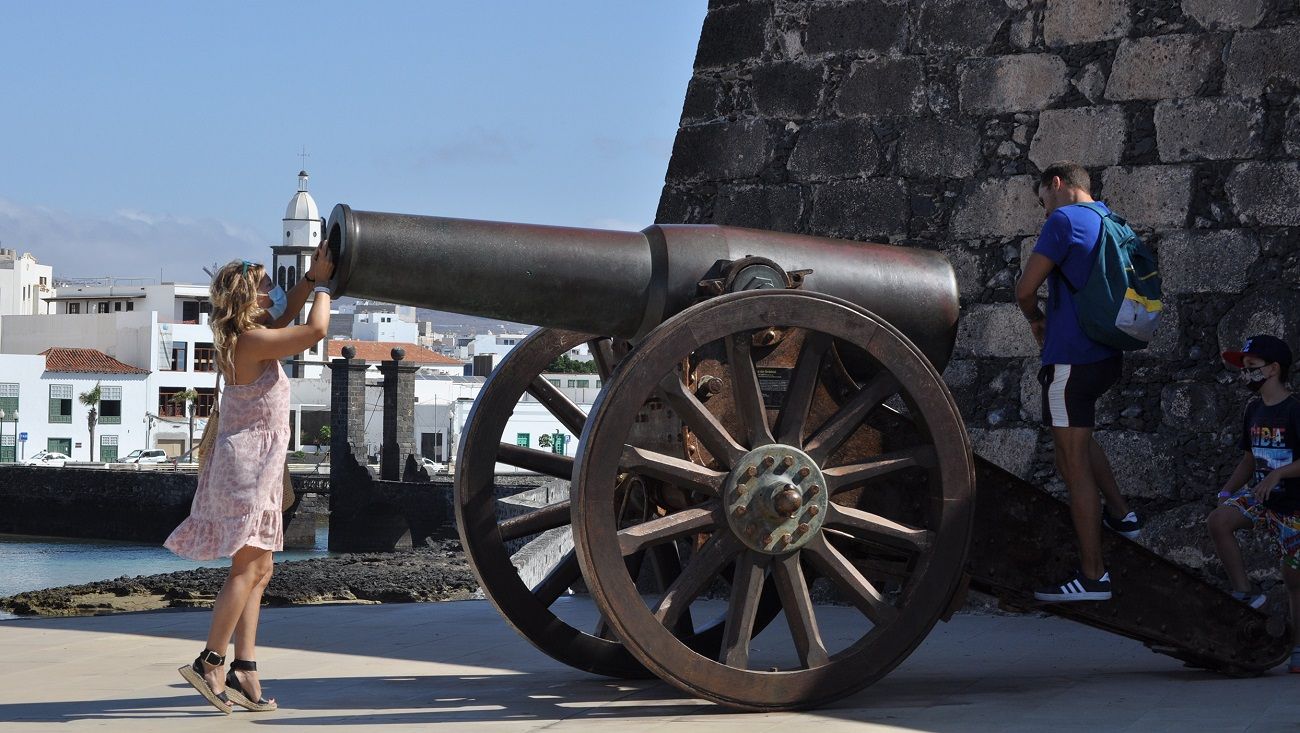
There was a time of pirates and corsairs in Lanzarote. A time of defending oneself from the enemy that arrived by sea. A time of building castles and fortresses to protect the island. Today, these buildings are preserved as traces of that past.
To know it, to get closer to the history of Lanzarote, there is no better way than to visit its castles. All had a common origin, but a different evolution. Have you ever dreamed of eating in a castle?
The Castle of San José
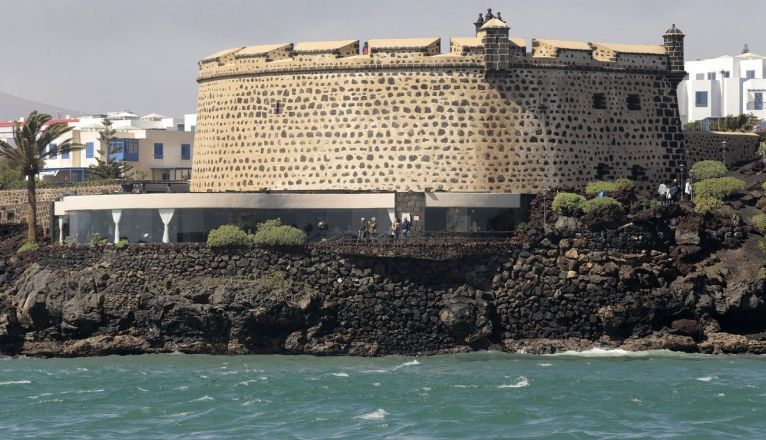
It was built between the years 1776 and 1779 by order of King Charles III, with the aim of protecting the port of Arrecife and providing work for the inhabitants of Lanzarote, who were suffering a period of hardship. The eruptions of Timanfaya had forced many Lanzaroteans to abandon their villages, and the construction of this fortress served to employ a good part of the population, which is why it became known as "the Fortress of Hunger".
Two centuries later, the artist César Manrique set his sights on this castle, promoting the remodeling and conditioning works of the building. In 1976 it opened its doors as a museum, with the aim of "promoting, gathering and exhibiting the most significant works of modern artistic creation".
The International Museum of Contemporary Art (MIAC) continues to fulfill this purpose today, within the network of Art, Culture and Tourism Centers of the Cabildo. The internal structure of the building has remained with hardly any modification, with mysterious rooms and stone vaults and its entrance drawbridge, but an adjoining construction was also made where a restaurant is located, with an immense glass window overlooking the sea along its entire facade.
Guanapay Castle
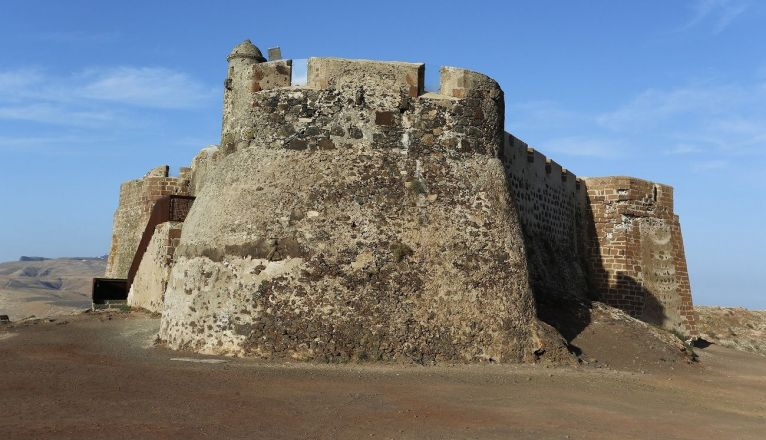
Guanapay Castle, also known as Santa Bárbara Castle, is the oldest in the Canary Islands, and stands on the crater of the volcano that bears its name.
Its strategic location, next to the Villa de Teguise, led Sancho de Herrera to order its construction in the 16th century, to watch the coasts on both sides of the island. Later, in 1571, Gaspar de Salcedo added the two towers that complete the rhomboidal plan of the fortress.
The castle was looted by pirates, and Argote de Molina decided to rebuild it in 1589. Improvement works continued afterwards by order of King Philip II, shaping the current state that is preserved. Among other things, they erected a new tower from which the view reached the sea.
The castle was also used as a shelter for the population and as a prison for prisoners, until in the 19th century, with the disappearance of pirate attacks, it lost its defensive utility. Since then it was a military dovecote until 1899 and a century later the Ethnographic Museum of the Canarian Emigrant. Currently it houses a Museum of Piracy, although since 2020 it has been closed for works.
Castillo de San Gabriel
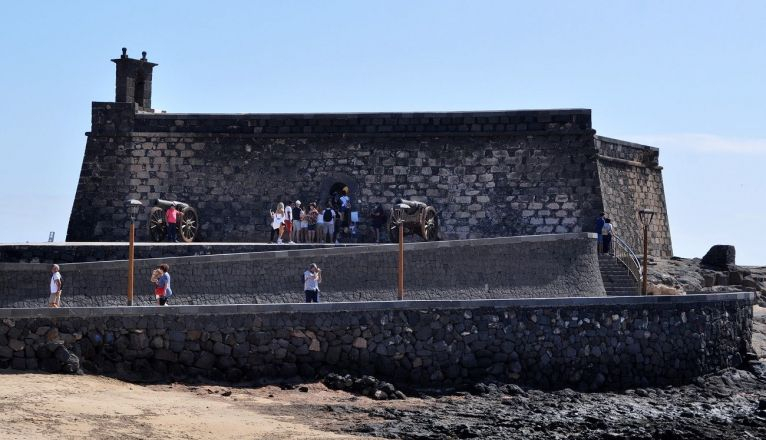
In the heart of Arrecife, located on one of its islets, is this emblematic castle, whose current appearance dates from the 18th century. Inside, it houses the Museum of History of Arrecife, where pieces from the ancient culture of the aborigines of Lanzarote, the majos, are preserved, as well as documents and models on the evolution of the capital.
Also built to defend the island from pirate attacks, today it is a must-see in Arrecife; and also one of its most characteristic images, along with the Las Bolas bridge that gives access to the fortress.
In 1586 it was burned after the attack by the pirate Morato Arráez, although it was later rebuilt by order of King Philip II, introducing some of the changes that have been preserved to this day. One of them, another access bridge provided with six cannons.
Castillo de Las Coloradas
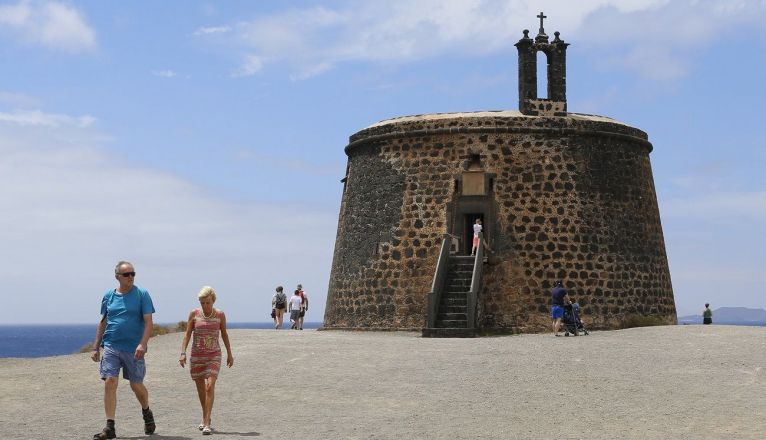
Also known as Torre del Águila, Castillo de las Coloradas is the only defensive construction that was erected in the southern area of Lanzarote, and also one of the best examples of military architecture in the Canary archipelago.
Built in 1741 to defend the island from the corsair attacks that ravaged the area, it had to be reformed in 1769, when it was destroyed by a fire caused by Algerian troops.
The building is circular in shape and a drawbridge closes its access. Inside, it housed a dormitory for the troops, three rooms, a storage room for gunpowder, a dungeon, and two cisterns.
That part cannot currently be visited, although there are projects to open it to the public by housing a museum.

Add La Voz de Lanzarote as a preferred Google source.
Stay informed with the latest current news.