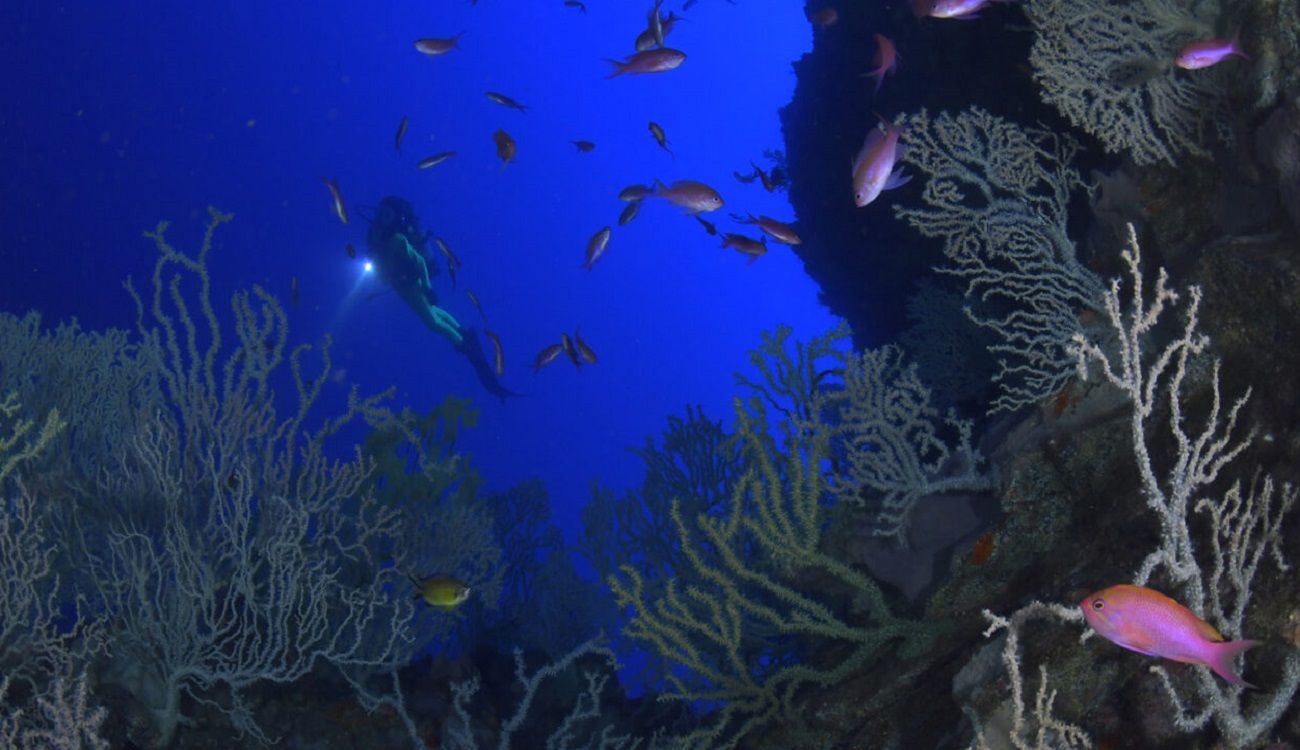
Lanzarote has perfect conditions for diving all year round, thanks to the numerous dives the island offers, but also to the microclimates that form, meaning the sea can be rough in Puerto del Carmen, but very good in Playa Blanca, just a few kilometers away.
Specifically, in Lanzarote you can do dives at 100 different spots for all levels, so few people can claim to know them all.
The island's potential is also reflected in the number of existing diving centers, a figure that exceeds fifty, as well as its rich marine fauna, with angel sharks, groupers, tuna, schools of horse mackerel, three-tailed damselfish, seahorses, stingrays, and even the occasional sunfish.
It is not an island that forces you into boat dives, which tend to be more expensive; many can be done from the coast, so there is diving for all budgets in Lanzarote.
1. Puerto del Carmen
In addition to being an area known for its constant tourism, Puerto del Carmen also stands out for having the spot with the most dives in all of Europe, the Playa Chica area. It is a diver's paradise.
The Playa Chica drop-off is the dive par excellence, both for beginners and experts, as it has an easy entry into the sea that you can even do walking, as well as a rich marine fauna.
This stretch has a gentle slope down to 50 meters deep and, thanks to its different platforms, several caves also form, such as the Cueva de Las Gambas. Likewise, for those divers with special certifications, they can descend to 50 meters deep to enjoy the black coral forest, of unparalleled beauty.
This explosion of life can also be observed in waikiki, in the Playa Grande area. This intermediate-level dive is very comfortable because you can descend along the sand to 18 or 20 meters, where one of the most superficial branches of orange coral in the archipelago grows.
However, for those who want to continue diving deeper, there is another drop-off at about 30 meters, with a small cave where numerous three-tailed damselfish are found.
And if what you like is wrecks, there are two well-preserved ones in front of the La Tiñosa pier and at the tip of Barranco del Quíquere. As they are not at great depths, they are good options for beginners and very entertaining. They are very romantic, you can always fantasize about the story of how they sank.
2. Playa Blanca
In Playa Blanca, the points with the most life in the area are the Las Coloradas wall, Playa Flamingo, or Punta Berrugo, dives that can be perfectly done by someone starting in this sport because they do not go below 20 meters.
Specifically, in Las Coloradas you will have the opportunity to see slipper lobsters, schools of sargos, groupers, and even turtles and barracudas, although it is important to mention that access is usually from a boat.
This also happens with the Punta Berrugo dive, where you can enter volcanic caves and enjoy a small sunken ship with the occasional moray eel.
Meanwhile, with the Playa Flamingo dive, it's like with Playa Chica, meaning it is an area for all levels, since you can also enter the water from the beach. It also does not have strong currents or other complications, and you can see angel sharks, schools of bogas, trumpetfish, and stingrays.
3. The North
For those looking for dives more focused on geology and who do not mind the absence of fauna, the perfect place to dive is in the area near Los Jameos del Agua.
If it is already a spectacular enclave on the surface, it is also replicated underwater, a very unique landscape that you will not see in other places.
4. La Graciosa
In La Graciosa, the eighth Canary Island, you will also find some dives that will leave you speechless.
One of the easiest is La Burrera, with a minimum depth of 18 meters, perfect for an Open Water, and a maximum depth of 25 meters, for more expert divers. Access is from a boat, and during the dive you can see schools of striped burritos.
If you are looking for a slightly more complicated adventure, you can go to the Las Anclas wall, with a rock face that crosses El Río. It should be noted that it is one of the few places that harbors a unique marine species, the black croaker, and where you will see numerous old anchors on the bottom.
Finally, advanced divers can embark on the Montaña Amarilla dive, with many caves, arches, and structures with giant anemones, bishops, and briotas.

Add La Voz de Lanzarote as a preferred Google source.
Stay informed with the latest current news.