
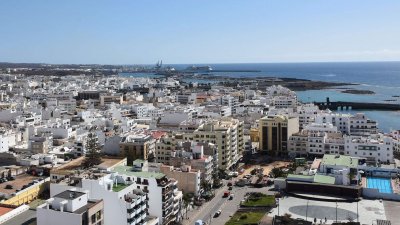
There was a day when Lanzarote began to change its capital. There was no ceremony. There were no grand speeches. There was no solemn proclamation. It happened on paper. It was September 26, 1847. That day, a Royal Order from Isabella II decreed the transfer to Puerto del Arrecife of the Court of First Instance of the judicial district of Lanzarote and Fuerteventura. The Court was previously in Teguise. The decision seemed administrative. Its consequences were much greater.
Teguise had been the political center of Lanzarote for centuries. The institutions were concentrated there. Power was located there. Its inland position had an explanation. The coast had been vulnerable to pirate and corsair attacks. The interior offered greater protection. But the 19th century was changing that reality. The sea began to signify wealth. The port began to signify power.
Arrecife grew around its port. Trade grew. Population grew. Communications grew. Institutions also grew. In 1792, the Muelle de las Cebollas had been built. In 1798, Arrecife obtained its municipality. The town had ceased to be a small port nucleus dependent on Teguise. It began to build its own administrative identity.
The change was progressive. It was also unstoppable. The port attracted goods. It attracted merchants. It attracted workers. It attracted population. Barrilla played an essential role. Other products would arrive later. Maritime traffic turned Arrecife into Lanzarote's great gateway to the outside world.
Institutions also began to move. The Royal Revenue Administration settled in Arrecife. So did the Accountant's Office. The Navy Adjutancy. The Military Government. Teguise, however, retained a decisive institution. The Court of First Instance.
And there began a battle that would last for years
In 1835, Arrecife began to formally request the transfer of the Court. The dispute was not minor. The Court made a town the head of the judicial district. It granted it administrative power. It gave it the capacity to attract the rest of the island. Arrecife wanted that power. Teguise wanted to keep it.
The residents of Arrecife even organized a collection. They wanted to finance the necessary steps with the authorities. The objective was clear. To achieve the transfer. The requests reached
Tenerife. They also reached Madrid.
Teguise reacted. It defended its historical position. It claimed its status as a Villa. It defended its administrative tradition. The conflict became a real struggle between two island models.
One looked inward. The other looked towards the sea. In 1836, new attempts were made to move the Court. Teguise's resistance was immediate. The issue continued for years. Arrecife kept growing. Teguise kept defending its position.
Then came 1847.
The economic situation clearly favored the port. Arrecife had reached an importance that made it increasingly difficult to maintain the old balance. Trade needed institutions. Merchants needed services. Communications favored the coast. Economic reality began to impose itself over tradition.
And September 26th arrived.
Isabel II approved the Royal Decree that ordered the transfer of the Court of First Instance to the Port of Arrecife. That decision changed the institutional balance of Lanzarote. The judicial headquarters began to shift. The center of power, too.
But the news had a peculiarity. The Royal Decree did not appear published in the main official organs of the time. It was not listed in the Gaceta de Madrid. Nor in the Official Bulletin of the Province of the Canary Islands. Knowledge of the resolution came through administrative channels. The historical change began almost in silence.
Teguise did not accept the decision. Its City Council reacted. It considered that the Villa was losing an essential part of its historical position. It demanded. It protested. It requested the restitution of the Court. The administrative battle continued.
Arrecife, meanwhile, moved forward.
The effective transfer of the Court did not occur exactly on September 26, 1847. Historical documentation places its materialization in 1848. It is an important detail. The date of 1847 marks the legal beginning of the process. The effective transfer came later.
In 1848, municipal documents from Arrecife already appear using a revealing expression. The Port was referred to as "capital of this Island of Lanzarote." The new reality began to become visible in documents as well.
Teguise continued to claim. It did not surrender. The dispute reached the Government again. In 1849 a new resolution confirmed that the capital of the district should remain in Puerto del Arrecife. The decision had a practical explanation. Its location offered advantages for most of the towns that made up the district.
The battle had ended.
There were no victors in a square. There were no troops. There were no flags. There were documents. There were petitions. There were appeals. There were administrative decisions. Arrecife had won the future.
Teguise did not disappear. It preserved its heritage. It preserved its history. It preserved its identity. But it lost the role it had played for centuries.
The change had a profound explanation. Power had followed trade. Trade had followed the port. And the port was in Arrecife.
The transformation continued over the following decades. Arrecife continued to grow. It continued to concentrate population. It continued to accumulate services. It continued to attract institutions.
In 1852 a new administrative reorganization of the Canary Islands took place. Some historical interpretations place the definitive consolidation of Arrecife as capital at that time. Other research considers that the administrative process had already begun in 1847 and was confirmed since 1849.
The difference in dates does not change the essential.
The capital status was not born from a single document. It was the result of a process. First came the port. Then came trade. The population grew. The institutions arrived. The Court arrived. And power ended up shifting.
Decades later came the definitive confirmation of the new status. In 1899 María Cristina granted Arrecife the title of city. Among the reasons were its status as judicial head and capital of the island. Also its maritime movement. Also its growth.
But it had all begun much earlier. It had begun on September 26, 1847. Teguise did not disappear that day. But Lanzarote began to change. The old center of power was inland. The new one was by the sea. Teguise represented the historical capital. Arrecife represented the new Lanzarote. A more commercial Lanzarote. More open. More connected to the outside. September 26, 1847. The date on which a Royal Order began to transfer the power of Lanzarote from Teguise to Arrecife.
It was not a military conquest.
It was an administrative conquest.
And it ended up changing the political map of the island forever.
Sources:
• José Manuel Clar Fernández, “Arrecife, capital de Lanzarote”.
• Agustín Millares Cantero, “Arrecife, el puerto de la barrilla”.
• Memoria de Lanzarote.
• Ayuntamiento de Arrecife.
• Archivo Histórico Municipal de Teguise.
• Documentación histórica sobre el partido judicial de Lanzarote y Fuerteventura.
• Gaceta de Madrid y Boletín Oficial de la Provincia de Canarias.
• Universidad de Las Palmas de Gran Canaria.



Add La Voz de Lanzarote as a preferred Google source.
Stay informed with the latest current news.