
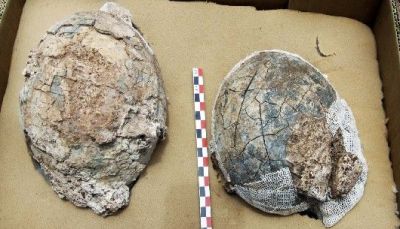
The team of researchers and specialists in paleontology, led by Antonio Sánchez Marco, an expert in fossil birds and doctor from the Catalan Institute of Paleontology 'Miguel Crusafont' of Barcelona, has found two new fossil eggs of ratites (a species that preceded the ostrich family that already, more than 90 million years ago, lost its ability to fly) in the deposits located north of Lanzarote, in the area known as Valle Grande, approximately one kilometer from the town of Órzola.
This team of paleontologists and specialists has been working on the island on the project "Birth of the continental Neogene of Órzola-Famara" since August 3, in which the Cabildo of Lanzarote has collaborated, through the Historical Heritage Service, once again promoting this paleontological survey and research together with the Catalan Institute of Paleontology and the Autonomous University of Madrid.
This is the third intervention carried out in this area of the north of the island, thus continuing the research campaigns carried out in 2010 and 2011 with the previous project, "Upper Miocene Sites of Órzola - Famara", in which important discoveries were made in the excavations.
First findings
In previous surveys, several hundred fragments of ratite, ophidian and turtle eggs were found. Among them, two whole and several fragmented ratite eggs, and a snake (boa) vertebra that is very possibly native to the area.
These past paleontological investigations were carried out in the northern areas of the Risco de Famara, in the areas known as Valle Chico, Valle Grande and Gusa, and in sediments from the Upper Miocene, so the age of the remains, according to the project director, "could reach a figure between 5.3 and 6 million years".
In this new 2012 research campaign, another two fossil eggs have been found, one practically whole and another more fragmented, which together with the previous ones found in the past 2011 excavations, will be transferred to the Institute of Paleontology of Barcelona to be studied, scanned and analyzed. The Project Director, Antonio Sánchez, does not rule out that some of those that have been found whole "even contain some fossilized embryo inside".
An unexplained mystery
The director of the paleontological project also confirmed that "the existence of the eggs could be dated between 5 and 6 million years" and that "there is no record anywhere else in the world of ostriches of this species (ratites) on islands that have emerged from the oceanic crust, as is the case of Lanzarote, except in large ones that have been part of a continent, such as Australia or New Zealand, which are configured from a process of drift from a continental part". Thus, Sánchez Marco specified that the mystery of the origin of these birds -characteristic of the African continent- "will remain in force until other remains of the same species are found that allow analyzing said evolution on the island".
He also explained that during the expeditions carried out in Lanzarote "the paleoclimatic and biogeographic processes surrounding the development of giant birds in conditions of insularity, the flora and other fauna that accompany them, have been studied through the findings of other fossils found", such as the eggs and fossils of turtles or the reptile column, also described by this researcher as "native to the island".
Visit to the site
The president of the Cabildo of Lanzarote, Pedro San Ginés, who went to the area this Thursday together with the Councilor for the Historical Heritage Area, Juan Antonio de la Hoz, the Councilor for Economy and Finance, Luis Arráez, and the head of the Heritage Service, María Antonia Perera, to visit the excavations of the Valle Grande site, and especially thanked the work carried out by the researchers and volunteers from the island who have been working hard these days in the excavations.
San Ginés highlighted that we are facing "a mystery that awakens an extraordinary international scientific interest and that connects with the very origin of the Canary Islands", since until now "no one has been able to explain how it is possible that birds whose eggs date back more than 5 and 6 million years and whose most immediate ancestors lost their ability to fly some 90 million years ago, could have arrived here, if the islands emerge -the oldest Fuerteventura and Lanzarote- some 20 million years ago".
In this campaign, in addition to the team of researchers and specialists transferred to the island and the technicians of the Cabildo of Lanzarote, resident volunteers and members of Senderismo Lanzarote have collaborated.


