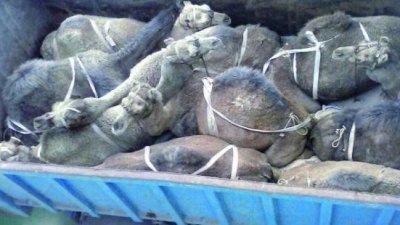
The transport of dromedaries in the Canary Islands must be carried out in accordance with specific regulations from December 31. This has been established by the Ministry of Agriculture, Livestock, Fisheries and Water of the Government of the Canary Islands, which has issued a circular adapting the current regulations, both national and European, to this species. The objective, according to this circular, is that the journeys are carried out "in the best possible way" as well as "minimizing the suffering and the possibility of injury" of these animals. Thus, it includes considerations such as that the vehicles that transport them carry separators to avoid overcrowding or that they can travel standing up.
The circular, published this Tuesday in the Official Gazette of the Canary Islands, explains that the legislation refers "fundamentally to animals of the most frequent productive and domestic species in the Community territory." Thus, it establishes a series of "instructions" to complement that legislation, and does so using "comparative parameters with the provisions for species of similar volume and weight", specifically equine and bovine animals.
On the one hand, the Ministry has established that the containers in which the dromedaries are transported must have a minimum surface area per adult animal of 1.75 square meters. Once the animals are in those containers, "duly authorized and registered", their caregivers must have access; and that access must have the "necessary security measures". In addition, for journeys lasting more than 12 hours, the animals must have water.
Vehicles with separators and prohibition of using mechanical means
On the other hand, the circular states that transport must have individual separators, "which allow the animals to travel raised and whose consistency does not endanger the stability and safety of the vehicle during transport and animal welfare is guaranteed."
The Ministry establishes as an exception that it will not be mandatory to transfer the animals with individual separators when the journeys are within the same island, last less than two hours and are linked to "shows such as parades". In these cases, the dromedaries may travel "adequately restrained, so as to prevent their incorporation" and taking "special care" with the means used to restrain them, "so that they do not cause wounds or injuries to the animals, as is the case with flat straps." The circular emphasizes that also in these cases it will be necessary to guarantee "at all times the welfare" of the animals.
In this same sense, with the new regulations of the regional Executive, the use of mechanical means for the animals to access the vehicle is "prohibited". The dromedaries will have to "access and descend" from it "on their own feet" or with "access ramps". As the only exception and "provided that it is duly justified", the circular indicates that "eventually" vehicles with a "multi lift" type hydraulic platform may be authorized. The use of these devices, which the circular itself indicates "are not specific for the transport of animals" will be "circumscribed" only to this species and will always be "prior authorization".
Animals that "respond with strangeness" to transport
The transport of dromedaries has generated recent controversies in Lanzarote. The Local Police of Santa Cruz de Tenerife fined two vehicles that were transporting camels from Lanzarote to participate in the Three Kings Parade of the city in 2015. The agents reported that the animals were traveling crowded and tied by the legs and neck, so they could not move and considered that these conditions could constitute animal abuse. As a result of that, the Association of Camel Breeders of Timanfaya came out in their defense, emphasizing that "in the transport of camels, for the safety of the animals themselves, it is not recommended to make them travel standing up, but lying down, and it is done by grouping them because they are animals that group together to rest and that is how they feel most comfortable".
In this sense, the circular of the Government of the Canary Islands also states that they are animals "fundamentally gregarious, who like and reassure the fact of being very close together", as well as that they usually "rest grouped together". However, it also points out that "they have enormously routine habits, so they respond with strangeness to any novelty, as is the case of occasional transport, and in many occasions the handling can be complicated in these circumstances." It also points out that its height makes "its center of gravity high, being convenient for security reasons that the walls of the containers in which they are transported exceed the height at the withers."
Add La Voz de Lanzarote as a preferred Google source.
Stay informed with the latest current news.