The Lanzarote Island Council has reported this Friday morning that the Government of the Canary Islands will withdraw the published maps where solar panel fields and wind turbines were projected on more than 3,100 hectares of the island.
Lanzarote was the first island in the Canary Islands to determine the Renewable Energy Acceleration Zones (ZAR). However, that initial agreement between the Lanzarote Island Council and the Ministry of Ecological Transition of the Government of the Canary Islands ended up generating a conflict between institutions.
The island institution has indicated that this withdrawal will allow "to continue advancing in the elaboration of a new proposal", which adapts to the landscape reality of Lanzarote.
The measure responds to the joint work developed during the last months between both administrations and opens "a new phase" in which the Island Council will transfer a proposal based on the energy model it wants to implement on the island. Among other proposals, the island institution has warned that protected rural land for agriculture will be excluded and public participation in the benefits derived from energy generation will be advocated.
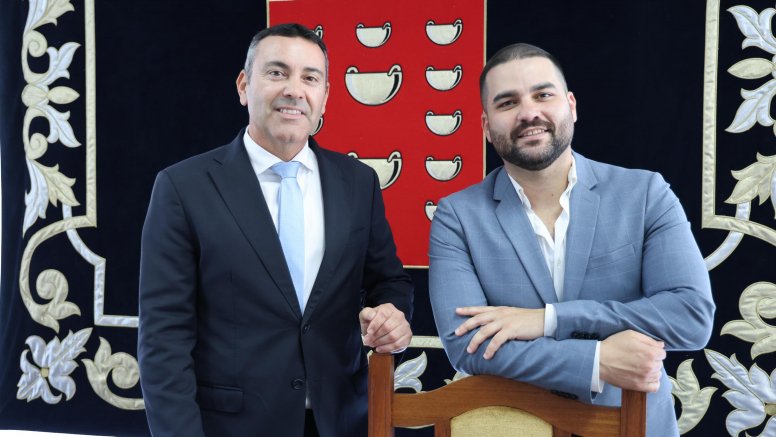
The president of the Lanzarote Island Council, Oswaldo Betancort (Coalición Canaria), positively valued the decision adopted by the regional Executive and thanked the sensitivity shown towards the approaches made from the island.
“I want to thank the Government of the Canary Islands for having listened to the demands made by the Lanzarote Island Council. The withdrawal of these maps allows us to correct a situation that caused concern and to move towards a proposal built from the knowledge of the territory, from technical rigor and from respect for the uniqueness of Lanzarote and La Graciosa”, Betancort pointed out.
Attack on the PSOE
Betancort took advantage of his speech to attack the main opposition party, the PSOE, and accused them of trying to "generate alarm" by using maps that "were never assumed by the Lanzarote Island Council and which have precisely been withdrawn for review". "The reality is that these documents do not respond to the model defended by this Institution", added Betancort.
Faced with this, the Deputy Minister of Transition of the Government of the Canary Islands, Julieta Schallenberg (PP), highlighted in statements to La Voz at the beginning of the year that those maps, which were published in the Official Gazette of the Canary Islands during the past summer, were agreed upon with the Cabildo, although they were published with a technical error, which was "rectifiable".
For months, the island's head of Territorial Policy, Jesús Machín Tavío (CC), refused to appoint two representatives of the institution to sit at the table with the Government of the Canary Islands and rectify those maps.
Currently, the Minister of Territorial Policy, Jesús Machín Tavío, has explained that the new proposal that the Cabildo will present will be based on territorial planning and landscape protection criteria. “We defend an orderly implementation of renewables, concentrated in degraded or transformed areas, excluding rural land with agricultural protection and preserving those areas of greatest territorial value,” he insisted.
The Cabildo has assured that the energy model it defends for Lanzarote "prioritizes the use of already intervened spaces, avoids the dispersion of facilities throughout the island and opts for active participation of the public sector so that the benefits generated by renewable energies revert to the citizens through the public company Eólica Lanzarote".
Rejection of the solar plant projected in Mácher
In this same line, the Cabildo de Lanzarote announces that it is preparing the corresponding institutional report on the photovoltaic plant projected in Mácher, which was also rejected this Thursday by the Tías City Council.
The island corporation clarifies that in this file "no declaration of public interest has been applied under article 6 bis", but rather that an report has only been requested from the affected administrations within the consultation process provided for in current regulations.
The Cabildo will convey an unfavorable position to the project, considering that "it does not conform to the energy and territorial model it defends for Lanzarote, based on the concentration of facilities in previously transformed areas, the preservation of the landscape and the exclusion of high-value agricultural land".
Machín has concluded that “the request for reports made by the Government of the Canary Islands is part of the ordinary administrative procedure and does not in any case constitute authorization for the project. The Cabildo is preparing its report and the position we will convey will be contrary to this installation because we understand that it does not fit the territorial model we defend for Lanzarote”.
Add La Voz de Lanzarote as a preferred Google source.
Stay informed with the latest current news.