
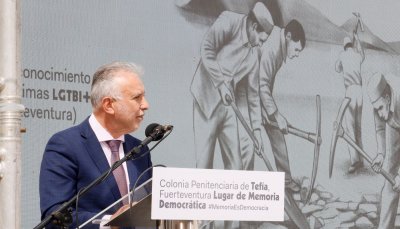
The Government of Spain has declared this Friday the former Agricultural Penitentiary Colony of Tefía, in Fuerteventura, as the first Democratic Memory Site of our country dedicated to the LGTBI+ collective.
This space, which, since this Friday, is already the first Place of Memory of the Canary Islands, housed a forced labor camp for homosexual and transsexual people during the dictatorship (between 1954 and 1966), through which dozens of inmates passed, who survived in subhuman conditions, of hunger, beatings and humiliations.
“Tefía was the symbol of the shame of a fascist regime, rotten with white heteropatriarchal supremacism, in a suffocating and prudish Spain where freedom could not sprout,” has pointed out the Minister of Territorial Policy and Democratic Memory, Ángel Víctor Torres, during the act held today in Tefía, in which he has delivered ten declarations of Recognition and Reparation to victims who passed through this center, as well as to people and collectives who have distinguished themselves in the struggle of the LGTBI+ movement.
Torres, who has been accompanied by the president of the Canary Islands, Fernando Clavijo; by the president of the Cabildo de Fuerteventura, Lola García; by the government delegate in the Canary Islands, Anselmo Pestana; and by the Secretary of State for Democratic Memory, Fernando Martínez, has stated that the Francoist regime “did not know what it was doing by trying to sow in the Canary Islands the seed of hatred for diversity”.
The minister has recalled that the LGTBI+ collective of the islands has historically been one of the most deeply rooted in the country. “Our Trans Law was approved unanimously by all political forces represented in the autonomous Parliament, by all of them,” Torres wanted to emphasize, who warned that, at that time, there was still no representation of the far-right in the Canarian Parliament.
During his speech, Ángel Víctor Torres, has highlighted the commitment of the people honored today. “Their stories, their lives, are our fuel, lives dedicated to expanding rights, exemplary and unrepeatable lives, who also helped us recover the democracy that was stolen from us overnight, by blood and fire”, he affirmed.
Furthermore, he has traced the path to the declaration of this “space for infamy” as a Place of Memory. The minister has explained that “as soon as he took office”, he was clear that the Canary Islands had to have their Places of Memory and that their victims should be recognized, because, “although there was no war front in the Islands, there were thousands of people detained, disappeared or murdered”.
After Tefía, the next Place of Memory of the Canary Islands, with a file already initiated, will be the Masonic Temple of Tenerife, which will join the 37 that have already been declared or initiated throughout Spanish territory.
The minister has made a call to defend democracy from those who want to undermine it, especially, to “tell young people what happened.” Torres has recognized that it is “an evidence” that “involutionary postulates are taking hold” and that “they spread like wildfire” on social media. “We cannot allow it to happen again; being born free is not a guarantee of dying free,” he has said.
The event was presented by journalists Lluis Guilera and Fátima Hernández, and featured a debate panel, moderated by Celeste González and composed of Víctor Ramírez (historian and LGTBI+ activist), Gracia Trujillo (LGTBI+ activist and professor at the Universidad Complutense) and Miguel A. Fernández (LGTBI+ activist from the Fundación Pedro Zerolo). In addition, the event featured musical performances by Julia Rodríguez and Pasión Vega.


