
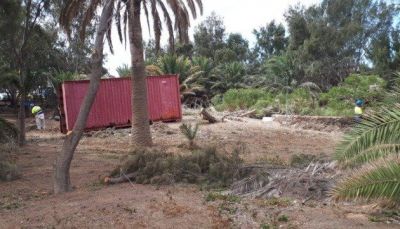
The environmental association SEO/BirdLife has filed a complaint with the Civil Guard for the "destruction" of a protected bird colony in Arrecife, with a felling of trees that it claims has been carried out by the public company Tragsa on behalf of the Cabildo of Lanzarote.
The association warns that the events may constitute a crime and that the Penal Code contemplates penalties of six months to two years in prison or a fine of eight to twenty-four months for the destruction of protected species of wild fauna or for having prevented or hindered their reproduction. And in this case, it affirms that "the birds were still breeding, and it has been verified that among the felled trees there were nests that were occupied".
"The destruction of this colony falls fully within this type of crime, since the felling of the trees and the consequent destruction of the nests, their eggs and/or chicks have caused the destruction and disturbance of the cattle egret or the little egret, two species protected by law", says Juan Antonio Lorenzo, technician of SEO/BirdLife in the Canary Islands, who specifies that it was the "only colony of these species in the Canary Islands".
They also denounce the lack of maintenance of that park
In a statement, SEO/BirdLife explains that they became aware of the events thanks to citizen collaboration, through one of its members, who this Tuesday "was able to document the destruction of the colony of these birds". With this data, the organization has filed a complaint with the Civil Guard "so that the destruction work is suspended and, at the same time, the appropriate investigations are carried out and the facts are clarified, as well as to determine the corresponding responsibilities".
The association also denounces that the Arrecife heron colony "has worsened over the years due to the lack of cleaning measures by the Cabildo of Lanzarote and the City Council of Arrecife". "Specific and regular actions every year, both cleaning and maintenance of the area where the colony is located, carried out always in periods that did not coincide with the nesting of the birds, would have avoided this current situation of dirt and bad smell", says Juan Antonio Lorenzo.
In addition, he insists that "it is the only colony of herons in the Canary archipelago" and regrets that "instead of becoming an attraction for nature tourism and an important resource for developing environmental education work, it has suffered abandonment and neglect by the authorities with powers in its maintenance, reaching the current situation".
An action very far from what had been agreed with the Cabildo
SEO/BirdLife also recalls that on June 11, the Cabildo organized a technical meeting to address the situation of the cattle egret on the island, and in particular its population increase in recent years and the state of the Arrecife colony. In the meeting, he explains that technicians from the CSIC, the Government of the Canary Islands and SEO/BirdLife participated, as well as farmers and hoteliers who stated that they suffered damage from the increase in herons.
"Among the conclusions of the meeting, the need to reduce the supply of food to the herons, gulls and pigeons in the Zonzamas landfill became clear, so that their numbers would be reduced naturally and proportionally in the same way that they have been growing over the years. In addition, it was agreed to initiate cleaning and adaptation measures for the colony, but none of them contemplated the felling of entire trees in the main part of the breeding colony, much less when the birds were nesting, with eggs and chicks", the association emphasizes.
Protected species
The cattle egret and the little egret are included in the List of Wild Species under Special Protection Regime (LSRPE) created by Law 42/2007, of December 13, on Natural Heritage and Biodiversity (art. 56) and regulated by Royal Decree 139/2011, of February 4, for the development of the List of Wild Species under Special Protection Regime and the Spanish Catalog of Threatened Species.
In addition, both the cattle egret and the little egret are protected by Directive 2009/147/EC of the European Parliament and of the Council of 30 November 2009 on the conservation of wild birds. Likewise, at the international level, the Convention on the Conservation of European Wildlife and Natural Habitats (Bern Convention), which entered into force in general on June 1, 1982, protects these species.
SEO/BirdLife states that once the facts have been clarified, the damage caused must be repaired, which in this case is especially necessary since it is the only colony of these species in the Canary Islands, so the entire breeding population of both species has been affected.


