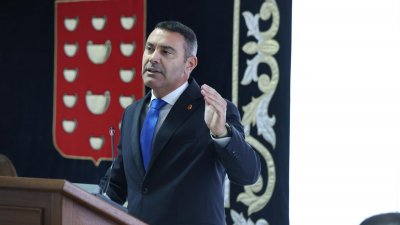
The president of the Cabildo of Lanzarote, Oswaldo Betancort, has opened the State of the Island Debate 2025, an annual accountability exercise that is being held this Tuesday and Wednesday in the plenary hall, in which he claimed that the current governing group has spearheaded "the most decisive two and a half years of island policy in recent times".
Before the councilors, Betancort has underlined how Coalición Canaria and Partido Popular, along with the support of councilor Armando Santana, have demonstrated that "political colors take a backseat when the general interest prevails," and has especially thanked the work of Vice President María Jesús Tovar, "decisive in ensuring the economic solidity and rigor of the Cabildo."
The island president emphasized some of the many investments executed and mobilized in just two and a half years, an activity in management that constitutes "the greatest investment and management effort in the recent history of the Cabildo, and which today the Institution already shows visible results".
He was referring to the Tahíche Elderly Residence, finally unblocked, with works underway and more than 16 million euros invested; to the Cáritas Integral Center in Altavista, the island's most ambitious social project, with 10 million financed entirely by the Cabildo; to the Tinache Reservoir (+6 million), the San Bartolomé Wind Farm (+12 million), the new Zonzamas composting plant (7 million), the portable desalination plant for agricultural irrigation, the El Golfo sanitation project, or the reopening of the island's slaughterhouse, among other interventions launched under his decisive presidency.
"These projects are just proof that we are transforming Lanzarote and La Graciosa with actions, not words," he said
Hydraulic impulse and unlocking planning
One of the central pillars of the intervention was the integral water cycle, described by the president as "a historic priority." Betancort announced that 65 million euros have already been mobilized for key infrastructure – under construction, completed, or under contract – and asserted that "in this term, what should have been done in the previous legislature and was not, has been done." He also recalled that Lanzarote was a pioneer in desalination in 1964, and stated that today it is laying the groundwork to have, "in the medium term, the best integral water cycle system in the world."
Likewise, the president pointed out during his speech that upon taking office, "nothing had been done," and specifically regarding territorial planning, that more than 600,000 euros had been "thrown away" from the well-known Ezquiaga plan.
Faced with this, he listed "historic advances" in the matter such as the activation of each and every one of the island planning tools. He announced the environmental validation - this very Tuesday - of the scope document for the Special Plan of La Geria; he recalled the advanced stage of the PRUG of the Chinijo Archipelago; he clarified that island energy planning is underway; and he expressed his "satisfaction," as the new Insular Territorial Planning Plan (PIOT) has overcome the public exhibition phase and will have its scope document before the end of the year
The island leader emphasized that "the new preliminary PIOT document protects 60% of the territory, triples agricultural land, and eliminates over 100,000 square meters of tourist use in Playa Blanca." He also highlighted that 2,100 tourist beds with expired licenses have been removed and that the Cabildo of Lanzarote "has been the first in the Canary Islands to initiate inspections of vacation homes, detecting 150 irregular ones to date that can no longer operate in the market."
A model that prioritizes quality over quantity
On the other hand, the president emphasized that Lanzarote "once again stands out for the intense work being done to consolidate a sustainable and quality tourism model, highlighting that while tourist spending per person per day, €196.27, breaks a historic record and leads the Canary Islands, it is at the same time the island that best contains tourist arrival growth, with a 1.9% increase in the first months of 2025, below the rest of the islands.""The aim is to generate wealth in balance with the population's quality of life and respect for our identity, also through tools such as the Awareness Strategy for Ethical and Responsible Tourism, currently underway," he assured
This set of actions configures what he called the "Lanzarote Model": a "fact-based sustainable" model, internationally validated by the recent recognition from the FAO, which declared Lanzarote a World Agricultural Heritage Site (GIAHS)
Real protection for a unique place
The first day of the State of the Island Debate has served for Betancort to highlight how the public managers of the Lanzarote Biosphere Reserve have moved from "empty speeches" to concrete actions: environmental educators, access control, shuttle buses in sensitive enclaves, and the tender for the new integral transport, surveillance, and maintenance system in the Los Volcanes Natural Park.
In addition, he announced **new firm actions against illegal activities such as buggy routes** in protected areas, just after the recent sanction imposed in Los Ajaches became known yesterday
The Island of Care
On the other hand, the president described the change in social policies as a "radical transformation." After years "without dialogue with the third sector," the Cabildo has recovered collaboration and consolidated 35 million euros for social concertation (2024–2029), another 50 million annually in social spending for agreements and projects that assist thousands of people, the new Insular Council for the Elderly, and an Accessibility and Inclusion Strategy that is already a regional benchmark. "We are building the Island of Care from the ground up," he stated
Combating the "inaction" of the central government
Betancort also addressed how the Cabildo, although it does not have direct housing responsibilities, has indeed made "the greatest island effort in recent years," referring to the more than 15 million euros allocated to housing: 14 million aimed at the purchase of three plots in Arrecife and Uga, as well as another 42 homes in Playa Blanca, which will be designated for affordable rent after an agreement with ICAVI. These initiatives are currently in the administrative process of transfer to the Executive. He also mentioned the 1.4 million allocated to the Youth Rent Bonus, being the first Cabildo in the Canary Islands to co-finance it
He attributed the current housing crisis to "the State Housing Law" and defended the new regulation of tourist rentals approved by the Parliament of the Canary Islands as "a necessary step to balance the market".He also detailed health advances promoted by the Canary Islands Government: the incorporation of the Da Vinci surgical robot at Molina Orosa (1.7 million); the reduction of the surgical waiting list from 100 to 61 days; the reinforcement with 90 specialists; or the launch of the Radiotherapy Unit, Hemodynamics Unit, and Early Intervention, among other projects executed during the first half of the termIn terms of immigration, he questioned the central government's non-compliance, especially the absence of the SIVE platform announced in 2015.Betancort also addressed the loss of purchasing power for families, the 40% tax burden according to the OECD, and the situation of the island's 12,000 self-employed individuals who face future increases in their contributions.
Employment and direct support for citizens' wallets
In a detailed analysis of the socioeconomic situation of Lanzarote and La Graciosa, the president of the Cabildo has detailed the reinforcements carried out in specific public policies, with several key measures such as the 1.5 million euros annually dedicated to municipal employment plans; the "Caring for Lanzarote and La Graciosa" program, for 13 million euros, which employs 150 people and strengthens the maintenance of all municipalities; the Consume Lanzarote 2025 campaign, with almost 13,000 vouchers mobilizing 800,000 euros in local businesses; or the incorporation of 20 new hybrid buses and the expansion of strategic routes that, together with the free service, strengthen island public transport, among other actions deployed during the current term
Finally, Oswaldo Betancort called for the public debate to focus on the "real problems" of citizens and not on "smokescreens," appealing for responsibility and foresight. He highlighted the fact that he was appearing "to be held accountable," presenting a balance sheet based on "facts, data, and work," and reiterated that the Cabildo is doing "what should have been done a long time ago."

Add La Voz de Lanzarote as a preferred Google source.
Stay informed with the latest current news.