
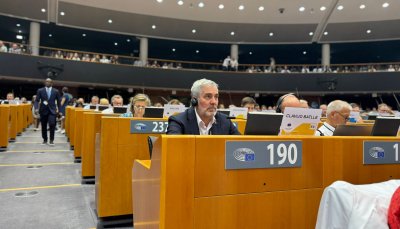
The President of the Government of the Canary Islands, Fernando Clavijo, has requested this Wednesday to the European Commissioner for Sustainable Transport and Tourism, Apostolos Tzitzikostas, to maintain beyond 2030 the exemption of emission taxes to air and sea transport between the islands and with the peninsula. This exemption was achieved in 2022 within the framework of the negotiations of the European climate package to reduce CO2 emissions, but it is not guaranteed that it will be maintained beyond 2030.
Clavijo has described the meeting held in Brussels as "very positive". In addition, he has informed Tzitzikostas of the "absolute dependence" of the Canary Islands on air and sea connectivity due to its condition as a territory far from the continent and fragmented. Given this specificity and as an outermost region, he considers it "essential that the archipelago has guaranteed in the medium and long term a specific treatment in the application of the ETS system, at least for transport between islands and with their respective States".
The Commissioner for Sustainable Transport guaranteed the Canarian President his support for this extension of the exemption after 2030. According to the head of the Canarian Government, the high-ranking EU official "understands and supports" the situation of the Canary Islands, so both have agreed on the exchange of technical documentation. In addition, Tzitzikostas has received with "much affection" Clavijo's invitation to visit the islands to learn first-hand about their "absolute" dependence on air and sea connectivity.
However, the Canary Islands wants to go further. Fernando Clavijo has also demanded a global "rigorous and realistic" review of the impact that emission taxes are having on the outermost regions, which the EU has been applying since January 1, 2024. The Commissioner was willing to specifically assess the situation of the nine ORs covered by Article 349 of the European Treaty. The objective is also to achieve an exemption in the application of the ETS to air and sea connections with the entire European territory, not only with the peninsula and between islands.
Clavijo reminded the European Commissioner that "the remoteness and insularity of the Canary Islands means that the ETS increases the mobility of citizens and the supply of goods, which slows down the economic convergence of the islands with the continental territory." In particular, he referred to the increase in air tickets and argued that "the emissions from flights to the ORs represent a marginal fraction of the EU total, so a general exception would have a reduced environmental effect."
Likewise, the head of the Canarian Government explained to the European Commissioner that this system is causing "a collateral effect" and implies "the loss of competitiveness of the archipelago's ports." According to the Government in a statement, "the application of emission taxes since 2024 has motivated the deviation of maritime routes to extra-community enclaves in North Africa to avoid costs, putting at risk the strategic role of the Canarian ports, threatening the regular supply and increasing freight and imports."
Clavijo reminded Tzitzikostas that currently sea routes to third countries close to the EU are subject to 50% of emission taxes, while between the Canary Islands and other Member States (except within Spain) they pay 100%. This difference "has distorted the competition of the Canarian ports, so the Canary Islands asks Brussels to consider for the ORs a treatment equivalent to that of third countries in terms of maritime ETS, delivering rights equivalent to 50% of emissions."
Financing for trains
The head of the Canarian Government has also taken advantage of the meeting with the highest responsible for European transport policy to request funding, through the Connecting Europe Facility, for the railway projects that are already underway in Gran Canaria and Tenerife.
Accompanied by the Deputy Minister of the President's Office, Octavio Caraballo, Clavijo explained to Tzitzikostas that trains are a strategic commitment of the archipelago to achieve more sustainable mobility that will contribute to the decarbonization of the most populated islands and to the reduction of urban congestion, thus aligning with the objectives set by the European Green Pact. To accelerate these projects, the Canary Islands needs to have economic resources from the EU, in addition to those provided by the State, the Autonomous Government and the respective island councils.
The estimated cost of the Gran Canaria train amounts to 1,492 million euros, funds thanks to which Las Palmas de Gran Canaria would be connected with Maspalomas, covering about 58 kilometers with 11 intermediate stations. The Cabildo de Gran Canaria has already allocated 16.6 million euros to finance the expropriation of land necessary for the layout.
In Tenerife, the project is valued at approximately 2,500 million euros, which would serve to unite Santa Cruz de Tenerife with Adeje by rail, crossing key areas of the south of the island. It is in an advanced planning phase, with the first phase prioritized and pending the signing of a multi-year financing protocol with the Ministry of Transport.
Sustainable tourism
The president has also taken advantage of the meeting with the European Commissioner to inform him first-hand about the Responsible Islands initiative promoted by the Government of the Canary Islands to move towards a more sustainable tourism model. The project already has the support of the Islands Commission of the European Committee of the Regions (CoR) and is now seeking the support of the European Parliament and the European Commission to guarantee its financing in the new budgetary framework of the EU 2028-2033.
Clavijo asked Tzitzikostas for his support for a global strategy by the European Executive that takes into account the specificities of "the most stressed tourist areas and their impact on the quality of life of their citizens, especially in the islands and the ORs, which are the most vulnerable territories."
The Responsible Islands project defends a regenerative tourism approach, "promoting initiatives that allow tourism to actively contribute to the restoration of natural and cultural ecosystems." It also calls for support for the diversification of the tourism offer, promoting high value-added products linked to local culture, nature, science and lifestyle (astrotourism, ecotourism, gastronomy, wellness, knowledge tourism).
The head of the Government has also defended the commitment of the Canary Islands to sustainable tourism within the framework of the CoR assembly, a meeting also attended by the Commissioner for Transport and Tourism. His second day of work in Brussels also included attendance at the debate on water resilience with the Commissioner for the Environment, Water Resilience and Circular Economy, Jessika Roswall.
Previously, Fernando Clavijo participated in a meeting of the Renew Europe Political Group and in the family photo of the Spanish delegation displaced to the meeting of the assembly of the European Committee of the Regions.


