
In 2008, the Canary Islands was the third autonomous community with the highest number of women's deaths from homicide related to gender violence per million women, with 5.7 percent, only behind La Rioja with a rate of 14.8 and Murcia (6.8).
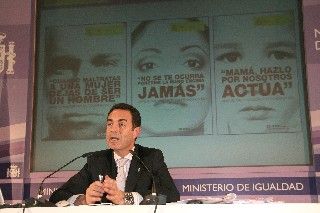
It is followed by Castilla y León (5.3), Galicia (4.7), Navarra (3.8), Valencia (3.7), Basque Country and Catalonia (3.1), Andalusia (2.6), Castilla-La Mancha (2.3), Balearic Islands (2.2), Asturias (2) and Aragon (1.7), according to the Government Delegate for Gender Violence, Miguel Lorente, who presented this Monday, at the headquarters of the Ministry of Equality, the balance of complaints and homicides due to sexist violence registered in 2008 and has reported on the calls received during the past year on the toll-free telephone line for victims 016.
By autonomous communities, the highest number of homicides due to gender violence is registered in Madrid with 11 women dead, followed by Catalonia (10), Andalusia (9), Valencian Community (8), Castilla y León and Galicia (with 6), Canary Islands (5), Murcia (4), Basque Country (3), La Rioja and Castilla-La Mancha (2) and Balearic Islands, Navarra, Asturias, Aragon, with one deceased due to gender violence. In 2008, no woman lost her life due to gender violence in Cantabria, Extremadura and the autonomous cities of Ceuta and Melilla.
Regarding homicides, in 2008, 70 women have been murdered by their partners or ex-partners, which is one case less than in 2007. In 16 of these 70 homicides, a prior complaint had been filed, while in the other 54 the victim had not filed a complaint. The number of deaths with prior complaints, requests for protection orders, protection orders in force and risk minimization factors has decreased for the third consecutive year since the entry into force of the Comprehensive Law against Gender Violence.
Thus, the percentage of cases in which there was a prior complaint has gone from 33.8 percent in 2006 to 22.9 percent last year, while in the same period, homicides in cases in which there was a request for a protection order has gone from 32.4 to 20 percent; in those in which there was a protection order in force from 23.5 to 14.3 percent, and in those in which there were risk minimization factors, from 10.3 to 2.9 percent.
It is also significant the decrease in the average of women killed by gender violence before and after the entry into force of the Comprehensive Law, the difference being, analyzing the period 2003-2008, of five points, going from 71.5 homicides on average before the Law to 66.5 after its entry into force.
Regarding the number of complaints for gender violence in 2008, the upward trend registered quarter by quarter since the beginning of 2007 continues. Thus, in the first nine months of last year, 108,261 complaints were filed, which represents an increase of 15.9 percent compared to the period January-September 2007, and that around 400 women a day decided to break with violence and trust the institutions to recover their lives.
Regarding the origin of the complaints, the vast majority (75.6 percent) were filed directly by the victim, followed by reports for direct intervention (12), the injury report (11) and the complaints filed by relatives (1.4 percent). However, it is this section, that of complaints filed by relatives, which grows the most compared to the first nine months of 2007, with an increase of 116.4%.
Regarding the rate of homicides per ten thousand complaints, there has been a decrease from 5.6 percent in 2007 to 4.6 in 2008.
Regarding the balance of the number of calls to the toll-free telephone line for victims 016, the data reflect that in 2008 74,951 calls were received, with Mondays, Tuesdays and Wednesdays being the days with the highest number of calls.
By autonomous communities, the largest volume of calls to 016 is registered in Madrid with 22,521 calls, followed by Andalusia (14,772), Catalonia (12,105) and the Valencian community (9,244). On the contrary, Ceuta, with 162 calls, Melilla, with 225, Navarra (883) and Cantabria (1,117) were the Communities and Autonomous Cities from where a smaller number were received.
Regarding the profile of the women who called 016 during 2008, 68.7 percent were in a cohabitation regime, 90.6% with dependent children, and with a level of studies that in 65.2 percent of the cases were university and middle, with 51.6 percent being working women.
And regarding the nationality of the women who used the telephone of the Ministry of Equality and their aggressors, in the case of the victims, they were Spanish in 75.2 percent of the cases, followed by 17.8 percent of Latin Americans, 5 percent of other European countries and 1.7 percent African.
Regarding the aggressors, 75 percent were Spanish, 14.1 percent Latin American, 6.4 percent from other European countries and 3.9 percent African.
ACN Press


