
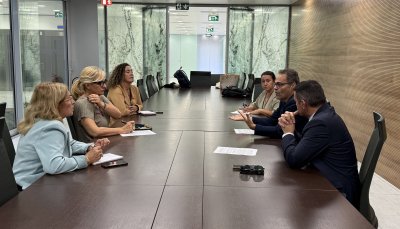
The Association of Patients and Users of Healthcare and Social Healthcare of the Canary Islands (APUSAS) held an institutional meeting this Tuesday, October 28, with the president of the Cabildo of Lanzarote and parliamentarian of the Canarian Nationalist Group, Oswaldo Betancort, the Minister of Health of the Government of the Canary Islands, Esther Monzón, and the general director of Assistance Programs of the Canarian Health Service (SCS), Antonia María Pérez, to analyze the health situation of the island and present proposals aimed at improving care for citizens. The meeting, led by the president of APUSAS, Fidel Ascensión Duarte, took place in a climate of collaboration and active listening.
During the meeting, the association insisted on "the need to advance in the humanization of the healthcare system, highlighting the urgency of establishing preferential circuits for cancer patients that allow for streamlining diagnoses, complementary tests, and interventions, avoiding delays that generate anguish and clinical risk." Likewise, attention to people with Diabetes Mellitus was addressed, as well as the importance of facilitating the early dispensing of continuous glucose monitoring sensors for higher-risk profiles, a tool that improves metabolic control and reduces complications.
APUSAS also conveyed its "concern about the operation of non-urgent healthcare transport, whose current operation causes delays and mobility difficulties for chronic or dependent patients." The entity also expressed the need to reduce waiting times for a second medical opinion, indicating that it cannot be delayed up to six months in processes of high diagnostic suspicion or oncological pathology.
The president of APUSAS, Fidel Ascensión, expressed his gratitude for "the willingness to open real spaces for dialogue," stating that "the goal is to build a more humane, efficient, and accessible assistance, where the patient's voice is heard and translates into decisions."
For his part, the president of the Cabildo of Lanzarote and regional deputy, Oswaldo Betancort, pledged to convey the demands to the Parliament of the Canary Islands and the competent administrations, stressing that "it is necessary to strengthen the channels of participation and ensure that citizens are represented in the bodies in which public services are designed and evaluated." He also positively assessed the association's contributions and noted that "patient associations are a fundamental voice to continue moving towards a healthcare system that is closer, more sensitive, and adapted to the needs of the people."
Likewise, the Minister of Health, Esther Monzón, highlighted that "listening firsthand to their proposals and experiences allows us to identify areas for improvement and reinforce our commitment to a more accessible and humane public health system." She also expressed her willingness to analyze the technical requests presented and advance in mechanisms that expedite healthcare circuits and improve coordination with hospital and primary care services.
Another point raised was the importance of strengthening communication channels between the Directorate of the Canary Islands Health Service and patient organizations, in order to refer priority cases quickly and effectively. The association also recalled that it has not been summoned to the Lanzarote Health Area Council or the hospital participation committee for more than three years, which are fundamental bodies for conveying the clinical and social reality of users.
APUSAS will continue to hold institutional meetings to "advance a comprehensive improvement in healthcare in Lanzarote, putting the patient at the center of the system and working in a coordinated manner with all the administrations involved."


