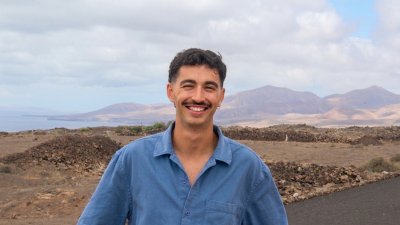
The film industry has experienced an exponential boom in the Canary Islands in recent years. The filming of series, films, and brand advertisements has turned the archipelago into a natural set where filmmakers like the Lanzaroteño Néstor Garmar (Tías, 2001) have managed to find a way to make a living without being forced to leave the islands.
Néstor García's (his real name) passion for cinema can be said to be in his blood. With a family full of artists, he says that he loved writing and telling stories since he was little. "I remember that on my father's old computer I had some written books where I had a jumble of all the stories I had read in books and movies," he recalls. However, it wasn't until the summer he turned 13 when he was with his cousins at home and decided to grab a camera he had to make an improvised short film.
"We told a story without a script, and it wasn't until the following school year, when I was in 2nd year of ESO, that a Cabildo project called Olivina came to the institute, which consisted of doing projects with students and making short films. That's when I discovered my favorite way of telling stories and that it could be a profession," he explains. For the Lanzaroteño, Olivina "was a great success by the institutions, and I would love for it to continue because you don't know all the stories that go untold because today's children don't find this way of telling them that they are passionate about."
When he had in mind to study Film Direction and Production, García had the support of his family and friends, although he admits that there was a teacher who told him to study something else that had more prospects. "I've always felt that if there's something you truly like and you don't stop until you achieve it, in the end, you'll end up being able to dedicate yourself to it," he points out. In fact, he remembers that on the first day at film school in Madrid, a professor told them that "if we had a plan B, we should leave."
"Over time, I've realized that he was completely right because it's a very beautiful job, but it's very sacrificed and hard at times, and if you have a plan B, it's better to do it," he continues.
The importance of contacts in cinema
Before entering the race, García was clear that the most important thing was going to be having contacts in the film industry. "These are the teams that you can put together in the future or that you can belong to, and that is the most important thing," he says. However, he emphasizes the learning from the degree because "it is very practical and you are practically two-thirds of the year from shoot to shoot."
His first steps as a film director and producer are divided into two parts: in his job and in his creative work in his free time. "When I'm not working, I'm in the library or in any closed place writing and developing my stories and my projects," he reveals.
Now, in Lanzarote, his work focuses on the production department, where "I enjoy it a lot, you meet really cool people and you also learn a lot." In addition, he is also part of the Lanzarote Film Festival, in coordination tasks.
Making the leap from the "jungle" of Madrid to Lanzarote
After finishing his studies, the Lanzarote native moved around different places in Madrid trying to work in the film industry, but this became complicated. "Madrid is a jungle and everything is wilder there," he comments. Furthermore, he believes that this makes the labor situation in the Spanish capital "more precarious because there will always be someone who will do the job for less money."
In fact, he recalls that during his job search, he only found unpaid jobs. "The first time I had a 'serious' job was on an English series for Paramount in Gran Canaria as a production assistant," he indicates, something that was his entry into the film industry on the islands.
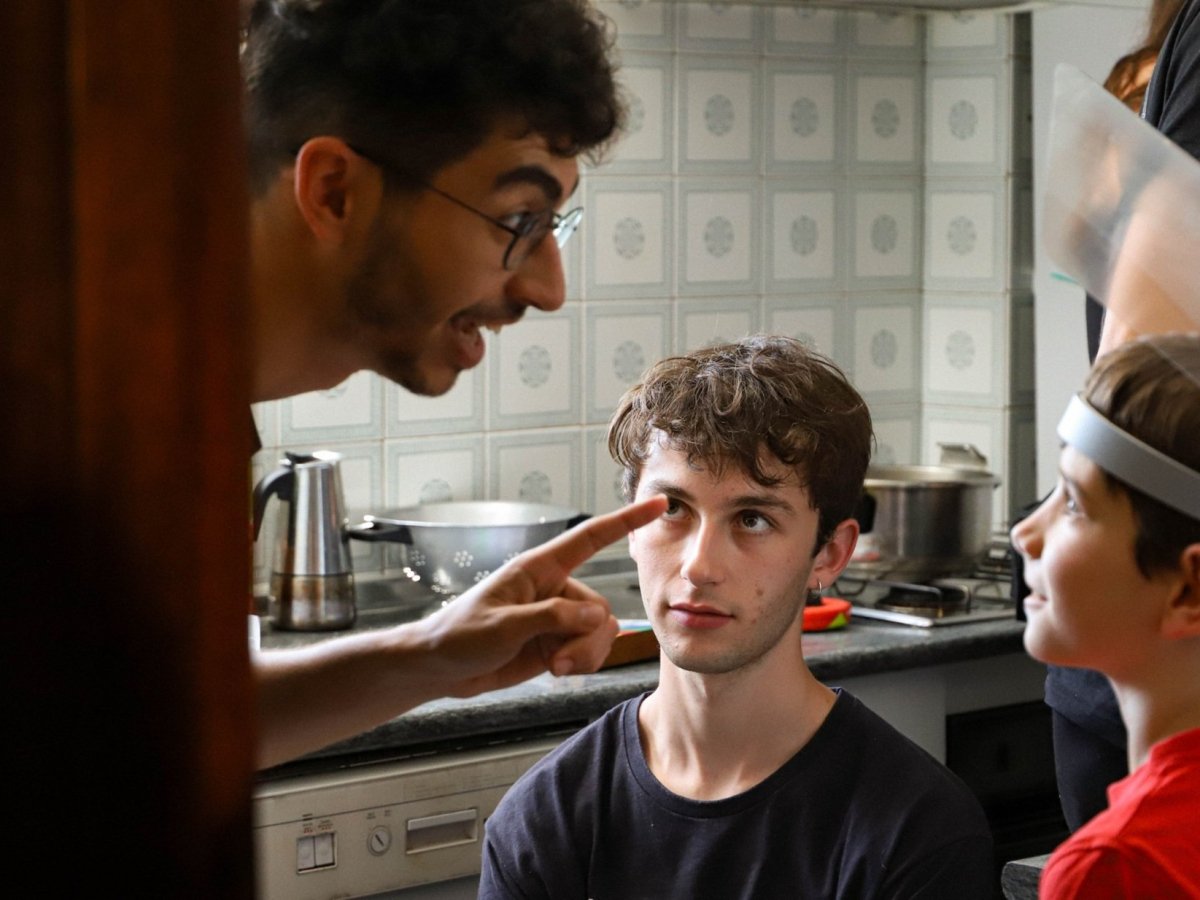
During that summer, he decided to attend a course organized by the Film Festival, where he met its members and began to immerse himself among lights, cameras, and scripts.
"Here in Lanzarote, what I have worked on the most has been advertising, especially in fashion commercials and shooting (photo sessions), and I have been able to work less in fiction on the island because not as many films come as advertising, but I was in Amarga Navidad, by Pedro Almodóvar, which for me was a dream come true," he highlights.
For the young filmmaker, working side-by-side with Almodóvar was unforgettable. "I don't think there's a day that goes by that I don't remember that project because I met many wonderful people, the whole team was lovely, and the dynamics were very healthy," he points out. Furthermore, he had the opportunity to speak with the film director. "It has been one of the most beautiful things that has happened to me and it is one of the things I have already accomplished, with which I feel fulfilled," he acknowledges.
One of the funniest anecdotes that Néstor Garmar remembers is having danced with the production team to the song Por medio peso, by Pepe Benavente, at the wrap party. "The team from the peninsula also found it strange that during lunch breaks there were fish sandwiches," he says, laughing.
Success of the Canary Islands as a natural set, but lack of opportunities
The boom in cinema in the islands is not accidental. The varied and different landscapes of each of them, the good climate, and the tax incentives that allow producers to reduce costs are some of the advantages that are causing the Canary Islands to experience an increase in the film industry.
However, despite the growth of this industry in the archipelago, Néstor Garmar emphasizes that there is still a lack of support for Canary Islanders in this field. "I am always surrounded by local colleagues from here who have a lot of talent and we are not always given the opportunities we often deserve," he opines.
"Many times I feel that, on many occasions, we are just pawns and I would like us to have more relevance because it is very sad to see people who you know are artists who do equally dignified work, but who could contribute a lot to stories and fiction," he continues.
This Canarian presence is not only about the islanders' contribution to the plot, but also about stories originating from the Canary Islands. "I would love to see more stories that originate from the Canary Islands with Canarian creators and characters, that are genuinely Canarian stories, but for that, more institutional support is needed," he declares.
The islands are becoming a breeding ground for professionals in the world of cinema, something that can be felt in the younger generation. "There is a lot of potential and talent, but also a lot of competition, professionalism, and discipline. We are very prepared to tell stories from here, with people from the islands and for everyone," he assures.
Despite the obstacles, many of these young people are betting on staying and working in cinema from the archipelago and rejecting the idea of having to leave the islands to live in cities like Madrid or Barcelona to be able to live off their passion. "I increasingly see people I want to tell stories about from here and decide to create industry," he comments.
Projects in mind
While he works, Néstor Garmar continues to fill his drawer of projects. Thanks to the project Mayores sin reparo promoted by the Film Festival, he made a short film this year with the elderly residences of Lanzarote. Now, his idea is to give visibility to this comedy short film made with the elderly from Tías and for people to get to know it. At the same time, he is immersed in different projects that, for the moment, he has not wanted to reveal.
Looking to the future, the biggest dream of this young man from Lanzarote is to write and direct a film, and, despite his favorite genre being comedy with a dramatic background, he admits that "in the end I always go for pure drama, but I try to work on it."
"It is true that when I write drama, I do it with a certain light, luminosity, and tenderness, but I would like to play a little more with comedy and the mix of both genres is the perfect cocktail," he concludes.
Add La Voz de Lanzarote as a preferred Google source.
Stay informed with the latest current news.