
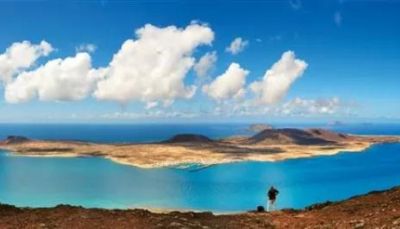
The National Geographic website in Spain has included photographs of the Risco de Famara and also the Cueva de los Verdes in its landscapes section. The images are taken by "prestigious photographers, who show some of the most suggestive places on the planet", it is explained on the website.
The photograph titled "Riscos de Famara in Lanzarote" was taken by Mauricio Abreu, from AWL Images. The image is accompanied by a text that says "the unevenness that characterizes the northern coast of Lanzarote constitutes perfect natural watchtowers".
National Geographic highlights that the "most spectacular" watchtower of all is the Mirador del Río, "which rises above one of the cliffs, 470 meters from the sea." "Its location was used in the past as a point of defense of the island and, in the mid-twentieth century, the Canarian artist César Manrique (1919-1992) chose it for the beauty of its views. With the idea of unifying his art with the environment, he created a building with covered passageways and terraces", he points out.
In addition, he also places special emphasis on the views it covers, since from El Mirador del Río you can see "the salt flats of the Río, which were already exploited in Roman times, and opposite, on the other side of a two-kilometer marine channel, the island of La Graciosa, one of those that form the Chinijo Archipelago Natural Park".
On the other hand, National Geographic also publishes on its website an image of Antonio Vázquez. It explains that around 5,000 years ago, the eruption of the La Corona volcano "opened a seven-kilometer tunnel inside Lanzarote through which lava flowed to the coast".
"The cavity was solidified and, centuries later, it was used by the islanders as a refuge against attacks by privateers, and even as a home by the family of shepherds who began to inhabit it in the 18th century and from whom it takes its name: the Verdes.


