
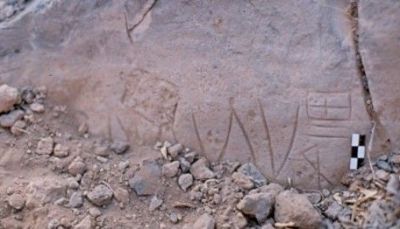
The Government of the Canary Islands, through its General Directorate of Cooperation and Cultural Heritage and with the collaboration of the Island Council, has presented the research related to Lanzarote of a pioneering study in the Islands on Libyan-Berber inscriptions.
This is an ambitious project that began in El Hierro and has been implemented in phases, with a term of four years. This research, led by philologist Renata Springer, has been comparatively studying the sites with inscriptions on the seven islands. Despite the importance of these graphic testimonies, few investigations have been carried out to date on this topic.
Of all the rock art manifestations known in the Canary Islands, inscriptions are especially revealing as they are explicitly a writing. The aboriginal community writes texts that we are now determined to read. The purpose of this project is to know all the details of one of the two alphabets that the aboriginal population of the Archipelago uses to express themselves and that they learn in their places of origin in North Africa.
Lanzarote second island object of the study
The General Directorate of Cooperation and Cultural Heritage updates the corpus of inscriptions on the island of Lanzarote, focusing on the inventory of its signs, frequencies, associations, execution techniques, peculiarities, places where they are found, connection with other writing enclaves or of another nature, visual domination, etc.
19 sites have been studied, all of those currently known. In them, 218 panels are documented, which are the stone supports on which the writing is found, of which 35 have Libyan-Berber writing, adding a total of 70 lines of words. Lanzarote, together with Fuerteventura, has the characteristic of housing another alphabet that has been called Libyan? Canarian, exclusive worldwide to these two islands.
This work has highlighted the coexistence of both alphabets, occasionally being used in the same writing line; thus, there are texts that begin to be written with Libyan-Canarian signs to continue with Libyan? Berber.
"Monumental inscriptions" are discovered
Renata Springer's research has brought to light, 'to the surprise of the Canarian archaeological world', some monumental inscriptions, thus denominating the recording of Libyan?Berber signs of considerable size, and it can be thought that it is a symbolic writing.
These are motifs made by large furrows six to eight centimeters wide and ten deep in the ground, reproducing large shapes. The furrows are excavated in volcanic tuff and have been found on the slopes of several mountains.
Equally striking are the sites where alphabetic signs have been written on foot silhouettes, since these podomorphic engravings are what sacralize the land. Sometimes this figurative image of the foot is oriented towards the Tindaya Mountain, visible from several areas of Lanzarote and located in Fuerteventura.
Precedents
The research, which will cover the seven islands, began in El Hierro and has continued in Lanzarote. In both cases, the collaboration of the island councils has been counted on.
Libyan-Berber inscriptions occupy an exceptional place among Canarian engravings; being present on all the islands and, attached to most of the remaining rock art manifestations, they have become a unifying element, in addition to being a prominent structural component of the culture and an obligatory reference when carrying out a comparative study.
In fact, the alphabet, as a conventional system of signs, refers to the places where this writing has been generated, so it constitutes a reliable indicator about the origin of the inhabitants who populated our islands.
Its study has been taking place since the first discoveries in the 19th century, so it is not surprising that the validity of the oldest works is currently very limited, when also now, in recent dates, numerous findings of new sites have occurred that call into question the hypotheses that have been made in past times when different characteristics appear that had not been documented previously; it is effectively the part of the Canarian heritage that is most in need of a review, to place writing in a range similar to the remaining testimonies of archeology.
These arguments are more than enough to undertake its study in a broad scope. From here it is when it will be possible to determine the writing habits valid in these islands, the uses and employments related to certain social aspects, as well as analyze the alphabets, the signs used and their variants.


