
A date to recover a voice
There are dates that remember a birth. And there are births that allow us to discover a part of history that was in front of us and perhaps we had not looked at enough.
On September 10, 1837, in Tetir, Fuerteventura, Antonio María Manrique y Saavedra was born. His birth certificate belongs to another island, but a good part of his intellectual and professional career would end up linked to Lanzarote. He settled in Arrecife as a notary and there he developed an intense activity as a writer, researcher, and journalist.
He was one of those characters difficult to confine to a single profession. He wrote about history and geography, but also about very specific issues of daily life. He was concerned with communications, fishing, education, the economy, and, especially, one of the problems that has historically most conditioned life in Lanzarote: water.
Writing to change things
Manrique did not conceive of the press solely as a place to report what had happened. It could also serve to warn, discuss, propose, and demand.
At the beginning of the 20th century, in a Lanzarote hit by droughts, he defended the possibility of searching for water in Famara and bringing it to Arrecife. He also recommended capturing rainwater by building cisterns.
More than a hundred years later, his concerns are surprisingly familiar. Because behind those texts was a simple idea: journalism could serve to think about the island before problems became irreversible.
When the press of Lanzarote was just beginning to walk
To understand Manrique's dimension, one must place oneself in the Lanzarote of the late 19th and early 20th centuries. The island's press was still taking its first steps. Newspapers appeared and disappeared with enormous speed, and some barely survived a few months.
Manrique was part of that small intellectual universe. His name appears related to different mastheads, and specialized studies place him among the regular contributors to the island's press.
And then that first "La Voz" appeared
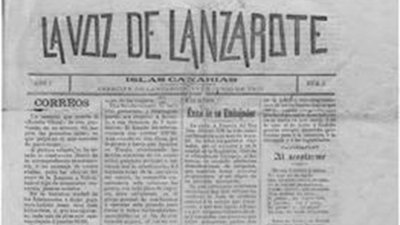
On May 17, 1905, a masthead titled La Voz de Lanzarote appeared in Arrecife. It was a publication with a short life: it stopped being published on July 23 of that same year. Jable, the Digital Press Archive of the ULPGC, preserves two copies, dated June 17 and 24.
The research of Mario Ferrer Peñate on the press of Lanzarote and Fuerteventura identifies among its collaborators the scholar Antonio María Manrique, along with Santiago Pineda Morales and Francisco Jordán. The publication was advertised as a "Newspaper of general interests" and also addressed current local affairs.
So here we can establish a documentary connection: Manrique was part of that first "La Voz de Lanzarote" of 1905.
But that "La Voz" is not the current one
And this clarification is fundamental.
The La Voz de Lanzarote of 1905 belongs to the history of the old island press. It is not the same masthead as the newspaper we know today. Jable also registers other historical publications with the same name in 1913 and 1918.
The current La Voz de Lanzarote was born in 1985, decades later. Therefore, there should be no talk of a business or editorial continuity between that publication of 1905 and the current newspaper.
What does exist is something more interesting for an anniversary: a continuity of journalistic memory. The press of then and the press of today belong to different moments, but both have contributed to Lanzarote being written down.
The current La Voz has also recovered Manrique
The connection with the current newspaper is not a retrospective invention. La Voz de Lanzarote itself has dedicated space to recovering the figure of Antonio María Manrique.
In 2005, Lorenzo Lemaur Santana remembered him in an article dedicated to characters who give names to streets in Arrecife. The text highlighted his birth in Tetir, his arrival in Lanzarote as a notary, and especially his defense of the regular water supply for Arrecife, including his proposal to find water in Famara and conduct it to the capital.
The current La Voz has also preserved and made available its own memory: in 2010 it reported on the digitization of its first twenty years, between 1985 and 2005, allowing access to thousands of news items, reports, and photographs.
There is, therefore, a very simple thread: Manrique wrote in the press of his time; the current La Voz has written about Manrique again and preserves part of the journalistic memory of contemporary Lanzarote.
An old voice and another modern voice
Antonio María Manrique wrote in that La Voz de Lanzarote of 1905. The current La Voz de Lanzarote was born in 1985.
They are not the same newspaper. They are not the same company. There is no demonstrated editorial continuity between the two.
But they can be found in one place: the need to tell Lanzarote and to record what happens on it.
When the first "La Voz" came out, Manrique had already spent decades in intellectual and journalistic activity. When the current La Voz began its journey, that pioneering press was already part of history. Today, both are part of a much broader memory: that of an island told from its own pages.
The journalist who looked ahead
Perhaps that is why the figure of Antonio María Manrique deserves to be remembered every September 10th.
Not only because he was born on that date. Not only because he wrote hundreds of articles. Not even solely because his name appears among the contributors to that first La Voz de Lanzarote.
He deserves to be remembered because he understood something that remains fully valid: that writing about an island is also a way of intervening in it.
Manrique wrote about its past, but also about its present problems and about the future he imagined for the Canary Islands. And some of those problems still accompany us: water, communications, the economy, the territory, and the need for Lanzarote to have its own voice.
A story that meets again
On September 10, 1837, Antonio María Manrique was born.
Decades later, his signature was linked to that first La Voz de Lanzarote, an ephemeral publication that only lasted a few months.
Eighty years after that journalistic experience, in 1985, the La Voz de Lanzarote we know today was born.
It is not the same masthead. It is not the same company. It is not the same newspaper. But there is something that allows us to unite them: the will to tell Lanzarote and to leave a memory of it.
Typewriters have been replaced by computers, paper by screens, and newspaper archives by digital archives. But the same need remains: for someone to tell what happens in Lanzarote so that, in a hundred years, someone can remember that it happened.
And perhaps that is why, every September 10th, it is worth looking for the name of Antonio María Manrique again.
Because before Lanzarote had a journalistic memory as we know it today, there were already men who were determined to write it.
And he was one of them.
Sources: Jable, Digital Press Archive of the ULPGC; Memoria de Lanzarote; historical studies on the press of Lanzarote and Fuerteventura; Mario Ferrer Peñate, Journalism in the periphery of the periphery of Western Europe; archive of La Voz de Lanzarote.



Add La Voz de Lanzarote as a preferred Google source.
Stay informed with the latest current news.