
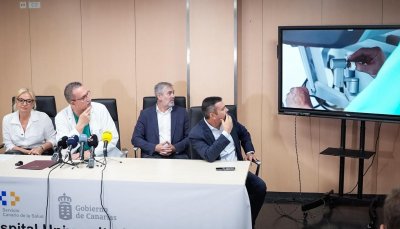
The President of the Canary Islands, Fernando Clavijo, and the Minister of Health of the Government of the Canary Islands, Esther Monzón, the Director of the Canary Islands Health Service, Adasat Goya, together with the President of the Cabildo of Lanzarote, Oswaldo Bentancort, visited this Wednesday the new Robotic surgery equipment at the Doctor José Molina Orosa University Hospital of Lanzarote. This is the DaVinci surgical robot with which the first interventions have already been carried out, since September 24, carried out successfully.
The President of the Canary Islands, Fernando Clavijo, assured that the Molina Orosa is taking a historic step in the field of medicine and highlighted the work of the surgical team, given that this type of latest generation technology, which has involved an investment of 1.7 million euros, can only be developed in those hospitals that have a team of consolidated and highly qualified health professionals and technicians.
Clavijo assured that the incorporation of robotic surgery places Molina Orosa alongside the four large reference hospitals in the archipelago with high-precision surgery, a service that was incorporated into the public hospitals of Gran Canaria and Tenerife in the month of April 2019 and that now makes the leap to the health area of Lanzarote.
The President of the Canary Islands, Fernando Clavijo, congratulated the public health team in Lanzarote this Tuesday during the presentation of the incorporation of robotic surgery to the Doctor José Molina Orosa Hospital. “If there is an island that has taken a giant leap in care and in reducing waiting times, it has been Lanzarote, and that has been thanks to the involvement, application and dedication of all the professionals who work in this hospital”, he highlighted.
Clavijo stressed that the commitment of the Government of the Canary Islands has been to provide public health professionals with the instruments, technology and equipment necessary to ensure that care for citizens is of the highest possible quality. “With this incorporation we are taking a further step that will allow our public professionals to do their job even better, facilitating their daily work and improving the lives of patients”, he pointed out.
This advanced technology and the capacity of the professionals will allow Lanzarote patients to access less invasive treatments, with faster recovery and greater precision in the procedures that guarantees the best results, assured the Minister of Health, Esther Monzón.
The Minister emphasized that the incorporation of this equipment "responds to the commitment to innovation and modernity of the Canary Islands public health system and to the obligation to give citizens the best service and the highest quality care."
The President of the Cabildo of Lanzarote, Oswaldo Betancort, stated that "the arrival of the surgical robot at the Doctor José Molina Orosa Hospital places Lanzarote at the level of the large hospitals in the Canary Islands. It is a decisive step towards a more modern, efficient and close public health system, which offers our patients the same cutting-edge treatments without having to leave the island.”
For his part, the head of the Surgery service of Molina Orosa, Juan De Diego, who has performed the first interventions together with the specialist Andrea Rossetti, explained that the first interventions have been performed in the specialty of General and Digestive System Surgery with good results.
Likewise, he said that "having robotic surgery represents a giant leap in terms of precision and ergonomics for the surgeon, which translates into maximum safety for the patient and a reduction in recovery times. In addition to placing our Hospital at the highest levels of medical-surgical equipment, this achievement is a consequence of years of growth and effort by all levels of our Center and the Canary Islands Health Service to achieve the best levels of care for the citizens of Lanzarote."
Progressive incorporation
The robot is designed to perform interventions on soft tissues, which includes the specialties of general and digestive surgery, urology, gynecology. “Although, until now, the surgery team is the only one that has performed these interventions, the surgical planning of the Molina Orosa Hospital will progressively incorporate the rest of the surgical specialties such as Urology, until completing the portfolio of services that is currently offered with laparoscopic surgery”, explained the manager of the hospital center Pablo Eguía.
Among the main advantages offered by the Da Vinci robotic system to both patients and surgeons are the greater precision and safety in surgical interventions, less bleeding during operations, faster recovery, as well as a shorter hospital stay.
The Robot
The Da Vinci Xi surgical robot of the Molina Orosa Hospital consists of three large units: surgeon's console, patient cart and vision tower. On the one hand, there is the surgeon's ergonomic console, which is considered the command center of the Da Vinci system. It is designed to offer comfort to the professional who handles the robot's controls, in contrast to the postures adopted in conventional laparoscopic techniques.
The surgeon sits at this console from where he operates a 3D endoscope, two main controllers of the surgical instruments with both hands, as well as pedals with the feet. The movements made by the professional in the surgical console are digitized and modified by the robot's computer system capable of eliminating tremors, thus providing the surgeon with a greater field of action and a precise intervention during the operation.
The second technical element is the surgical cart, responsible for technically performing the operation on the patient and whose main function is to support the 'arms' of the equipment where the instruments are installed. In this sense, the nursing staff plays a fundamental role, as they help the surgeon who is in the console with the exchange of instruments and endoscopes, as well as in other tasks in the patient area.
The vision tower is the last major component of the surgical robot, which houses both the visualization equipment and the central processing of the system.


