
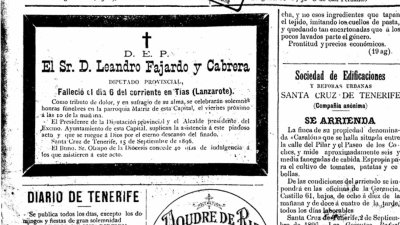
September 6, 1896: the assassination of Leandro Fajardo Cabrera, the elections, power, and a question that survived the century
At one in the morning on September 6, 1896, while Lanzarote was preparing for an election day, a shot ended the life of Leandro Fajardo Cabrera in Tías. A lawyer, journalist, and politician, Fajardo was one of the most influential figures on the island. The crime had a convicted perpetrator, but it left an enigma much more difficult to solve: what was behind that shot.
The night that changed an election
Tías was still asleep when the life of one of the men who best embodied the power struggles of late 19th-century Lanzarote ended. Leandro Fajardo Cabrera was assassinated in the early morning of Sunday, September 6, 1896, a few hours before elections for the Provincial Deputation. The coincidence made the crime a political issue of enormous resonance from the very beginning.
Historical sources place the assassination around one in the morning. Fajardo was sleeping on the ground floor of his brother's house. The identified perpetrator was Francisco Díaz Monfort, known as Frasco, a relative of the victim and a resident of the El Pavón area. The reconstruction by the Tías City Council and the historical press agree on the essential elements of the event.
But that death cannot be understood solely as a crime story. Fajardo was then a candidate for the conservative sector, opposed to the candidates linked to Fernando León y Castillo's Canarian Liberal Party. The assassination on the eve of the election made it inevitable that his supporters would see a political operation behind the crime.
Leandro Fajardo, much more than a candidate
Fajardo was born in Arrecife and studied law in Madrid, where he graduated in 1873. He was a lawyer, professor, property registrar, and journalist. In Madrid, he was associated with the editorial staff of Las Novedades and, upon returning to Lanzarote, he founded and directed El Horizonte, a newspaper published in Arrecife between 1887 and 1889.
His political career was particularly varied. He began in republicanism and even faced Fernando León y Castillo electorally; he was later linked to liberalism and, after leaving that sphere, he ended up becoming a figure of island conservatism. Studies on the politics of the Restoration present him as one of the men who dominated Lanzarotean politics.
Precisely that trajectory explains the intensity of the rivalries. Island politics were crossed by factions, alliances, and personal networks. In that scenario, Fajardo was not a spectator: he was one of its protagonists.
Two explanations for the same shot
Here begins the most delicate part of the story. The material fact of the murder and the identity of the convicted person are documented. What cannot be affirmed with identical certainty is the definitive motive.
The first interpretation is political. Fajardo was a candidate, he was facing the leonine sector, and he was murdered precisely on the eve of the elections. The temporal proximity was too significant for those who defended this explanation.
The second interpretation points to a personal, family, and economic conflict. Subsequent investigations have linked the crime to loans, properties, and disputes between Díaz Monfort and Fajardo. This hypothesis appears in later historical works and in local reconstructions, but it must be presented as an interpretation and not as an unquestionable judicial truth as long as the complete case file is not consulted directly.
The controversy did not arise a century later. As early as 1899, a pamphlet titled "El asesinato de Fajardo. La verdad resplandece" (The Murder of Fajardo. The Truth Shines), signed by "a Lanzaroteño," circulated in Las Palmas. Studies on the Restoration indicate that that text sought to defend, from liberal positions, that the crime had not had political motives. The dispute over explaining the death, therefore, began practically with the case itself.
The trial and the shadow of the garrote
The judicial investigation acquired an extraordinary dimension. Magistrate Mariano Cano intervened in the instruction of the case file, and Francisco Díaz Monfort was imprisoned. News from the time reflects that the possible existence of accomplices was even investigated.
The trial ended with a death sentence. Díaz Monfort was to be executed by garrote on a scaffold. History, however, took a final turn. The death penalty was commuted to life imprisonment after the intervention of Fernando León y Castillo before the Queen Regent.
Díaz Monfort would end up in the penal colony of Ceuta, where he died in 1910. Thus, the murder that had shaken Lanzarote ended with a convicted man who never faced the garrote, while the discussion about the reasons for the crime continued long after its protagonists disappeared.
Five days later, a street
Fajardo's memory began to be built almost immediately. On September 11, 1896, just five days after the assassination, the Arrecife City Council agreed that the former Calle Nueva would bear his surname. The current Fajardo street was thus linked to the memory of the assassinated politician.
The detail has extraordinary symbolic force. The same week in which a bullet had ended Fajardo's life, a public institution began to turn his name into permanent memory. The man disappeared; the surname remained on the street map.
The Lanzarote Behind It
The Fajardo case allows us to glimpse a very different island from the current one: a society where the politics of the Restoration were articulated around large families, local leaders, newspapers, and networks of influence; an island where a candidate could become the center of a power struggle that transcended the ballot box.
And the social context was not simple either. In those same days, the national teacher Santiago Noda García was going through an extreme situation of economic precariousness and recorded his difficulties. There is no basis for connecting the two episodes, but together they help to understand the social tensions of that Lanzarote at the end of the 19th century.
The Question That Remains
Today, 130 years later, history allows us to state with certainty that Leandro Fajardo was murdered in Tías on September 6, 1896, and that Francisco Díaz Monfort was convicted of the crime. What is more difficult is to definitively close the explanation of why it happened.
Was politics the motive for the assassination? Did personal and economic conflicts weigh more heavily? Were both worlds mixed in a society where power, family, heritage, and politics were closely related? The sources allow us to ask the questions; historical prudence requires us not to turn a hypothesis into a sentence.
Perhaps that is why the Fajardo case continues to be so fascinating. It is not just the story of a murder. It is the story of an island vying for power, of a journalist who was also a politician, of an election overshadowed by a crime, and of an explanation that never managed to completely extinguish the others.
The early morning ended. The elections passed. The condemned man died far from Lanzarote. But the name of Leandro Fajardo remained on a street in Arrecife and in the island's historical memory. And every September 6th, the date returns a question that has been waiting for a definitive answer for more than a century.
Add La Voz de Lanzarote as a preferred Google source.
Stay informed with the latest current news.