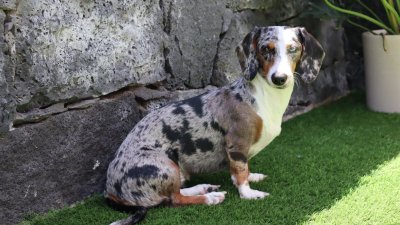
If there is a dog breed that is in fashion, it is the dachshund or popularly known as the sausage dog. Social media, coupled with the friendliness of this breed and its small size, have caused a boom of this dog in Spain and in other parts of the world. However, behind this breed hide medical problems due to its elongated body, which causes ailments related to the spine.
Dachshunds are native to Germany and there are different varieties, from short-haired to long-haired, including colors such as gray, black, brown, or spotted. In addition, several sizes are differentiated: the standard, which weighs between nine and fifteen kilos, and the kaninchen, whose weight is between three and five kilos. The latter also has distinct physical features.
Vela, one of the Lanzarote dachshunds
This breed has also reached Lanzarote. It is inevitable to walk down the street and not encounter a sausage dog. The fever for this breed is such that there are even WhatsApp and Facebook groups dedicated to this breed where meetups are organized. Patricia Casas is a Lanzarote native who, when it came to getting a pet, opted for a dachshund. Hers, a mini female sausage dog named Vela, is three years old. Casas traveled to Barcelona in 2023 to buy Vela through an intermediary for breeders of this breed.
The price of these dogs is usually high, between 500 and 900 euros if bought from individuals or up to 1,800 if bought from specialized breeders. However, they can reach a price of 2,500 euros if the puppies' parents are champions of contests or have very uncommon characteristics such as rare colors. In Patricia Casas's case, she bought Vela at three months old for 1,450 euros, to which the costs of the plane ticket and stay were added.
This Lanzarote native opted for a sausage dog because she assures that she "had an obsession" with it. "Many years ago I saw a couple with a dachshund in Madrid and it was the first time I saw one and I loved it," she says.
Patricia Casas, based on her experience, describes sausage dogs as "very stubborn, very barky, and they don't understand that everyone has their personal space because wherever you go, she goes." In addition, she also indicates that it is a possessive breed.
Regarding her energy, she points out that Vela is "very active when I take her out all day, but at home she sleeps." "She is not a dog that likes to go out morning, noon, and night, but rather goes out to relieve herself and comes back," she continues. However, she highlights that what she does like is "going for a walk, to the beach, or to an avenue."
Despite the spinal problems that are usually present in this breed, Vela is an almost untamable whirlwind. "We are careful when picking her up, but she goes up and down stairs, jumps on the sofa and the bed, she does whatever she wants even though we try to stop her, although it is true that in Vela's case her body is not so close to the ground because she has slightly longer legs," she says.
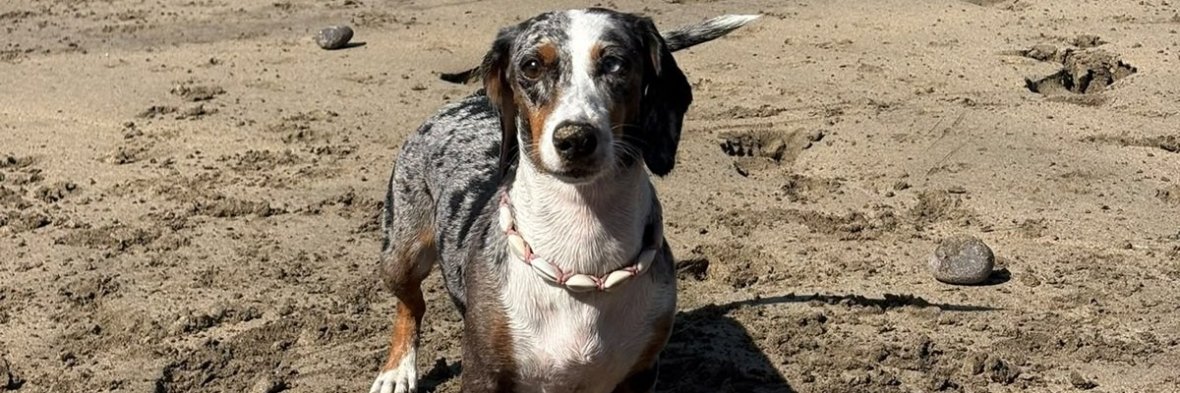
Pathologies of this breed
One of the main pathologies that dachshunds suffer from is intervertebral disc disease. "It happens because it is a breed predisposed to it because it is chondrodystrophic and there is a genetic alteration of endochondral ossification," explains Enilay Parapás, a veterinarian at a clinic in Lanzarote. This means that "the cartilage of the growth plates matures and ossifies prematurely, which causes the long bones to stop growing very early."
This usually occurs at a very young age, from three to seven years old. "Depending on where the problem is located, the dog will have cervical, thoracic, or lumbar pain," points out Parapás. This pain sometimes also manifests with ataxia (loss of muscle control and lack of coordination in voluntary movements), paraparesia, or tetraparesia (affectation of two or four legs). All of this leads to loss of sensation in the extremities.
In her practice, the veterinarian has noticed an increase in this breed, especially lately. "I have received many puppies from the peninsula, especially from the Seville area," she says. Furthermore, she reveals that most dogs of this breed that she treats at the clinic arrive with spinal problems. "They can also have patellar luxation if they are very small, hereditary cataracts, or progressive retinal atrophy," she details.
Another very common condition among dachshunds is congenital deafness and cryptorchidism, that is, the presence of a single testicle because the other has formed but is retained in the abdomen or inguinal canal. Likewise, the professional explains that dachshunds tend to suffer from obesity. "Since they suffer from spinal problems, it is important that they do not gain weight from an early age," she warns.
In her opinion, the veterinarian comments that when it comes to having this breed as a pet, people "do know that they have spinal problems because many come to my consultation and tell me that they have been told that it is a breed that usually has these problems, and I think even breeders tell them."
Tips to avoid possible damage
One of the tips that experts most recommend when picking up a dachshund is to do so with both hands from the lower part of the animal. This way, we will avoid causing damage to its spine.
Likewise, Enilay Parapás also advises that the physical exercise the dog does should not be too intense. "Let it be of light or moderate intensity, but not intense," she details.
On the other hand, she points out that dachshund owners should prevent their pets from jumping from high places such as a sofa or a wall. "If it suffers from spinal problems, it can cause this injury to be more severe," she explains.



Add La Voz de Lanzarote as a preferred Google source.
Stay informed with the latest current news.