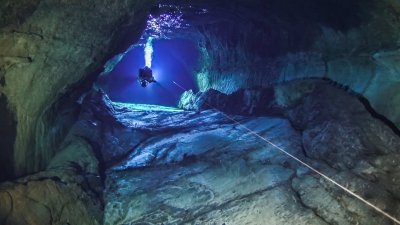
The La Corona–La Atlántida volcanic tube has been part of The Third 100 IUGS Geological Heritage Sites since Friday, November 6, the third selection of 100 geological heritage sites of global relevance by the International Union of Geological Sciences (IUGS). The recognition, presented in Monchique (Portugal), distinguishes the exceptional scientific value of this system, approximately ten kilometers in length, which includes the Cueva de los Verdes, the Jameos del Agua, and the Atlántida Tunnel. The proposal was presented by Javier Lario Gómez, Professor of External Geodynamics at UNED, and brings together more than a century of studies and new research results that he has developed and coordinated over the last decade, especially concerning its submarine section.
The uniqueness of the complex goes beyond its dimensions. Inside, sediments and mineral deposits are preserved, allowing us to trace the transformation of a volcanic conduit formed on dry land and later flooded by the ocean. "The Atlántida Tunnel preserves a geological archive that allows us to reconstruct how this environment has changed and how sea level has risen over the last 26,000 years," explains Lario, who is also a member of the Scientific Advisory Committee of the UNESCO Global Geopark of Lanzarote and Chinijo Archipelago, where the site is located.
A submarine tunnel that formed on dry land
The system originated during the eruption of the La Corona volcano, approximately between 26,000 and 21,000 years ago. Its continuation under the ocean forms the Atlántida Tunnel, which, with a length of nearly two kilometers and a depth of up to 64 meters, is the longest known submarine lava tube in the world.
Although it is submerged today, this section formed on dry land. During the final stages of the Last Glacial Maximum, the ocean level was approximately 120 meters below the current level. The area now occupied by the submarine tunnel was then emerged, and the volcanic conduit developed in the open air. The subsequent rise of the sea progressively flooded its lower sections, leading to its current configuration.
The traces of this transformation remain in the sediments and mineral deposits inside the cavity. Among them are carbonates and sulfates that record different stages of its evolution. Their analysis allows us to relate the history of the tunnel to environmental changes and sea-level rise.
To reconstruct this sequence, the research has combined studies of landforms, sediments, rocks, and minerals with geochemical analyses and uranium/thorium and radiocarbon dating. The result is a record spanning from the end of the Pleistocene to the Holocene, the current geological epoch.
Exploring to reconstruct its history
An essential part of these advances comes from underwater exploration and sampling campaigns. Recent research on the system has been carried out within the framework of R&D projects funded by state calls, with UNED's own research funds and in collaboration with the UNESCO Global Geopark of Lanzarote and Chinijo Archipelago, in addition to the participation of researchers from other institutions. An essential part of these advances comes from underwater exploration and sampling campaigns in the Atlantis Tunnel. "Over the last decade, we have moved from understanding the dimensions and shapes of the tunnel to a much more detailed reconstruction of its geological and environmental history," says Lario.
One of the milestones of the ProyectoSublántida was the return of its cave diving team to the terminal wall of the tunnel, located at a depth of 64 meters, for the first time in over three decades. The campaign allowed for the collection of geological samples from this sector to study its evolution and expand knowledge of one of the least accessible areas of the system.
The results have been compiled in a monograph dedicated to the geomorphological and sedimentological characteristics of the Atlantis Tunnel and in a recent scientific publication that integrates research on environmental and sea-level changes recorded within it. The dissemination of this work has also led to the documentary Acuanautas bajo el volcán, directed by Javier Lario and produced by UNED, which has received several awards at international festivals. On the occasion of the recognition, TVE will re-broadcast it within the program Universo UNED on Friday, November 6 at 10:00 AM and on Sunday, November 8 at 7:00 AM.
A reference for studying Earth and other planets
The interest of La Corona–La Atlántida also extends to planetary geology. Terrestrial lava tubes are used as analogues for studying possible volcanic cavities on the Moon and Mars, which has led to Lanzarote hosting research and training activities linked to the ESA and NASA.
The flooding of the system has also generated a unique anchialine environment, with underground waters connected to the sea that host highly specialized fauna. The candidacy includes more than 37 endemic species, including the well-known jameíto (Munidopsis polymorpha). This biological heritage complements the geological and geomorphological value that underpins the recognition.
The IUGS selection distinguishes sites of exceptional scientific value for their contribution to the knowledge of the Earth. In La Corona–La Atlántida, this value brings together the scale of the volcanic system, the uniqueness of its submarine section, and the conservation of an archive that documents thousands of years of environmental changes. "This inclusion recognizes a long history of research and reinforces the importance of continuing to study, conserve, and disseminate this exceptional volcanic system," concludes Lario.
Add La Voz de Lanzarote as a preferred Google source.
Stay informed with the latest current news.