
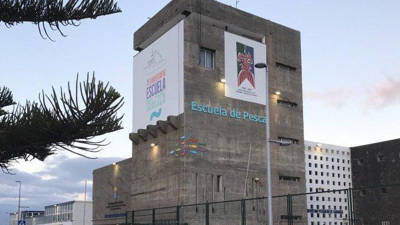
A school born from Lanzarote's seafaring vocation
For generations, the sea was much more than a horizon for Lanzarote. It provided food, work, and trade routes; it sustained fishing families and fueled an economic activity that also extended to workshops, warehouses, salting and drying industries, and port-related businesses. In that context, specialized training eventually became a necessity: it was not enough to know the sea through experience; it was also necessary to learn to navigate, interpret coastal conditions, and assume technical responsibilities on board.
The Arrecife Fishing School was born linked to that reality. Its history is not explained solely by the creation of a teaching center, but by the need to train professionals capable of working in an essential activity for the island's economy. The institution opened a path of regulated training for young people who, until then, could depend mainly on practical learning and knowledge passed down within fishing families themselves.
Juan de Quesada street, the first headquarters
The chronology published by Memoria Digital de Lanzarote places the school's inauguration on October 17, 1942, at number 17 Juan de Quesada street, in Arrecife. The reference points to the volume El Puerto del Arrecife, by Antonio J. Montelongo Franquiz and Marcial A. Falero Lemes, which cites documentation from the Archive of El Museo Canario. According to that reconstruction, the center would later move to the Puerto Naos area.
It is worth distinguishing that inauguration from the institution's administrative antecedents. Canary Law 8/1999, when reconstructing the evolution of maritime-fisheries training, indicates that the center originated in 1939 and that academic activity began in 1943. The dates do not necessarily describe the same milestone: one refers to administrative creation, another to the inauguration recorded by historical chronology, and another to the start of classes. The consulted documentation allows for this distinction, although consulting the original file would be the surest way to definitively close the sequence.
The first headquarters was a modest-sized house, far from the image that today is associated with a specialized center. Its location in the urban fabric of Arrecife placed it close to the daily life of a capital that was growing at the pace of the port and the activities that depended on it. The school began to provide academic structure to knowledge that until then had circulated, above all, through direct experience.
An economy that went far beyond boats
The importance of fishing training is better understood by observing the economic environment of those years. Fishing did not end when the vessels returned to land. The product had to be preserved, prepared, and distributed, and around that chain, salting facilities, drying sheds, and small industries developed, connecting the work of the boats with markets located outside the island.
Historical records from Lanzarote document, among other examples, the activity of the Las Nieves salting factory, acquired by Agustín Morales in 1930, and the drying facilities promoted on the Islote del Francés starting in 1938 by the businessman Rodolfo Alonso Lamberti. In 1947, the sardine salting industry linked to R.A.L.S.A. also appeared. These references do not mean that the school alone originated the modernization of the sector, but they do help to understand why specialized technical training could be strategic for an economy with such a direct relationship with the sea.
The center was thus integrated into a broader transformation: that of a traditional activity that needed professional knowledge, qualifications, and preparation capable of responding to increasingly complex vessels, techniques, and demands. Its history therefore belongs to both the education and the maritime economy of Lanzarote.
The first results: offshore and high-seas skippers
A news item published by the weekly newspaper Antena on November 6, 1956, offers a concrete reference to the school's results. When reporting on the planned construction of a new three-story building, it indicated that up to then 90 students had obtained the title of deep-sea fishing skipper and another 87 that of high-seas fishing skipper. The information allows us to gauge the center's training activity during its early years, although the figures must be expressly attributed to that news item and not presented as an independent, verified count.
Behind these titles lay a relevant professional opportunity. Preparation for deep-sea and high-seas fishing required knowledge of navigation and the conditions of work at sea that went beyond local experience. The school offered a way to turn this preparation into a recognized qualification, with which students could aspire to assume greater professional responsibilities.
The data published in 1956 also shows that the center had surpassed the scale of a small initiative. The plan to build larger facilities responded to a training demand that required space, resources, and a more stable organization.
From the Old House to the Puerto Naos Building
The decisive step in the institution's material history came with the construction of a new headquarters in Puerto Naos. Documentation compiled by the Ministry of Agriculture, Fisheries and Food places the confirmation of the need to erect a new building in 1964 and the acquisition of a plot of about 5,000 square meters in the fishing port in 1965. In the same year, the Official State Gazette published the award of the works for the Official School of Nautical-Fishing Vocational Training of Lanzarote for a budget of 2,834,802.16 pesetas.
The new building was completed in 1968. The press and subsequent reviews attribute the architectural project to Laorga and Zanón, and place its opening on October 1 of that year. The difference between the first headquarters and the Puerto Naos facilities reflected a change in scale: the school was no longer just a house adapted for teaching, but an facility designed for technical training that required specific rooms and better working conditions.
Puerto Naos was not a casual location. The center was integrated into the port environment where a good part of the activity for which it prepared its students took place. The relationship between classroom, port, and sea was part of its very identity: learning could not be separated from the professional reality it was meant to serve.
From specialized school to maritime-fishing institute
The name and organization of the institution changed with the reforms in vocational training. Law 144/1961 reorganized nautical-fishing education and led to the designation of the Nautical-Fishing Vocational Training School. Later, educational reforms and the regulation of vocational training led to a new stage. Royal Decree 1887/1976 classified the corresponding centers as national maritime-fishing polytechnic institutes, a designation that in the case of Lanzarote was linked to the National Maritime-Fishing Polytechnic Institute of the Canary Islands.
These administrative changes should not be confused with the disappearance of the institution. On the contrary, they show its adaptation to an educational system that incorporated new qualifications and structures. The school went from an offering focused on the classic needs of navigation and fishing to being part of a broader network of maritime vocational training.
Continuity can be seen in the current offering of the Arrecife Maritime-Fishing Vocational Training Institute. The official catalog of the Government of the Canary Islands includes courses related to aquaculture, maintenance and control of ship and boat machinery, coastal navigation and fishing, and underwater and hyperbaric operations. These are different specialties from those that marked the early years, but they retain the essential link between technical training and the marine environment.
An institution that also tells the history of Arrecife
The trajectory of the Fishing School allows us to read a part of Arrecife's transformation. The capital was for a long time a port city whose pulse depended on boats, commercial activity, and industries linked to the sea. The creation of a specialized training center responded to that identity and, at the same time, contributed to modifying it: it prepared professionals with recognized qualifications and expanded the possibilities for those who wanted to make maritime work a career.
Its evolution also reminds us that the modernization of an economy does not depend solely on infrastructure, ships, or production facilities. It requires knowledge, teachers, learning resources, and opportunities for new generations to enter professions that change over time. In this sense, the school was an educational piece of a transformation that had many other dimensions.
Today, as maritime activity incorporates new technical, environmental, and safety requirements, the center's journey allows us to observe a continuity between past and present. Official names, curricula, and specializations have changed, but the need to train those who work at sea remains. The old school in Arrecife is, therefore, something more than a chapter in educational history: it is part of the professional memory of Lanzarote and the relationship the island has maintained with its main horizon.
Documentary Sources
• Digital Memory of Lanzarote. Chronology of the inauguration of the Fishing School on Juan de Quesada street, October 17, 1942. Bibliographical reference: Montelongo Franquiz, Antonio J. and Falero Lemes, Marcial A., El Puerto del Arrecife, Cabildo de Lanzarote and Ayuntamiento de Arrecife, 2000, p. 385.
• Official State Gazette. Law 8/1999, of April 27, on maritime-fishing vocational training institutes of the Canary Islands, BOE-A-1999-12226.
• Ministry of Agriculture, Fisheries and Food. Document on maritime-fishing training and the evolution of the Polytechnic Institute of Maritime-Fishing Vocational Training of the Canary Islands.
• Official State Gazette. Royal Decree 1887/1976, of July 26, on the classification of national maritime-fishing polytechnic institutes, BOE-A-1976-15331.
• Digital Memory of Lanzarote. Newspaper record of the news published in the weekly Antena, no. 182, November 6, 1956, p. 2, on the project for the new building and the degrees awarded.
• Official State Gazette, November 13, 1965. Award of the works for the Official Nautical-Fishing Vocational Training School of Lanzarote.
• Government of the Canary Islands. Official file of the Maritime-Fishing Vocational Training Institute of Arrecife, center code 35000240.
• Montelongo Franquiz, Antonio J. and Falero Lemes, Marcial A. «Fishing in Lanzarote: a primary economic activity», IX Conference on Studies on Fuerteventura and Lanzarote, vol. II, 2000.
Verification note: The consulted sources distinguish between the administrative origin of the center (1939), the start of academic activity (1943), and the inauguration recorded by historical chronology (October 17, 1942). The figure of graduates from 1956 is attributed to the news from Antena. To definitively close the sequence of dates and the denomination used in each stage, it would be advisable to consult the original file cited in the bibliography.



Add La Voz de Lanzarote as a preferred Google source.
Stay informed with the latest current news.