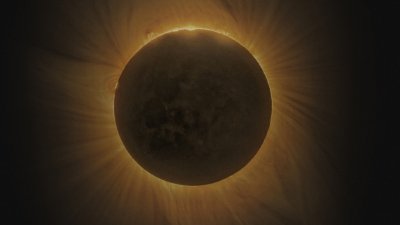
That it gets dark at an hour when it shouldn't, the temperature drops, and animals exhibit twilight behaviors is not what makes a total solar eclipse unique. What is peculiar about this phenomenon is the totality phase, which makes the corona, the outermost part of the Sun's atmosphere, visible.
This is how science communicator Miguel Ángel Delgado explains it in an article disseminated by the Institute of Astrophysics of the Canary Islands (IAC) titled "How to know if what you saw was a total solar eclipse," in which he points out that it is not uncommon to hear some people comment on what they usually use to watch eclipses, and they even refer to it as if they had witnessed several.
This is surprising considering that the last total solar eclipse visible in peninsular Spain took place in 1905, as the subsequent one in 1912 affected so little territory and for such a short time (only a few seconds) that very few people actually perceived it.
And nothing more since then, except for the one visible in 1959 in the Canary Islands, the communicator specifies, who believes there may be some confusion with lunar eclipses, which are much more frequent, or that a partial solar eclipse, which occurs every few years, may have been witnessed.
But apart from their origin, as both happen when the Moon passes between the Earth and the Sun, and in the case of a partial one, it does not completely hide the solar disk, the differences are very large, he adds.
However, he continues, they are incomparable in spectacularity, as a partial solar eclipse can even go unnoticed, especially if the hidden part of the Sun is small.
A total solar eclipse, except in cases of excessive brevity, is impossible to go unnoticed in a clear sky, and the key that makes total solar eclipses so unique is the moment of complete obscuration of the Sun, known as the totality phase, the appearance the solar disk takes during totality.
"It is at that moment alone that we can contemplate the solar corona, the outermost part of the Sun's atmosphere, and since it has millions of times less brightness than the star, it is completely invisible to us the rest of the time," he points out.
However, the solar corona is fundamental to understanding the Sun's dynamics, which governs prominences, originates the solar wind, and can disturb the Earth through what are known as solar storms.
So it is impossible to confuse a total solar eclipse with anything else, continues Miguel Ángel Delgado, who urges to watch this phenomenon following all safety instructions regarding it and recalls that the IAC will train the equipment it will use in the NATE project for next year's total eclipse on August 12 in Palencia, and we will have to wait until 2053 to see a similar phenomenon in the Iberian Peninsula.
Add La Voz de Lanzarote as a preferred Google source.
Stay informed with the latest current news.