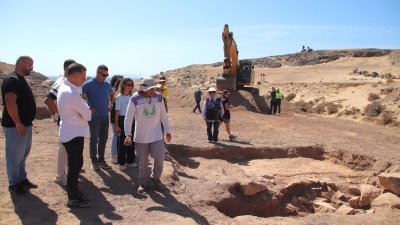
The seventh campaign of the archaeological intervention project at the San Marcial del Rubicón site, in the south of Lanzarote, has just concluded with new findings and clues that help the scientific team responsible for the project continue to map out the first European city in the Canary Islands, founded by a Norman expedition in the 15th century. Water management is an essential factor in the development of any city or civilization, so the discovery of two wells and a third structure linked to the enclave's hydraulic system, along with the results of the previous six campaigns, provides more information about the configuration of its buildings and the social organization of the settlement.
The research leadership, represented by archaeologists María del Cristo González, Esther Chávez, Nona Perera, Luis Alejandro García, and Miguel Ángel Hervás, cannot yet confirm whether the two new wells found in Rubicón were contemporary with the city's founding, as further excavations in future campaigns are necessary to assert this. However, they do explain the way in which the inhabitants took advantage of natural resources.
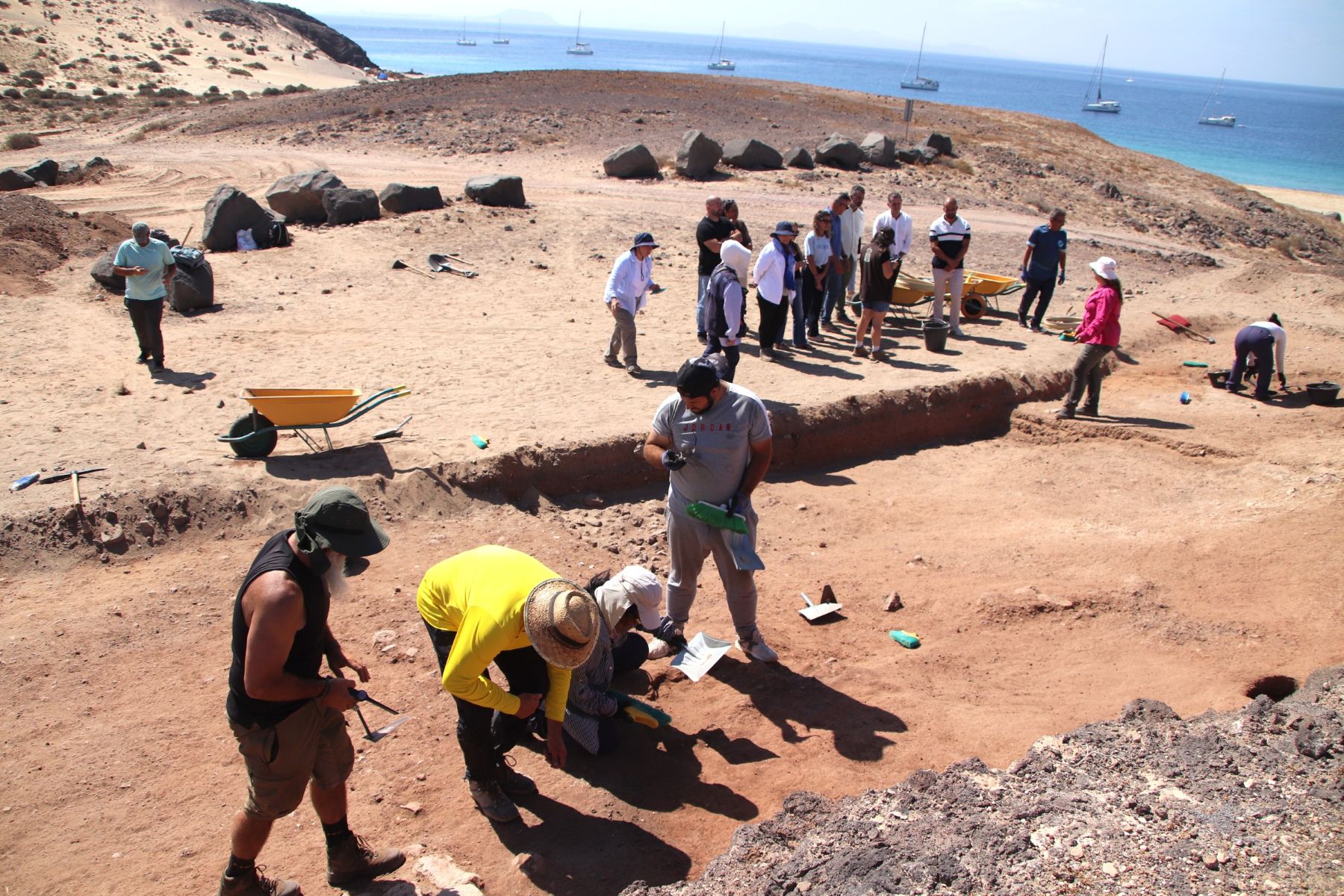
It is clear that San Marcial del Rubicón is the place where the construction of the first frontier city in the mid-Atlantic was effectively and permanently carried out, a city where people from outside and the conquered aboriginal population coexisted. The research project is financed by the Government of the Canary Islands, through its Directorate of Cultural Heritage, the two Canary Islands public universities, the University of Las Palmas de Gran Canaria and the University of La Laguna, and the Yaiza City Council.
The local administration, headed by Óscar Noda, emphasizes "the scientific work of seven exploration campaigns to ensure that this enclave becomes an archaeological park or site museum that guarantees the dissemination of part of the history and heritage of the Canary Islands."
For her part, the Councilor for Heritage of Yaiza, Silvia Santana, highlights that "the research team has especially appreciated the contribution of technical resources from the City Council in this campaign. Machinery had to be used to remove large quantities of earth that covered a large part of the ravine."
With the two wells found during this campaign, there are now six confirmed wells in San Marcial del Rubicón, pending corroboration of another structure linked to water management, which will also continue to be the subject of research. “Any element we find has few references, and that poses a challenge for the team for future campaigns,” points out María del Cristo González, co-director of the project.
In previous campaigns, research has discovered, among other elements and spaces, pottery pieces, coins, domestic habitats, fortifications, a cemetery, and a lime kiln. In addition to the wells, this year a space that could be linked to the kiln was also found, and another space, ‘La plaza’, which Professors Antonio Tejera and Eduardo Aznar had already explored. The objective is to find the different spaces that configured the first European city in the Canary Islands.



Add La Voz de Lanzarote as a preferred Google source.
Stay informed with the latest current news.