
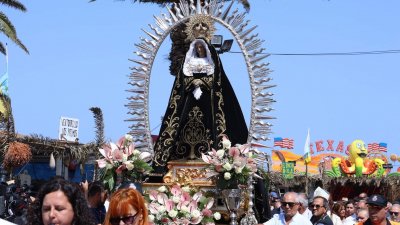
Every September 15, Lanzarote is recognized in Mancha Blanca. The island stops before the image of Our Lady of the Volcanoes and relives a tradition that was born in one of the most dramatic moments in its history, when the eruptions of 1730 to 1736 transformed the territory forever, buried villages, farmland, and roads, and forced its inhabitants to live with fire for years. Devotion to the Virgin of Sorrows has been linked since then to that volcanic memory, and over time the celebration became one of the great collective expressions of Lanzarote's identity.
Tradition attributes the halting of the lava flows that threatened Tinajo to the Virgin's intercession and tells how the neighbors, faced with the advance of the lava, went in procession towards the Mancha Blanca area. The promise to build a hermitage if the danger ceased is part of that memory passed down through generations. Historical documents allow us to place a request from the residents of Tinajo as early as 1735 for Our Lady of Sorrows to act as a mediator against the eruptions, while local tradition places the first celebration of the festival on September 15 in 1736. It is not necessary to turn faith into a scientific explanation to understand its importance: that episode ended up becoming part of the emotional memory of an entire island.
And perhaps that is why September 15 offers an opportunity that goes beyond celebration. It is not just about looking towards Mancha Blanca, admiring the patron saint, and expressing our devotion. It is also a perfect day to stop, look up, and observe Lanzarote. To ask ourselves what island we have built, where we are taking it, and what we want to preserve of it when those of us who inhabit it today are no longer here.
Because Lanzarote has once again entered a stage of transformation. This time it is not the volcano that is modifying the territory. It is us.
For decades, the island went from an economy marked by agriculture, fishing, and scarcity to becoming one of the main tourist destinations in the Canary Islands. The landscape that previously seemed like a difficulty became one of its greatest assets. Architecture, territorial protection, the absence of certain urban planning models, and the uniqueness of its natural spaces built an image that ended up becoming a powerful international attraction.
The problem arises when success begins to endanger what made it possible.
The summer of 2026 has left some indicators difficult to ignore. In July, César Manrique-Lanzarote airport exceeded 800,000 monthly passengers for the first time, with 800,545 movements. Housing continued to become more expensive, reaching an average of around 3,208 euros per square meter across the island in June, while tourist rentals, although down from the previous year, still represented a considerable presence. Added to this are the structural difficulties the island faces in terms of water, energy, mobility, waste, and sanitation.
These are not isolated problems. They are part of the same equation.
The issue can no longer be framed exclusively in terms of how many tourists we want to receive. The most important question is what capacity Lanzarote has to sustain the economic model we have built without deteriorating the conditions that make daily life possible for its inhabitants and without consuming the natural heritage that attracts visitors.
And nowhere is this question more evident than in La Graciosa.
The eighth island, officially recognized as such since 2018, remains administratively integrated into Lanzarote and the municipality of Teguise. Barely just over 700 people reside permanently on it, but its human dimension contrasts with extraordinary tourist pressure. Caleta de Sebo port registered 595,461 passengers during 2025, a figure that allows us to understand the magnitude of the phenomenon, although it does not equate to the number of unique visitors or the people simultaneously present on the island.
Almost 600,000 passengers per year for a permanent community of just over 700 inhabitants forces us, at the very least, to ask questions.
La Graciosa is not attractive because it has large infrastructure. Quite the opposite is true. Its value lies, to a large extent, in what it does not yet have: large hotels, conventional urban traffic, shopping centers, a network of paved roads that cross the entire island, or a complete transformation of its landscape. Its charm lies in its scale, its tranquility, its nature, its sense of isolation, and a way of life that still retains characteristics difficult to find elsewhere.
Therein lies one of the great contradictions of the current moment: the more tourist success La Graciosa has, the greater the need to provide it with adequate services; but the more is built to respond to that success, the greater also the risk of altering what makes visitors want to come.
The history of the island's protection shows that this concern is not new. In 1986, the Canary Islands declared the Natural Park of the Northern Islets of Lanzarote and the Famara Cliffs, incorporating La Graciosa into a framework of protection that sought to reconcile conservation with traditional uses and the rights of its inhabitants. In 1993, Lanzarote was declared a Biosphere Reserve by UNESCO, and in 1995, the Marine Reserve of Fishing Interest of La Graciosa and the northern islets of Lanzarote, with approximately 70,700 hectares of protected marine surface.
It is significant that marine protection was also related to the demands and concerns of the fishing sector itself. Protecting did not necessarily mean expelling traditional activity, but rather trying to guarantee its future.
In 2006, the Master Plan for the Use and Management of the Chinijo Archipelago Natural Park was approved, designed to regulate coexistence between conservation, traditional uses, and human activity. Subsequent problems arising from the situation of this planning have contributed to difficulties in regulating certain actions and in providing a coherent response to the island's new needs.
Meanwhile, basic needs have continued to grow.
One of the most evident examples is sanitation. For years, solutions progressed with difficulty, and some projects were paralyzed or had to be rethought. In 2024, the Government of the Canary Islands itself recognized the seriousness of the situation and initiated exceptional procedures to make a solution possible. In January 2025, the supply and sanitation works were declared of regional interest, with the regional government assuming responsibility for driving their execution.
In 2026, planning includes a sanitation network, pumping stations, water treatment, reuse, and sludge management. Regional budgets include one million euros for the sanitation of La Graciosa. We are not, therefore, facing infrastructure designed to encourage tourism growth. We are facing a basic necessity that should have been resolved much earlier and whose absence poses an environmental and health threat to a particularly vulnerable territory.
Something similar is happening with water.
The existing pipeline, installed between 1996 and 1997, has limitations when occupancy reaches its maximum levels and has suffered breakdowns. In 2026, a new pipeline has been put out to tender for 3.88 million euros, with approximately 1,220 meters of submarine section and another 1,100 meters on land. It is essential work to guarantee future supply.
But it is also worth asking what exactly that future means.
Because supplying La Graciosa better is an obligation to its residents. And guaranteeing sufficient water during periods of maximum occupancy also responds to a tourism reality that cannot be ignored. The question is whether the new infrastructures will serve to correct existing deficits and guarantee basic rights or if, indirectly, they will end up allowing pressure to continue growing without a clearly established limit.
The blackout suffered by La Graciosa in August 2026 showed the extent to which essential systems are connected. More than twelve hours without electricity also meant interruptions in the water supply, as pumping depends on electrical energy. The experience highlighted a vulnerability that cannot be resolved solely by increasing the capacity of existing infrastructure. The energy community El Sol de La Graciosa has precisely raised the need for solar generation and battery storage to guarantee essential services such as water supply, the health center, telecommunications, sanitation, or facilities linked to fishing.
Innovative solutions are also being studied, such as the possibility of incorporating a solar-powered desalination plant within the European ICONIC project. The objective seems clear: to reduce the dependence and increase the resilience of a territory that, due to its insular condition, cannot afford for an energy failure to become a general emergency.
The port of Caleta de Sebo represents another piece of this same puzzle. In 2026, the renovation of its esplanade has been unlocked, with an investment of over one million euros, to improve pavements, accessibility, circulation, and separation between pedestrians and vehicles, in addition to facilitating access to the jetties. The action can notably improve the conditions of residents and workers and organize a space subjected to increasing pressure.
But again, the underlying question arises: does ordering the pressure mean making it sustainable or simply making its growth more efficient?
The difference is not minor.
Because we could be making tourist pressure sustainable instead of making La Graciosa sustainable.
The answer requires talking about carrying capacity. Not as another technical expression within an administrative document, but as the true limit that should determine the island's future. How many people can La Graciosa receive in a day without water, sanitation, waste management, mobility, and natural spaces being overwhelmed? How many people can be concentrated simultaneously in its most sensitive areas? How many vehicles can circulate on its tracks without deteriorating them? How many boats can anchor? What pressure can the Marine Reserve withstand? How much water can be consumed? And, above all, what number of visitors allows for the preservation of the experience they are precisely seeking?
Playa Francesa has already emerged as one of the examples where tourist capacity may have been exceeded. If a natural space needs restrictions to prevent its degradation, we are not facing a tourism failure. We are facing the need to govern it.
That should be one of the great debates of Lanzarote.
It is not about pitting residents against visitors. Nor is it about demonizing an economic activity on which a large part of the island's prosperity depends. It is about asking ourselves what tourism model we want and what part of the wealth it generates should return to the services that allow life to be sustained on the island.
Water, housing, energy, transport, sanitation, waste, healthcare, education, security, and environmental conservation are not independent issues from tourism. They are the conditions that make the destination function.
And there is another issue that should not be forgotten: tourism sells precisely what it risks destroying.
It sells landscape, tranquility, nature, authenticity, space, and uniqueness. If to receive more and more people we need to progressively transform these attributes, we may end up building an island better prepared to receive visitors and less attractive to them.
Lanzarote has already shown that it knows how to transform its territory. It did so under the force of the volcanoes and, decades later, through a collective decision to make the landscape an essential part of its identity. The transformation we now face is different. It will not be accompanied by lava or smoke. It will come through budgetary decisions, urban planning, hydraulic works, ports, roads, housing, energy facilities, and visitor numbers.
It will be less spectacular than an eruption, but its consequences can be equally profound.
That is why September 15th can be more than just a date on the calendar. It can be a day to look at our history and, at the same time, look at ourselves. To remember that our ancestors had to adapt to an island that was changing before their eyes and that we now have the responsibility to decide what changes we are willing to accept.
La Graciosa is at a crossroads. One path leads to an increasingly well-equipped island, but subjected to growing pressure. The other demands the use of these infrastructures to first guarantee the lives of its inhabitants, protect its resources, and establish clear limits to growth when necessary.
These are not two entirely incompatible paths. The difficulty lies in determining where one ends and the other begins.
The real test will come when we have to decide not how much we can build, but how much we are willing to limit.
Because protecting La Graciosa does not mean freezing it in time or denying its residents services that any citizen deserves. It means ensuring that necessary improvements do not become the gateway to a model that ends up consuming what it aims to protect.
Perhaps the true indicator of the eighth island's sustainability is not how many visitors it can receive, but how many it can stop receiving to remain La Graciosa.
Documentary sources
Official Gazette of the Canary Islands (BOC), 2003: documentation on the 1735 neighborhood petition linked to Our Lady of Sorrows and the celebration of September 15.
Government of the Canary Islands: Canary Islands labor calendar 2026, with September 15 as an island holiday for Lanzarote and La Graciosa.
CanariWiki / Government of the Canary Islands: Romería de Los Dolores – Our Lady of the Volcanoes. TopLanzarote / University of Las Palmas de Gran Canaria: historical documentation of the hermitage of Los Dolores.
Official Gazette of the Canary Islands (BOC), 1986: declaration of the Natural Park of the islets of northern Lanzarote and the cliffs of Famara.
UNESCO: Lanzarote Biosphere Reserve, declaration of 1993.
Marine Reserve of Fishing Interest of La Graciosa and the islets of northern Lanzarote, 1995. Management Plan for the Chinijo Archipelago Natural Park, 2006.
Lanzarote Data Center / ISTAC / Canary Islands Ports: passenger traffic in the ports of Lanzarote and La Graciosa, 2024-2025 data.
Government of the Canary Islands: water supply and sanitation actions in La Graciosa, declaration of regional interest and planning for 2024-2026.
Government of the Canary Islands: tender for the new water supply pipeline for La Graciosa, 2026. Government of the Canary Islands: improvements to the port of Caleta de Sebo, 2026.
Public information and documentation from the El Sol de La Graciosa energy community on energy resilience and essential services.
European project ICONIC: initiatives linked to energy solutions and desalination in island territories. Public sources and statistics for 2026 on airport traffic, housing, tourist rentals, water, and the state of services in Lanzarote.


Add La Voz de Lanzarote as a preferred Google source.
Stay informed with the latest current news.