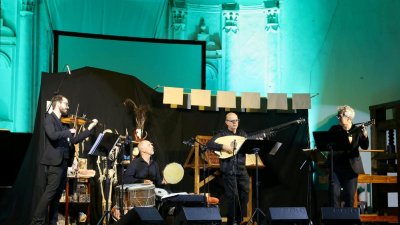
The Convent of Santo Domingo hosted an evening of exquisite musical sensitivity starring the ensemble El Afecto Ilustrado, within the commemorative acts of the third centenary of the birth of the illustrious son of Teguise.
Music, when born of knowledge, sensitivity, and interpretive rigor, has the virtue of transporting us to other eras and returning to us, with extraordinary vividness, the essence of a past time. That was precisely what happened last Saturday night at the Convent of Santo Domingo in Teguise, where the Aceró Música Antigua de Lanzarote Cultural Association offered the public a musical evening of notable artistic caliber, framed within the commemoration of the third centenary of the birth of José Clavijo y Fajardo, one of the most illustrious figures born in the Villa de Teguise.
The historic convent enclosure became the ideal setting for an event in which ancient music acquired all its splendor. Four extraordinary performers, members of El Afecto Ilustrado, a Spanish ensemble founded in 2012 and specialized in historically informed performance, were in charge of guiding the audience through an exciting sonic journey through different eras of our musical history.
The artistic philosophy of this group is based on bringing to the public the repertoire ranging from the early Baroque to the early Romantic period through rigorous, documented, and, at the same time, close and expressive interpretations. A musical conception that was magnificently reflected throughout the entire evening.
The carefully selected program brought together works from the 16th, 17th, and 18th centuries, a repertoire of extraordinary richness that allowed for an appreciation of the evolution of musical languages, the variety of their forms, and the personality of some of their great composers. The works of Francisco Guerau, Juan Hidalgo, and Santiago de Murcia, among other authors, configured a musical itinerary of great interest, in which the delicacy of the melodies, the richness of the nuances, and the elegance of the interpretations found a perfect balance.
Each composition was an invitation to discover a sound universe in which plucked strings, percussion, and bowed strings dialogued with naturalness, painting atmospheres of extraordinary beauty. The selection of the repertoire demonstrated not only the knowledge and musical sensitivity of its performers, but also the success of a proposal conceived to show the relevance and appeal of a musical heritage that continues to speak to us through the centuries.
One of the especially significant moments of the evening came with the performance of "Canarios," one of the most recognizable and representative pieces in the historical repertoire of music for plucked strings, whose popularity reached a special dimension during the 18th century. Its rhythmic character, its vitality, and its unmistakable personality captivated the audience, highlighting the extraordinary capacity of this music to maintain its expressive and communicative force intact.
The ensemble was composed of Carlos Orama and Juan Carlos Mulder, both specialists in plucked strings; Sergey Saprichev, on percussion; and Adrián Linares, on bowed strings. Four musicians with solid careers and exquisite preparation who offered a joint performance of great synergy, technical solvency, and artistic sensitivity. The precision of their executions, the care of the dynamics, and the timbral richness of their instruments made possible a musical experience as refined as it was intimate.
To all this was added an element that decisively contributed to the artistic result: the extraordinary acoustics of the Convent of Santo Domingo, a heritage space that seems to hold a special complicity with music within its walls. Its sound conditions favored the projection and transparency of each instrument, allowing the different musical voices to unfold with clarity and balance.
The scenic staging also had special significance. The recreation of an old Royal Cabinet of Natural History, along with the evocation of a historical printing press, established a suggestive link with the enlightened spirit of José Clavijo y Fajardo, writer, journalist, playwright, and naturalist. A scenic nod full of symbolism that allowed the concert to be contextualized within the intellectual and cultural universe of the honored figure, uniting music, history, and memory.
The presentation of the event was in charge of Luz Mari Duque, who accompanied the development of this cultural event before an audience that followed each of the interpretations with manifest interest.
Among the attendees were Mario Pérez Hernández, president of the José Clavijo y Fajardo Foundation, and Paco Dorta, a renowned luthier, as well as numerous lovers of music and culture who wanted to join this celebration.
At the end of the concert, the audience's response was the best recognition of the work of the four performers. A prolonged ovation, accompanied by an audience on their feet, expressed the gratitude and admiration of those who had the privilege of enjoying such a high-quality musical offering.
A night to remember. One of those events where culture reaches its true dimension: when historical heritage becomes a stage, music becomes a universal language, and the talent of the performers becomes a vehicle to recover and share the memory of our past.
Teguise once again demonstrated that its heritage wealth lies not only in its buildings, streets, and monuments, but also in its capacity to host excellent cultural proposals. And on this occasion, it did so by paying homage to one of its most illustrious sons, José Clavijo y Fajardo, whose figure found an especially beautiful and evocative setting for celebration in ancient music.
Because there is music that does not belong only to its time. It is music that transcends centuries and, when performed with knowledge, respect, and sensitivity, comes back to life with the same emotion with which it was conceived.



Add La Voz de Lanzarote as a preferred Google source.
Stay informed with the latest current news.