
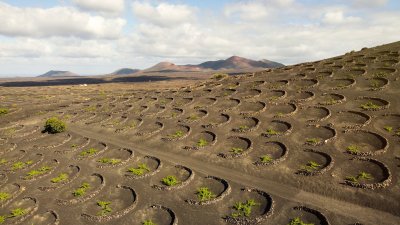
There are dates that seem to close a story and others that, with the passage of time, end up proving that they were actually opening a question. October 7, 1993 belongs to the latter. On that day, the International Council of the UNESCO MaB Programme agreed to declare Lanzarote a Biosphere Reserve, incorporating the island into an international network conceived to seek a balance between the conservation of natural and cultural values and the development of the communities living in those territories.
The decision had been preceded by a process initiated the previous year. The Plenary of the Cabildo of Lanzarote had agreed on April 26, 1992 to initiate the procedures to request the declaration and the Government of the Canary Islands adopted on November 6 of that same year the agreement to formally launch the candidacy. The recognition of 1993 was, therefore, not an improvised decision, but the result of an institutional process that also responded to a growing concern for the territorial future of the island.
But the history of the Biosphere Reserve cannot be explained solely from the institutions, because Lanzarote had been undergoing a transformation for decades that had profoundly altered its economy, its landscape, and its relationship with the outside world. Tourism had ceased to be an emerging activity to become the main engine of the island's economy, and the figures allow us to understand the speed of change: international arrivals had gone from 763,936 in 1990 to 998,094 in 1992 and 1,039,550 in 1993, while the total number of tourists registered on the island reached 1,190,222 in that last year.
That, therefore, was the Lanzarote that UNESCO was recognizing: a volcanic island of extraordinary landscape value, but also a tourist island, subjected to growing pressure and forced to face the consequences of an accelerated economic transformation. The recognition was not taking place on a territory isolated from human activity, but precisely on an island where nature, population, agriculture, urbanization, and tourism coexisted in a limited space.
That character was especially significant within the MaB Programme itself. Lanzarote and Menorca were declared Biosphere Reserves on the same October 7, 1993, at a time when the network was beginning to pay more attention to island territories with an intense human presence. In the case of Lanzarote, the declaration encompassed the island as a whole and all its population centers, a characteristic that differentiated it from the image of a reserve understood solely as a protected natural space.
In that transformation, it was impossible to ignore the figure of César Manrique, although reducing the entire process to his person would mean simplifying a much more complex story. His defense of the landscape, artistic intervention in certain natural spaces, and the creation and consolidation of the Centers of Art, Culture, and Tourism contributed to building an image of Lanzarote in which tourism, art, and nature could be part of the same narrative.
The Reserve's own trajectory recognizes Manrique's influence in the process that led to the candidacy and points to his defense of the island's territorial model as one of the elements that accompanied that initiative. However, when UNESCO approved the declaration, Manrique was no longer there to witness it: he had died on September 25, 1992, just a year earlier.
That temporal coincidence holds a powerful paradox. Lanzarote received international recognition for values that Manrique had helped defend for decades when the artist had already passed away, so the declaration arrived precisely at the moment when the island had to demonstrate whether that model could survive its main proponent.
But Manrique was not the only protagonist of the transformation. During the eighties, concern about tourist and urban expansion had increased, while different social sectors and groups defended the need to introduce limits to growth. The discussion about the future of Lanzarote had ceased to be exclusively economic to also become a territorial, environmental, and cultural issue.
The tension between growth and conservation found one of its decisive moments in the 1991 Island Territorial Planning Plan. That instrument, a pioneer in the Canary Islands, arose precisely from concern about the territorial effects of mass tourism and established a ceiling for tourist growth, limited the pace of expansion, and reclassified numerous areas of environmental and landscape value as rural land. The planning also declassified more than 250,000 tourist places planned in previous instruments and blocked about twenty partial plans.
The sequence is revealing: first came the tourist expansion, then grew the concern about its effects on the territory, subsequently instruments were adopted to limit growth, and finally, Lanzarote obtained UNESCO recognition. The Biosphere Reserve did not, therefore, appear as an isolated decision, but in the context of a discussion that the island had been holding for years about the development model it wanted for itself.
And precisely because of this, it is important to understand what that declaration meant. Being a Biosphere Reserve was not equivalent to turning Lanzarote into a closed natural park, nor did it mean placing a glass bell over the island. The MaB program proposes the conservation of natural and cultural values along with the economic and social development of the populations inhabiting these territories, seeking that human activity be part of a model of balance and not necessarily incompatible with environmental protection.
The delimitation of the Reserve reflected this philosophy, with core zones, buffer zones, and a large transition zone. The declaration affected all seven municipalities of Lanzarote and all their population centers, so that the population was not excluded from the concept of the Reserve, but rather constituted an essential part of it.
However, there is a fact that occurred just two months after the declaration that allows us to view that day from a very different perspective. In December 1993, the Cabildo conducted a study to ascertain the population's level of information about the new Biosphere Reserve, and 49.5% of respondents indicated they had no information, while another 30% declared themselves poorly informed. Among those who were aware of the declaration, 55.5% rated it positively or very positively.
The paradox is significant: UNESCO had just placed Lanzarote's name on an international network of reference territories, and yet, almost half of the population acknowledged that they still knew nothing about the meaning of that declaration. External recognition was, therefore, ahead of its social internalization.
That demonstrated that October 7, 1993, had not been the end of a process, but the beginning of a much more difficult one: ensuring that the declaration ceased to be solely an international recognition and became a territorial culture assumed by those who lived on the island.
Time would show that this challenge was not going to be easy. In 1993, Lanzarote had 72,755 inhabitants and registered 1,190,222 tourists, figures that already reflected extraordinary tourist pressure for an island with limited resources. Three decades later, both the population and tourist activity had reached much higher magnitudes, while the debate about the pressure exerted on the territory, resources, infrastructure, and services had become one of the major issues of the island's present.
Therein lies the true paradox of the anniversary. Lanzarote has preserved an extraordinarily important part of the landscape values that contributed to UNESCO setting its sights on it, but at the same time, it has become a tourist destination of much larger dimensions than those existing when it received the declaration. The Biosphere Reserve was not created to stop growth, but to pose a much more difficult question: how to make economic development compatible with the conservation of what gives meaning to the territory.
The trajectory of the Reserve itself shows that Lanzarote faces the challenge of reconciling economic development and sustainability in a territory with limited resources, and that the containment policies initiated with the 1991 Insular Plan were one of the fundamental elements of its evolution as a Reserve.
The declaration, therefore, cannot be read solely as a photograph of the past. It is also a question directed at the present: how much can an island grow without ceasing to be the island that decided to protect its landscape, how far can tourism go without turning that which attracts millions of visitors into a victim of its own success, and what does it really mean to be a Biosphere Reserve when human pressure on the territory is much greater than that which existed at the time of the declaration.
Perhaps that is why that date deserves to be remembered not as the day Lanzarote received an award, but as the day the island received a mirror. UNESCO did not invent the Lanzarote landscape, it did not stop its transformation, nor did it guarantee its future; it recognized conditions and a model of relationship with the territory that, since then, have had to face increasing pressure.
On October 7, 1993, Lanzarote entered the world map of Biosphere Reserves. That day it gained international recognition, but it also acquired a much more difficult responsibility to fulfill: to demonstrate that it could continue to grow without ceasing to recognize itself.
SOURCES
• UNESCO, Man and the Biosphere Programme (MaB), Lanzarote Biosphere Reserve file. • Ministry for the Ecological Transition and the Demographic Challenge, MaB Programme of Spain, official file of Lanzarote. • Government of the Canary Islands, Canary Network of Biosphere Reserves, official information on Lanzarote.

Add La Voz de Lanzarote as a preferred Google source.
Stay informed with the latest current news.