
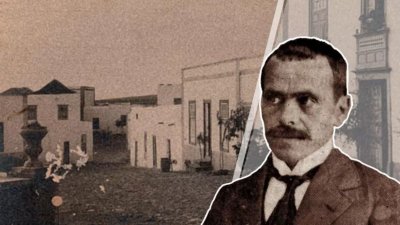
That day marked the end of the life of a man in Gran Canaria who had been involved in journalism and the social life of Lanzarote for almost four decades, but his story had begun much earlier, when Arrecife was still a city in transformation and the island press was trying to make its way.
Manuel Fernández Hernández was 54 years old when he died in the La Isleta concentration camp. He had been arrested in Arrecife six days earlier and transferred to Gran Canaria after being accused of "contempt for the homeland" for some papers in which he spoke out against the military rebellion. Historical research links his death to injuries sustained during his internment, while official documentation recorded "cardiac syncope" as the cause.
But to reduce his story to those six days would be to forget precisely what makes this character unique: Manuel Fernández had been a journalist long before becoming a victim of the repression of 1936.
A Journalist at 18
At the end of the 19th century, when the Lanzarote press was still taking its first steps, a young Manuel Fernández Hernández decided to take charge of Cronista de Arrecife. He was barely 18 years old and that experience would mark the beginning of a career that would last for decades.
Between 1899 and 1900 he directed that publication, which was edited in Arrecife, and later collaborated in different newspapers in Lanzarote, Fuerteventura, and Tenerife. His byline appeared, among others, in La Aurora, El Obrero, La Prensa, and La Voz de Lanzarote.
His relationship with journalism was not limited to writing either. Fernández was closely linked to the social activity of Arrecife and presided over the city's Workers' Society. In 1902 he was in charge of El Proletario, a publication linked to that labor movement, although historiographical sources maintain some discrepancy regarding his direction.
The activity of that society went beyond labor demands. Fernández also participated in initiatives related to the literacy of workers, while his writings addressed some of the problems affecting the island's population.
For him, the press was more than a profession. It was a way of intervening in the reality that surrounded him.
A Voice in the Lanzarote of His Time
The figure of Manuel Fernández allows us to recover a very different Lanzarote from the current one, an island that during the first decades of the 20th century was undergoing important economic and social transformations while Arrecife grew around its port and new forms of social organization began to consolidate.
The writings preserved from Fernández reflect his concern about the island's state of neglect, unemployment, droughts, and emigration, as well as his defense of greater worker organization. There are also references to his criticisms of caciquismo, bad governance, and lack of investment.
His journalistic and social activity led to confrontations. El Proletario had a brief trajectory and ended up disappearing after a period marked by the controversies surrounding the publication and its director. The research by Mario Ferrer Peñate also documents the criticism the newspaper received and the pressure from other publications on the island.
Fernández, however, continued to be involved in public life.
When 1936 arrived, he was not a newcomer to politics or journalism, but a man who had spent almost four decades using the written word to talk about Lanzarote.
The arrest
The military coup of July 1936 opened a period of political persecution in the Canary Islands that also reached Lanzarote.
On September 30, Manuel Fernández Hernández was arrested in Arrecife and accused of "contempt for the homeland" for some papers in which he spoke out against the military rebellion. He was transferred to Gran Canaria and interned in the La Isleta concentration camp.
He was 54 years old at the time.
Only a few days later, he would die there.
La Isleta
Testimonies later collected by researchers describe the aggressions suffered by Fernández during his stay in the camp. The reconstruction published by Canarias Ahora indicates that during the early morning of October 6, he was brutally beaten and then transferred to one of the facilities where the prisoners were held. His companions could only witness his final moments.
Historical research links the injuries sustained to his death, while official documentation recorded the cause as "cardiac syncope."
That contrast is part of the documentary history of Manuel Fernández himself and must be kept separate from the different existing versions regarding the specific authorship of the aggression.
What the preserved documentation does allow to establish is that the Civil Government communicated to the families, on October 9, that he had died "three days ago", placing his death on October 6, 1936.
The investigation into political repression in Lanzarote and Fuerteventura also identifies his case as the only death recorded among those detained in Lanzarote after the military coup of 1936.
The news arrived later
In Lanzarote, his family was still seeking answers.
On October 8, the Government delegate on the island telegraphed the civil governor of Las Palmas after family members requested information about Manuel, from whom they had received news that he might have died.
The response arrived the following day: "he died three days ago".
The official cause of death was "cardiac syncope". Manuel Fernández was 54 years old and single.
His body did not return to Lanzarote. Testimonies collected later suggest that he may have been transferred to a mass grave in the Vegueta cemetery, although the exact circumstances of his burial must be treated with the caution required by the available documentation.
Thus ended the life of a journalist who had begun his career when he was barely 18 years old.
Recovering a name
For decades, Manuel Fernández Hernández remained practically outside the public memory of Lanzarote, although his name continued to appear in investigations dedicated to the repression of 1936 and the history of the island's press.
His career, however, had left enough traces to reconstruct a part of that Lanzarote of the early 20th century: the young man who directed Cronista de Arrecife, the journalist linked to various Canary Islands publications, and the man connected to the Sociedad Obrera de Arrecife.
In December 2016, eighty years after his death, the Arrecife City Council agreed to declare him an adopted son posthumously, in recognition of his career and his commitment to the city and the island.
The recognition allowed a return of focus to a journalist whose name had remained in the background for decades.
Ninety years later
Anniversaries often focus on dates.
October 6, 1936, could be summarized in one line: Manuel Fernández Hernández died that day in the La Isleta concentration camp.
But behind that date there was a life.
There was a young man who, at the end of the 19th century, took charge of a newspaper when he had barely turned 18 years old. There was a journalist who for decades wrote about the reality of Lanzarote and collaborated in publications on several islands. And there was a man committed to the social life of Arrecife, whose career was cut short in the first months of the Civil War.
That is why remembering Manuel Fernández Hernández does not only mean revisiting the circumstances of his death.
It means recovering the journalist who existed before that death, the man who made the written word a way of participating in the life of his time and who left his name linked to some of the first chapters in the history of modern press in Lanzarote.
On October 6, 1936, his life ended.
Ninety years later, the date allows us to recover his story and write his name again.
Sources
José Alcaraz Abellán, Luis Alberto Anaya Hernández, Sergio Millares Cantero, Alexis Orihuela Suárez y Miguel Suárez Bosa, La represión política en Lanzarote y Fuerteventura durante la Guerra Civil (1936-1939), II Jornadas de Historia de Lanzarote y Fuerteventura, Cabildo de Lanzarote, 1990; Mario Ferrer Peñate, La prensa en la periferia de la periferia de Europa Occidental. Prensa, sociedad y cultura en Lanzarote y Fuerteventura; Juan Rodríguez Doreste, Cuadros del penal. Memorias de un tiempo de confusión; Juan Medina Sanabria, Isleta/Puerto de la Luz: Campos de Concentración; Memoria de Lanzarote; Jaime Balaguer, El trágico final de un periodista de Lanzarote, Canarias Ahora, 6 de octubre de 2016; municipal documentation on the declaration of Manuel Fernández Hernández as Favorite Son of Arrecife.

Add La Voz de Lanzarote as a preferred Google source.
Stay informed with the latest current news.