
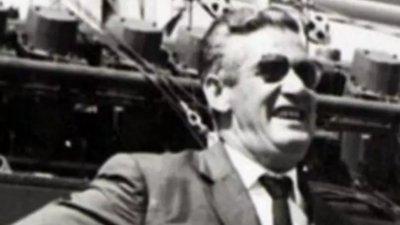
Ginés de la Hoz Gil had been born in Arrecife on December 27, 1918. Before reaching the Mayor's Office, he had already developed intense social and sports activity and had presided over the Sociedad Democracia in 1944. Later, he was president of the Casino Club Náutico and the Club Leones between 1966 and 1968. His public activity was not limited to the City Council: from 1961 to 1971 he was a councilor of the Cabildo de Lanzarote, where he assumed responsibilities in areas such as Health, Urban Planning and Housing, Education, Sports and Tourism, and also served as a representative in the Cortes. In this way, his influence during the sixties extended far beyond strictly municipal competencies.
When he came to the Mayor's Office, Lanzarote was going through one of its most serious historical problems: the lack of water. The 1960 drought had forced the island authorities to seek emergency solutions by transporting water from other islands. Ginés de la Hoz traveled to Madrid with the president of the Cabildo, José Ramírez Cerdá, and the government delegate, Santiago Alemán, to request a regular supply by tanker ships. But that trip would end up opening a much more ambitious door. In Madrid's Retiro Park, Ginés de la Hoz spoke with the Lanzarote naval engineer Manuel Díaz Rijo about the possibility of using seawater to definitively solve the problem. Díaz Rijo proposed developing a plant capable of transforming salt water into potable water, and the mayor supported the initiative.
The result was the commissioning in 1964 of the Termolansa plant, a pioneering facility that produced potable water from the sea and became one of the major turning points in the contemporary history of Lanzarote. The water problem did not disappear, but the island had found a decisive tool to face its future. Desalination made it possible to overcome one of the main obstacles that had historically limited population growth and economic activity and provided Arrecife with an indispensable base for its subsequent expansion.
The water bottleneck partially resolved, the city began to experience a rapid demographic and urban transformation. One of the most visible problems was housing. During Ginés de la Hoz's term, the construction of hundreds of social housing units in Santa Coloma was promoted. Documentation from the Sociedad Democracia puts the number of housing units promoted at the beginning of the sixties at around 500, with 160 built by the State and 340 by the City Council itself. In 1967, another hundred housing units, known as Casas Nuevas, were added in the Juan Salazar Ortiz neighborhood. The expansion of these residential areas decisively contributed to the growth of the capital and the incorporation of new spaces into the urban fabric of Arrecife.
That housing policy was part of a much larger process. Arrecife needed to prepare for a growing population and increasing economic expectations for the island. Housing construction required streets, services, facilities, and new communications. In those years, actions related to water supply and sanitation, urbanization, and the expansion of available spaces for a city that was beginning to overflow its traditional boundaries were promoted.
One of the main instruments for managing that growth was the first General Urban Planning Plan of Arrecife, approved in 1968. Ginés de la Hoz was at the head of the City Council when the capital was equipped with this planning instrument, at a time when it was beginning to look decisively towards the future. The approval of the Plan meant accepting that Arrecife was going to grow and that this growth should be channeled through urban planning.
Municipal documentation from those years also shows a conception of the city that is particularly revealing today. In 1970, the City Council was working on the delimitation of the General Plan, contemplating promenades, and studying the possibility of reclaiming land from the sea to expand available spaces. A municipal resolution from February of that year requested authorization to carry out works aimed at reclaiming land from the sea and utilizing the maritime-terrestrial zone. The objective was to transform the maritime facade and provide Arrecife with new urban spaces.
The relationship of Ginés de la Hoz with the navy and with the heritage of Arrecife was also important. During his term, the refurbishment of the Castillo de San Gabriel was promoted, a historical element that was separated from the daily life of the city and that was intended to be integrated again into the urban space. In 1960, the castle was inaugurated after its renovation and the installation of exterior lighting. A few years later, in 1963, the mayor requested the captain general of the Canary Islands to cede the property to continue with its refurbishment and cultural exploitation.
During that decade, important transformations also took place in the maritime facade and in the infrastructures of Arrecife. The expansion of the port, actions on the marina, the improvement of public spaces, and the creation of new promenade areas were part of an urban conception that aimed to turn the waterfront into one of the capital's great spaces. In parallel, the City Council studied new actions on areas such as Puerto Naos and Charco de San Ginés, while the port acquired growing importance for fishing and industrial activity.
Education also occupied a prominent place. During the years of Ginés de la Hoz, new facilities were consolidated that responded to the population growth and the needs of an island that was beginning to modernize its economic structure. Among them, the Blas Cabrera Felipe Institute stood out, as well as the Pancho Lasso School of Arts and Crafts and the Fishing School. Sports facilities and other public services were also developed. The expansion of new neighborhoods was accompanied by facilities that contributed to their progressive incorporation into the urban life of Arrecife.
Culture and heritage were not left out of that policy either. In 1961, Ginés de la Hoz promoted the renovation and expansion of the Municipal Library's collections, while the recovery of buildings and monuments and the creation of new spaces for cultural activity were part of a broader vision of the city. Retrospective references to his term also highlight the attention paid to historical monuments, green areas, and cultural and artistic initiatives.
The sporting dimension was another of the constants of those years. The creation of new facilities was added to the concern for providing a growing city with spaces for sport and leisure. Urban expansion demanded not only housing and streets, but also facilities capable of serving an increasingly numerous population.
But perhaps one of the best testimonies to understand what city Ginés de la Hoz imagined is found in an interview published in 1969 under the significant title of "Arrecife, the capital". In it, the mayor spoke of a city that already had around twenty thousand inhabitants and concentrated approximately half of the island's population. Arrecife faced a future of expansion that required new residential areas, beaches, sports harbors, promenades, green spaces, and sports facilities. Planning also had to be adapted to the evolution of the port's fishing and industrial activity.
That interview allows us to appreciate that the transformation was not understood solely as a sum of works. There was a certain idea of the city. Tourism growth was beginning to be part of the expectations, but it still coexisted with an economy closely linked to fishing and the port. Arrecife had to prepare for both realities. The General Plan itself contemplated different uses for the capital's areas and, already in those years, actions related to the creation of new spaces facing the sea and the expansion of the city were being considered.
In 1970, precisely during the last months of Ginés de la Hoz in the Mayor's office, a project that would affect the future of Charco de San Ginés also began to take shape. The initiative aimed to transform an important part of its surroundings through new accesses, an urban facade towards the Charco, and land reclaimed from the sea. A letter sent to the City Council on August 13, 1970, showed the interest of the company Cinam in developing the partial plan because it would complete the future maritime facade of the city. The project would have its greatest development during Rogelio Tenorio's term and would end up being abandoned in 1974, but its origin lies in the last months of Ginés de la Hoz's tenure.
It is significant that many of those actions were related to the same concern: preparing Arrecife for a transformation that was still beginning. Water, housing, roads, the port, urban planning, education, heritage, public spaces, and tourism were not independent issues. They were part of the same need: to provide the capital with the necessary conditions to face the growth that was glimpsed on the horizon.
That decade also had a political and administrative dimension. Ginés de la Hoz was recognized in 1962 with the Medal of the Order of Cisneros for his work as mayor, while simultaneously holding responsibilities in the Cabildo and the Cortes. His position allowed him to intervene at different levels of the Administration to seek resources and projects for the island. The combination of municipal, insular, and state responsibilities was a relevant characteristic of his career during those years.
Therefore, September 16, 1970, did not simply mark the end of a mayorship. It marked the end of a decade in which Arrecife had changed scale. The city that Ginés de la Hoz received in 1960 was still a relatively small capital, with significant deficiencies in water, housing, and facilities. The one he left ten years later had a growing population, new neighborhoods, educational and sports facilities, general urban planning, a revolutionary hydraulic infrastructure, and economic expectations that were beginning to look towards tourism.
The succession fell to Rogelio Tenorio de Páiz, who would remain at the head of the Mayor's Office until 1974. With him, a part of the projects initiated during the previous period would continue, although the city would progressively enter a new phase. The economic transformation of Lanzarote would accelerate during the seventies and tourism would end up acquiring a decisive weight in the future of the island.
Ginés de la Hoz would die on July 17, 1972, at the age of 53. His death occurred just two years after leaving the Mayor's Office, but his name remained linked to that decade of transformation. In 1975, an avenue in Arrecife was named after him and, decades later, the Sociedad Democracia recognized him posthumously as an Honorary Member, also advocating for greater institutional recognition of his figure.
His legacy, as with any historical period, can be subject to assessment and debate. But the data allow us to clearly identify the magnitude of the change produced during those ten years. The arrival of desalinated water in 1964, the construction of hundreds of social housing units, the expansion of neighborhoods, the first major urban planning instrument of 1968, the recovery of the Castillo de San Gabriel, the new educational and sports centers, the actions on the marina and the port, and the projects to transform the maritime facade are part of the same historical sequence.
September 16, 1970 was, in short, the end of a decisive decade. Ginés de la Hoz left the Mayor's office when Arrecife had not yet reached the future that he and his team had begun to imagine, but when many of the elements that would allow the capital to face the transformation of the following decades had already been put in place. Water had ceased to be an insurmountable barrier, the city had begun to expand, urban planning had acquired a planned dimension, and the port and the maritime facade had become fundamental pieces of its future. Arrecife was then entering another stage. And a good part of its foundations had been laid during that decade.

Add La Voz de Lanzarote as a preferred Google source.
Stay informed with the latest current news.