
On September 5, 1978, Lanzarote took to the streets to demand something that may seem elementary today: a decent hospital for an island that had endured for too long the shortcomings of clearly insufficient healthcare.
Thousands of Lanzaroteans participated in that first major demonstration. They were not asking for privileges. They were asking for something much simpler: that falling ill in Lanzarote should not mean being at a disadvantage compared to those living on other islands.
48 years have passed.
Almost half a century.
And it is inevitable to wonder what we have learned since then.
That mobilization was not anecdotal. It was the beginning of social pressure that would still take years to bear fruit. In 1983, a second major mobilization occurred, and after efforts made to the then Minister of Health, Ernest Lluch, the announcement of the hospital's construction arrived. Construction began later, and the General Hospital of Lanzarote opened its doors on April 14, 1989.
That generation understood something that we should remember today: healthcare is not achieved with speeches, but with demands, planning, and political commitment.
Today, Lanzarote has a university hospital, more professionals, more resources, and an infinitely superior service portfolio to that of the island in the late seventies. It would be unfair to deny that evolution.
But it would also be naive to think that the problems have disappeared.
In 2026, healthcare is once again occupying the streets of Lanzarote.
And this time, the discussion has a specific name: the Insular Hospital.
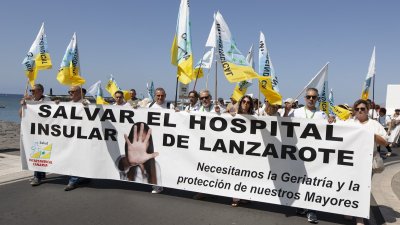
In June, around 7,000 people participated in a demonstration to defend the continuity of this center and to demand guarantees for geriatric care and for the future of its services. The protest highlighted that, for a significant part of Lanzarotean society, the debate is not solely architectural or administrative. It is a debate about what healthcare model the island wants.
The Administration maintains that the building has serious structural problems and that it is necessary to move the activity while its future is decided. The health directorate has argued that the building must continue to be used for healthcare, although fundamental decisions about its rehabilitation and its final destination are yet to be finalized.
And here appears the first major coincidence with 1978.
Then a hospital was claimed because Lanzarote had grown and its healthcare system no longer responded to the needs of the population.
Today Lanzarote is growing again.
And it needs its healthcare infrastructure to grow at the same pace again.
Because it is not enough to build buildings. They must be filled with professionals. Specialists must be guaranteed. Primary Care must be reinforced. Waiting times must be reduced. Adequate services must be available for an increasingly large and aging population.
Official waiting list data show that, as of December 31, 2025, the Doctor José Molina Orosa Hospital had 1,185 patients on the surgical waiting list, with an average delay of 74.45 days.
And while we discuss buildings, something as basic as personnel is also being discussed.
In July of this year, healthcare professionals reported a lack of staff and difficulties in covering absences and vacations, with a particular impact on Emergency services and also on Primary Care.
In other words, Lanzarote's problem is no longer exactly the same as in 1978. But it shares an essential characteristic: the island's reality is once again ahead of planning.
And that should worry us.
Lanzarote cannot continue to plan its healthcare as if it were a static island. The population has increased, tourism has multiplied the care pressure, the average age of some of its residents is increasing, and healthcare needs are much more complex than fifty years ago.
Even emergencies remind us daily that Lanzarote does not end in Arrecife. La Graciosa, for example, depends on a care chain that requires, when gravity requires it, stabilizing the patient on the island and then transferring them to Lanzarote.
That is why perhaps we should stop asking ourselves only what hospital we want and start asking ourselves what healthcare system Lanzarote needs for the coming decades.
The new building linked to the Insular Hospital represents an opportunity. The Molina Orosa needs to continue growing and adapting. Primary Care needs resources. Professionals need stability and adequate conditions. And the population needs to know what services they will have tomorrow, not just what promises were made yesterday.
Because there is another risk.
That healthcare ends up becoming a succession of announcements, inaugurations, photographs, and political confrontations.
Some governments will claim what the previous ones did. The previous ones will remember what they left planned. The opposition will denounce the delays. The Government will respond with figures. And meanwhile, the citizen will continue waiting for an appointment, a test, a procedure, or a specialist.
That is not health planning. That is managing the emergency.
48 years ago, that crowd that took to the streets did not ask which party could gain the most electoral benefit from the demand. They asked for a hospital.
And they got it.
Perhaps that is the main lesson we should recover.
Lanzarote's healthcare should not be the property of any political party, union, or platform. Nor should it be used as a throwing weapon every time the government's color changes.
It should be an island issue.
Of the present and the future.
Because if in 1978 Lanzarote had to take to the streets to get a hospital, it would be sad that in 2026 we would have to take to the streets again to explain that an island that has grown so much needs healthcare that grows with it.
Next September 5th will mark 48 years since that first great mobilization. Perhaps it is worth remembering it.
Not only to honor those who took to the streets then.
But to ask ourselves an uncomfortable question:
Have we built healthcare for the Lanzarote we have, or are we still trying to solve the island's future problems with past solutions?
The answer should not belong to one party.
It should belong to everyone.
Add La Voz de Lanzarote as a preferred Google source.
Stay informed with the latest current news.