
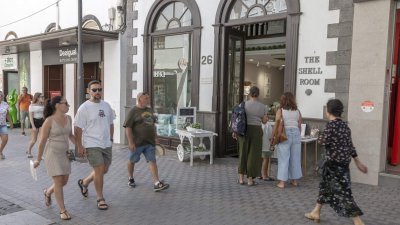
The difficulties of traditional commerce did not begin with the tourist declaration. In April 2004, the Data Center of the Cabildo of Lanzarote published the study Arrecife Zona Centro, based on 428 interviews conducted at the end of 2003. Its conclusions already warned of problems related to the commercial offer and accessibility.
17.7% of the people surveyed pointed to the lack of parking as one of the main drawbacks, while 14.2% indicated the insufficient variety of establishments. Furthermore, 35% considered the commercial offer to be scarce and 71% missed new businesses or facilities.
Competition from other areas, such as Deiland, in Playa Honda, and Biosfera Plaza, in Puerto del Carmen, was also part of that scenario. The city center needed to renew its offer, improve its access conditions, and provide new reasons to attract residents and visitors.
When the 2013 declaration arrived, therefore, Arrecife was already dragging structural difficulties that could hardly be resolved by a simple extension of commercial hours.
2013: a declaration to revitalize the historic center
The Order of November 8, 2013, published in the Official Gazette of the Canary Islands on the 18th of that month, declared Arrecife a Zone of High Tourist Influx. The City Council had initially requested, on February 15, 2013, that the measure cover the entire municipality, although the approved scope was finally limited to the historic center.
The declaration allowed for more flexible commercial hours and facilitated the opening of certain establishments on Sundays and holidays. Its objective was to take advantage of tourist activity to generate economic opportunities in an area that needed to regain dynamism.
However, the measure had a specific scope: it did not oblige merchants to open, it did not guarantee an increase in sales, nor did it entail an automatic subsidy. It offered greater hourly freedom, but did not in itself resolve the parking problems, the scarce commercial diversity, or the competition from other shopping formats.
The initial delimitation changed over time. On January 29, 2015, an extension was approved that incorporated the Arrecife-Puerto Commercial Park, in an area related to the arrival of cruise passengers. Subsequently, by an Order of June 7, 2019, the declaration was extended to the entire municipality.
Thus, an initiative initially conceived for the historic center ended up encompassing the entire capital. The territorial expansion, however, did not in itself guarantee an improvement in the commercial conditions of Calle Real.
Zara and Almacenes Ferrer: the closure of emblematic establishments
The transformation of the capital's commerce became especially visible with the disappearance of establishments that for decades had been part of the daily lives of several generations.
In May 2021, Zara closed its store on Calle Real. The departure of a benchmark firm had a significant symbolic impact and showed that one of Lanzarote's main commercial hubs was not immune to the changes affecting urban commerce.
On November 11, 2022, Open Mall Lanzarote opened its doors, with approximately 35,100 square meters of gross leasable area and 1,075 parking spaces. The new complex reinforced the offering concentrated in large spaces, where consumers find establishments and services grouped in the same complex.
Its opening coincided with a period of difficulties for traditional commerce, but it would be simplistic to attribute all the responsibility for the center's transformation to it. The problems had been documented long before and also responded to changes in consumer habits, competition, and the operating conditions of urban businesses.
Another particularly significant episode occurred in May 2024, when Almacenes Ferrer closed its historic establishment at number 32 on Calle León y Castillo. The store had opened on December 12, 1958, and in its best years had around 80 employees. At the time of the closure of that premises, the staff consisted of 23 people. The company continued its activity in other locations, but one of the most recognizable establishments in Arrecife's commercial memory disappeared.
The closures of Zara and Almacenes Ferrer respond to different business realities and do not, in themselves, constitute a statistic of commercial decline. Nevertheless, they illustrate the transformation of an area that has lost part of its traditional commercial landscape.
More cruise passengers, but how much does commerce benefit?
The arrival of visitors by sea has been one of the fundamental arguments to justify the importance of the tourist declaration. Arrecife holds a prominent position as a cruise stopover and the figures reflect the weight of this activity.
According to data released by the City Council and the Port Authority, 663,396 cruise passengers were registered during 2025. Between January and August 2026, 413,039 were counted, approximately 15% more than in the same period of the previous year.
These are relevant figures for the capital's tourism economy, but they do not allow us to know how much of this movement directly benefits downtown commerce. To measure its impact, it would be necessary to know how many passengers walk down Real Street, how long they stay there, which establishments they visit, and how much they spend.
No public measurement has been found to establish this relationship. Therefore, the increase in cruise traffic cannot be automatically presented as a recovery of commercial activity in the historic center.
The issue is especially important: Arrecife receives visitors, but it still needs to demonstrate how much of this movement translates into purchases and economic activity for its small businesses.
From commercial premises to housing
The transformation of the city center is also reflected in the destination of its properties. In April 2025, the City Council reported that during the previous year, it had processed the change of use of 39 commercial premises to housing, in a context marked by the need to increase the residential supply.
This figure does not mean that all these premises were located on Real Street or that they remained empty. However, it shows that some spaces intended for commercial activity are finding a new residential function.
The change poses a challenge for the future of the historic center. Arrecife needs housing, but also needs to maintain sufficient economic activity to prevent its main streets from losing their commercial and meeting function.
The Urban Mobility Study prepared for the works of the General Supplementary Planning Plan, in November 2024, identified problems related to sidewalks, the continuity of pedestrian routes, the lack of vegetation and shade, and an urban distribution that, in certain areas, favors vehicle movement.
They are factors that condition the experience of those who visit the center. A commercial street does not depend exclusively on the establishments it houses: it also needs to be accessible, attractive, and pleasant to walk through.
Announced investments and outstanding accounts
The recovery of the center has been featured in various institutional announcements. In February 2025, the Government of the Canary Islands announced a subsidy of two million euros for the comprehensive renovation project of Pérez Galdós street. The total announced cost was around 3.2 million, meaning the City Council had to cover the difference.
The action was presented as an opportunity to improve an urban space linked to commercial activity. However, announcing a subsidy is not the same as carrying out the works. To know the real outcome, it is necessary to check the contracting file, the award, the certifications, the payments, and the effective execution schedule.
There was also political debate about the needs of Real street. In the municipal plenary session of October 30, 2024, a proposal to promote actions on urban furniture and streetlights was discussed. The initiative was rejected by 13 votes to 10.
The discussion on resources allocated to economic promotion continued in 2026. In April of that year, Lanzarote En Pie denounced that certain allocations for commercial promotion and aid to small and medium-sized enterprises had not been executed during 2024 and 2025. It also pointed out the lack of technical staff in the Commerce department.
This is a political complaint that must be verified against budget settlements and municipal documentation. To understand the real scope of the investment, it is necessary to distinguish between planned credits, budget modifications, commitments made, recognized obligations, and actual payments. The existence of an allocation does not prove that the money has reached businesses or that it has translated into improvements for the center.
New openings, but without demonstrated recovery
The picture in Arrecife in November 2026 is not exclusively negative. The City Council has announced new openings on Real street, with businesses occupying premises previously linked to other establishments.
It has also disseminated figures reflecting the economic weight of the capital: 1,941 companies registered with Social Security in November 2025 and 2,027 active companies in October 2026. This data shows the business dimension of the municipality, but it does not, on its own, measure the evolution of retail trade in the historic center, as it includes activities from different sectors.
New openings are a sign that deserves attention, although they are not enough to speak of a consolidated recovery. To understand the real evolution of Calle Real, it would be necessary to have an updated census of establishments, vacant premises, and implemented activities, comparable to the one that existed when the declaration was approved.
Recovery is not measured solely by the opening of some businesses, just as decline cannot be calculated by counting only the most well-known closures. Rigorous and sustained comparison over time is needed.
Thirteen years later, the big question remains open
The declaration of a Zone of High Tourist Influx expanded the possibilities for commercial opening in Arrecife, but it has not guaranteed the continuity of traditional businesses nor has it resolved the problems of accessibility, supply, and urban attractiveness that already appeared in studies from the beginning of the century.
The capital receives hundreds of thousands of cruise passengers, has new commercial spaces, and maintains a relevant business fabric. At the same time, it has lost historic establishments, has seen the use of premises change, and continues to seek ways to restore prominence to its streets.
Thirteen years later, the question is no longer just whether shops can open on more Sundays and holidays. The truly important thing is to determine whether Arrecife has managed to turn its status as a tourist destination into a real opportunity for downtown commerce.
To answer this, data is needed that is not yet publicly and homogeneously available: a census of establishments from 2013 and another from 2026, figures on the execution of announced investments, and a study on the routes and spending of cruise passengers in the historic center.
This November 28th allows us to look back at a decision that aimed to boost Arrecife's commercial heart. The city continues to receive visitors, maintains its economic activity, and has renovation projects. The pending challenge is to ensure that this movement translates into livelier streets and businesses capable of remaining open.
Because an area of high tourist influx is not necessarily a prosperous commercial area. The true success of that declaration should be measured by its ability to get those who arrive in Arrecife to also walk its streets, enter its establishments, shop, and return.
DOCUMENTARY AND CONSULTATION SOURCES
• Official Gazette of the Canary Islands: Order of November 8, 2013, published on November 18, 2013, on the declaration of Arrecife as a Zone of High Tourist Influx.
• Official Gazette of the Canary Islands: Order of January 29, 2015, regarding the expansion of the declaration's scope. • Official Gazette of the Canary Islands: Order of June 7, 2019, regarding the extension of the declaration to the entire municipality. • Lanzarote Island Council Data Center: Arrecife City Center, April 2004.
• Arrecife City Council: communications on cruise passengers, business activity, changes in the use of premises, and new commercial openings.
• Port Authority of Las Palmas: cruise traffic statistics.
• Urban Mobility Study for the General Supplementary Planning Plan of Arrecife, November 2024. • Government of the Canary Islands: documentation regarding the subsidy for the renovation of Pérez Galdós street. • Arrecife City Council: minutes of the municipal plenary session of October 30, 2024, and budgetary and settlement documentation.
• Official Gazette of the Canary Islands, November 7, 2025: budgetary documentation regarding the commercial space improvement project.
• La Voz de Lanzarote: reports on the evolution of Calle Real and the closure of historic establishments. • Lanzarote En Pie: public complaint about the execution of funds allocated to commercial promotion and aid to SMEs, April 2026.


Add La Voz de Lanzarote as a preferred Google source.
Stay informed with the latest current news.