
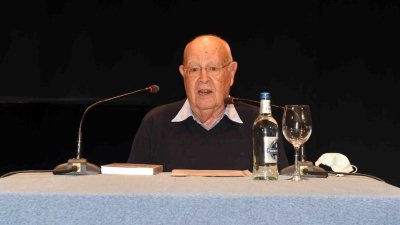
On November 4, 2010, Arrecife experienced a significant day for its history and cultural heritage. The plenary hall of the City Council hosted the solemn investiture ceremony of Antonio Lorenzo Martín as the first Official Chronicler of the capital of Lanzarote, a recognition of a career dedicated to researching, writing, and disseminating the city's past, its people, and the events that have contributed to defining its identity.
With that distinction, the municipal corporation recognized the work of a man who had made the recovery of Arrecife's everyday stories one of his main intellectual concerns.
The appointment had been approved by the City Council's Plenary in the session held on February 22 of that year. The proposal was approved with the abstention of Alternativa Ciudadana, according to the information published at the time. It was an honorary position intended to research, preserve, and disseminate municipal history, protect its documents and testimonies, and collect traditions, customs, and events that could be of interest to future generations.
The November ceremony publicly formalized that institutional recognition. The designation responded to the purpose of reinforcing the conservation of the capital's historical and cultural heritage, preventing the loss of testimonies and episodes that, despite their apparent simplicity, are part of the evolution of a community. The chronicler's role was to be responsible for both researching the past and documenting the present, with the aim of transmitting that knowledge to those who would come after.
During the ceremony, Lorenzo Martín expressed his emotion and gratitude for the trust placed in him. He considered the distinction one of the most important recognitions he had received in his life and stated his commitment to continue collecting the memories and experiences of the residents. The then-mayor, Cándido Reguera, highlighted the importance of recognizing Arrecife's history and identity, as well as the value of those who had contributed to preserving them.
From island politics to culture and historical research
Antonio Lorenzo Martín's career was closely linked to the political transformation of Lanzarote during the democratic Transition, without neglecting his commitment to culture and literary activity.
A Law graduate, he belonged to a generation that actively participated in the construction of new democratic institutions after the dictatorship. His name holds a prominent place in the island's political history for having been the first president of the Cabildo of Lanzarote in the democratic era, a position he held between 1979 and 1983 at the head of the Unión de Centro Democrático (UCD).
These were decisive years for consolidating representative institutions, organizing the island administration, and facing the economic and social changes that were beginning to transform the island. His time as president of the Cabildo placed him among the protagonists of a fundamental stage in Lanzarote's contemporary history.
However, his public activity did not end with that political responsibility. Over the years, he maintained a strong connection with writing, historical research, lectures, and the media. He also cultivated painting, an artistic facet that was part of his personal journey.
La Historia Menuda: the value of memories and daily life
One of Antonio Lorenzo Martín's most recognizable contributions was his way of approaching the past from a perspective different from that of major political and institutional events. For him, the history of a city was also in its streets, its shops, the establishments that disappeared, its popular characters, and the anecdotes preserved by those who had lived in other times.
From this perspective, Historia Menuda de Arrecife was born, a compilation of 42 costumbrista articles previously published in La Voz de Lanzarote. The work brought together stories about well-known characters from the capital, commercial establishments, streets, and episodes of daily life that allowed for the reconstruction of Arrecife society's evolution from a close and human perspective.
The book was continued with Más Historia Menuda and Lanzarote. Historia Menuda III, publications that expanded that work of recovering island memory. Its pages rescued names, situations, and testimonies that rarely occupy a prominent place in conventional historical accounts, but which are essential for understanding how previous generations lived, worked, and related to each other.
His work made it possible to highlight a part of the past that is not always recorded in administrative documents or in the great official chronicles. The memories of the neighbors, personal experiences, and apparently minor events thus became sources of knowledge to approach the social history of Arrecife.
That conception of historical dissemination found its natural continuity in the responsibility assumed as Official Chronicler: to investigate events, gather testimonies, and record a city in permanent transformation.
A career linked to island communication
Communication was another constant in his life. For decades he collaborated with publications and news outlets in Lanzarote, from which he helped disseminate historical episodes, characters, and events related to the island's cultural heritage.
He also maintained a long-standing connection with radio, especially through his appearances on Cadena SER in Lanzarote. In his programs and collaborations, he shared memories and knowledge about Arrecife and the island as a whole, bringing history closer to listeners through direct language, supported by anecdotes and his knowledge of Lanzarote society.
As a writer, lecturer, and communicator, he defended a way of understanding culture closely linked to people and their experiences. His work helped to give visibility to numerous episodes of local history and to keep them accessible to those who wished to better understand the past of their city.
A legacy that remains in the history of Arrecife
Antonio Lorenzo Martín passed away on June 17, 2025, leaving behind a career linked to some of the main political, social, and cultural events in Lanzarote during recent decades. His death prompted numerous expressions of condolence and institutional recognition. The Cabildo de Lanzarote decreed three days of official mourning in memory of who had been its first president in the democratic era.
His figure represents two relevant facets of island history: participation in the construction of democratic institutions and dedication to recovering collective memory. From the presidency of the Cabildo, he contributed to the early years of the island's political organization; through writing and popular research, he dedicated a good part of his life to rescuing testimonies that explain what Lanzarote was like and how its society has evolved.
The appointment on November 4, 2010, was much more than the granting of an honorary title. It represented recognition for work that had made it possible to recover numerous episodes from Arrecife's past and give prominence to people, places, and events that are also part of its cultural heritage.
His contribution consisted, precisely, in demonstrating that history is not built solely from great events, political decisions, or notable dates. It is also found in the establishments that disappeared, in the streets that changed their appearance, in the characters who marked an era, and in the memories of those who witnessed that transformation.
On that November 4, 2010, Arrecife officially recognized the one who would assume the responsibility of preserving and disseminating its past. Sixteen years later, the anniversary allows us to remember Antonio Lorenzo Martín and vindicate the value of work that helped preserve the daily memory of the Lanzarote capital.
Because, thanks to those who collect and transmit these small stories, a city can continue to recognize itself in its own past.
Documentary Sources
- Arrecife City Council. Plenary agreement appointing Antonio Lorenzo Martín as Official Chronicler, February 22, 2010.
- Arrecife City Council. Institutional information on his career and death.
- La Voz de Lanzarote. "Arrecife City Council appoints Antonio Lorenzo Martín official chronicler," February 18, 2010.
- La Voz de Lanzarote. Biographical information on Antonio Lorenzo Martín and his political and cultural career.
- Publications Service of the Cabildo of Lanzarote. Small History of Arrecife, More Small History, and Lanzarote. Small History III, by Antonio Lorenzo Martín.
- Biographical and historical documentation on the first democratic stage of the Cabildo of Lanzarote.



Add La Voz de Lanzarote as a preferred Google source.
Stay informed with the latest current news.